Get Full Government Meeting Transcripts, Videos, & Alerts Forever!
Get email alerts on the Gravel Pits topic
No spam. Unsubscribe anytime.
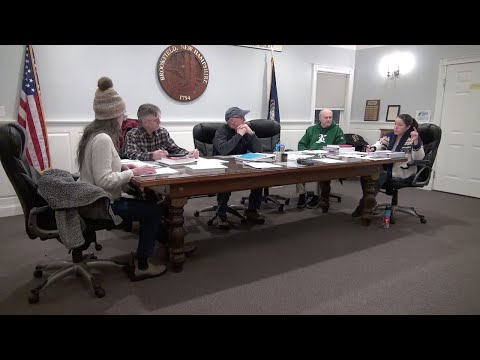
Brookfield planning board seeks missing pit reclamation records, weighs 5‑acre grandfathering language
Summary
At its Feb. 10 meeting the Brookfield Planning Board discussed missing historical documents for local sand/gravel operations, inspection plans and related warrant language clarifying 5‑acre grandfathering; legal counsel said reclamation plans should be on file even if RSAs do not clearly require them.
BROOKFIELD TOWN — The Brookfield Planning Board on Feb. 10 reviewed long‑running questions about local sand and gravel operations, said it has lost some historical permitting paperwork, and discussed next steps including inspections and a warrant article that would clarify 5‑acre grandfathering for earth extraction uses.
The matter drew extended comment from Frank Frazier, speaking as chairman of the Brookfield Conservation Commission, who said the original grandfathering document for the site traditionally called the “Mason Pit” on Moose Mountain Road appears to be a hand‑drawn sketch rather than a formal multi‑page plan. "It was literally a drawing of a big mound of sand," Frazier said, adding that the original submission looked like "half a piece of paper" or a back‑of‑an‑envelope sketch describing removal of a sand mound and reseeding rather than excavation down to grade.
The distinction matters because, as board members noted, RSA guidance allows existing extraction operations to be grandfathered in some circumstances, and the board’s local earth‑excavation rules set a five‑acre threshold. The board said it will try to locate archived files for the Mason Pit and the Smith Pit and requested copies from current owners where records are missing.
Why this matters: Reclamation plans and clear grandfathering records affect what future extraction is permitted, how a site must be restored, and whether an operator needs to submit a new permit to expand or excavate below existing grades.
Board discussion and next steps
Planning board members said they have been reviewing the files and undertaking inspections. Ed Ingalls, chair of the Planning Board, said inspection letters were sent and that one operator has returned requested materials. "We got the information we requested," Ingalls said of the operator communications the board has received ahead of public hearings.
Board members reported that pit inspections were done in November of last year and that additional inspections are in progress; one member noted Gus Stratton is handling part of that work. The board said it found an old two‑page checklist in the files (typed on a typewriter, dated about 2008) and plans to combine that with a more recent, longer checklist to produce a concise 10–12 question inspection checklist.
Legal counsel and documentation
Board members said they asked town legal counsel about whether a formal reclamation plan is required by law. Legal counsel Laura Spector told the board she believes it is good policy to have reclamation plans on file for these pits and that the board can ask operators to provide them, even if the RSA language is ambiguous. "She believes that we should have reclamation plans on file for both these pits," a board member summarized from counsel’s advice.
Missing materials and public‑record search
Several board members said they could not find previous multi‑page reclamation documents that had existed during earlier permitting and enforcement matters. Frazier and others recalled a prior operator who provided extensive engineering and reclamation exhibits when proposing an expansion; those large exhibits appear not to be in the current files, the board said. The board will attempt to obtain copies from operators and owners, and requested that owners provide earlier reclamation plans that may still be in private possession.
Regulatory consequences and public process
The board clarified that if an operator wants to excavate beyond what an historical grandfathering authorization allowed — for example, to open a new pit or expand beyond five acres — the operator will need to submit a new application and go through the full review process, including traffic and environmental reports and possible regional‑impact determinations. Board members cautioned that site visits with a quorum must be publicly noticed and limited to fact‑finding; deliberations must take place at a subsequent public hearing.
Votes at a glance
The meeting recorded one procedural vote: the board approved a motion to accept the minutes from two previous meetings by voice vote. Ed Ingalls moved to accept the minutes; the motion carried by voice vote. (No roll‑call tally was recorded in the transcript.)
What the board recorded as clarifications
Board members noted the following clarifications they plan to record in committee work: that RSA guidance allows grandfathering for some existing operations up to five acres; that a hand‑drawn historic "grandfather" plan may not include explicit excavation depths; that reclamation plans should be requested from owners even if not strictly required by statute; and that the planning board will try to retrieve missing documents from current or former operators.
Next steps
The board said it will continue the file search, request reclamation plans from owners (including the Smith Pit and the Mason Pit properties), finish on‑site inspections, revise its inspection checklist, and coordinate with legal counsel about the wording of a warrant article on clarifying the five‑acre grandfathering threshold that will appear on the town ballot.
Ending
Board members said public hearings will continue on scheduled dates and that any site visits would be publicly noticed and limited to observation. The board adjourned at 6:28 p.m.