Get Full Government Meeting Transcripts, Videos, & Alerts Forever!
Get email alerts on the City Sustainability Program topic
No spam. Unsubscribe anytime.
Norwalk’s new sustainability director outlines plan to measure emissions, build a ‘green team’
Summary
Jody Trendler, Norwalk’s director for sustainability and resilience, described a 16‑month plan to build a greenhouse‑gas accounting platform, convene an internal green team and set measurable targets aligned with state and international goals. A resident urged the city to join national networks and consider an artificial‑turf moratorium.
Jody Trendler, Norwalk’s director for sustainability and resilience, told an ad hoc City Council committee that her first priorities are building a greenhouse‑gas accounting platform, creating an internal “green team” and developing a decision framework to prioritize projects that reduce emissions and deliver community co‑benefits.
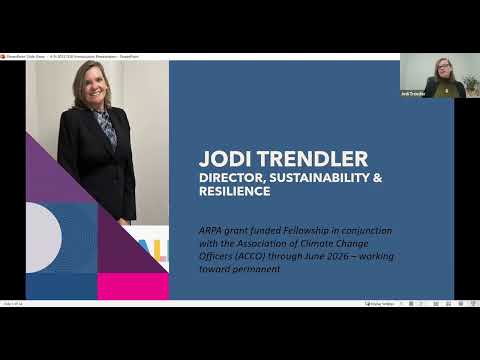
Trendler, whose position is funded through June 2026 by an American Rescue Plan Act (ARPA) grant and a fellowship with the Association of Climate Change Officers, told the committee she will “operationalize sustainability” by integrating sustainability considerations across departments, tracking progress with metrics, and coordinating community organizations and businesses.
Trendler said the city’s Sustainability and Resilience Plan (SRP) and a recent inventory show most local emissions come from the community rather than city operations, with roughly 46% from buildings and 42% from transportation. She said the SRP’s identified actions currently account for about 24% of emissions reductions the city will need and that Norwalk must address roughly 2,000,000 additional tons of CO2‑equivalent to align with recommended targets. As an illustrative example, she said offsetting that amount would require “about 777 wind turbines.”
The presentation outlined concrete steps Trendler plans to take over roughly 16 months: define what “greenest city” will mean for Norwalk, set greenhouse‑gas targets aligned with Connecticut and Intergovernmental Panel on Climate Change (IPCC) goals (net‑zero by 2050), complete a tracking database, pursue Sustainable CT recertification, form an interdepartmental green team and produce a prioritization framework that scores projects on cost, feasibility, emissions and co‑benefits.
Trendler said greenhouse‑gas accounting will be the city’s primary standardized metric and that co‑benefits such as public health, resilience, ecological restoration and economic savings would be folded into decisions. She described outreach plans that include a monthly newsletter, workshops, resident and business events, and ongoing coordination of community groups to reduce redundancy and increase effectiveness.
In public participation before the presentation, Diane Loricella of 21 Little Fox Lane told the committee she supports exploring membership in the Global Covenant of Mayors and ICLEI, cited the city’s Plan of Conservation and Development (POCD) and asked the city to consider a “final ban or moratorium on artificial turf fields.” Loricella also offered local volunteers and business leaders to participate in a sustainability committee or task force.
Council members responded positively to Trendler’s early plans and said the prioritization framework and emphasis on economic co‑benefits and bond/insurance implications were useful context for budgeting and policy decisions. Trendler said she will seek council input on representatives for community engagement and asked council members to help identify organizations and stakeholders from their districts.
The meeting recorded two formal procedural actions: acceptance of the minutes from the previous meeting and a motion to adjourn. No detailed vote tallies for either action were recorded in the transcript.
Trendler’s stated next steps include completing the sustainability tracking database, finalizing targets tied to state and IPCC guidance, advancing Sustainable CT certification work (the city most recently held bronze status) and launching the green team to guide internal coordination, project prioritization and community engagement.