Lifetime Citizen Portal Access — AI Briefings, Alerts & Unlimited Follows
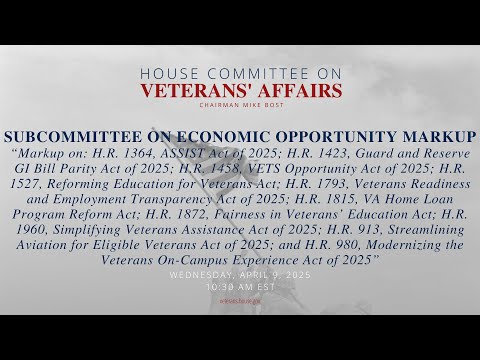
Subcommittee advances VA Home Loan Program Reform Act after tense debate over VAprogram end
Loading...
Summary
The House Veterans' Affairs Subcommittee on Economic Opportunity on April 3, 2025, voted to forward H.R. 1815, the VA Home Loan Program Reform Act of 2025, to the full committee after adopting an amendment in the nature of a substitute that would authorize the Department of Veterans Affairs to establish a partial-claims loss-mitigation program for guaranteed home loans.
The House Veterans' Affairs Subcommittee on Economic Opportunity on April 3, 2025, voted to forward H.R. 1815, the VA Home Loan Program Reform Act of 2025, to the full committee after adopting an amendment in the nature of a substitute that would authorize the Department of Veterans Affairs to establish a partial-claims loss-mitigation program for guaranteed home loans.
The bill and its amendment were debated at length after members raised concerns about the VAadministrationhaving abruptly ended the Veterans Affairs Servicing Purchase Program (VASP) earlier that week. Ranking Member Pappas argued VAshould reinstate VASP as a stop-gap while Congress works to enact a partial-claims alternative; the chair opposed that approach and said the subcommittee must reclaim congressional authority over the program.
The debate centered on two competing approaches. The chairman said the amendment under consideration "will give the VA the authority to create a partial claims program to help veterans get back on track with their payments," and framed the change as aligning VA home-loan rules with other federal mortgage programs. Ranking Member Pappas said he did "not oppose a partial claims program" but argued the VAshould not end VASP without an immediate alternative in place. He offered two substitute amendments to the amendment in the nature of a substitute—each would have either reinstated VASP immediately or reinstated it temporarily until a statutory partial-claims program became effective.
Both of Pappassubstitute amendments failed. A recorded vote on Pappassubstitute amendment number 1 resulted in 3 ayes and 5 nays; a later recorded vote on substitute amendment number 2 also failed by 3 ayes and 5 nays. After the failed substitutes, the committee agreed to the amendment in the nature of a substitute before forwarding the bill. The chair described the partial-claims approach as a way to prevent future unilateral actions by VA and to preserve the long-term viability of the VA home-loan guarantee.
Members discussed program costs and budgeting constraints during the markup. Committee members noted the subcommittee had asked the Congressional Budget Office for preliminary cost estimates but had not received final CBO scores on the bills. In the debate, committee members cited prior agency actions in which VA purchased loans using VASP: the chair said last Congress VA had, without congressional authorization, purchased defaulted loans at a much higher cost per case (citing an average VA purchase figure and aggregate spending discussed at the hearing).
The committee then voted to forward H.R. 1815 as amended to the full Veterans' Affairs Committee; the chair announced that "the ayes have it" on the motion to forward the bill. No final numeric roll-call tally for the forwarding motion was provided on the record; recorded tallies were provided for the Pappas substitute amendments only (3 ayes, 5 nays on each). The chair also directed staff to make technical and conforming changes to the bills advanced by the subcommittee.
Why it matters: The bill would create a statutory partial-claims mechanism for VA-guaranteed loans, a loss-mitigation tool that supporters said would give VA authorities similar options to those available to other federal mortgage programs. Supporters argued the move is urgent because VAhad already ended VASP; opponents cautioned about budgetary impact and said unilateral agency actions complicate Congresswork to authorize and fund alternative protections.
Clarifying details captured during the markup include that committee staff had contacted the Congressional Budget Office for preliminary cost estimates (final scores were not available at markup); committee members cited an average delinquency figure of roughly $25,000 per veteran case and discussed agency purchase averages and aggregate spending on VASP referenced in committee remarks (figures were presented during debate but members characterized some of those numbers as illustrative of the program's fiscal scope). The transcript records that members pressed for CBO offsets for any proposal that would increase federal outlays.
The subcommitteerecord shows the following formal steps on H.R. 1815 at this session: the amendment in the nature of a substitute was filed and considered; two substitute amendments offered by Ranking Member Pappas were defeated (each by recorded votes of 3 ayes and 5 nays); the amendment in the nature of a substitute was agreed to; and the committee voted to forward H.R. 1815 as amended to the full committee.
The committee paused to allow recorded votes per committee rules; the clerk reported vote totals for the Pappas substitutes but not for the final forwarding voice vote. The bill will next be considered by the full House Veterans' Affairs Committee.