Get Full Government Meeting Transcripts, Videos, & Alerts Forever!
Get email alerts on the Housing Property Tax Exemptions topic
No spam. Unsubscribe anytime.
Committee adopts substitute to let municipalities offer optional property-tax exemptions to incentivize housing
Summary
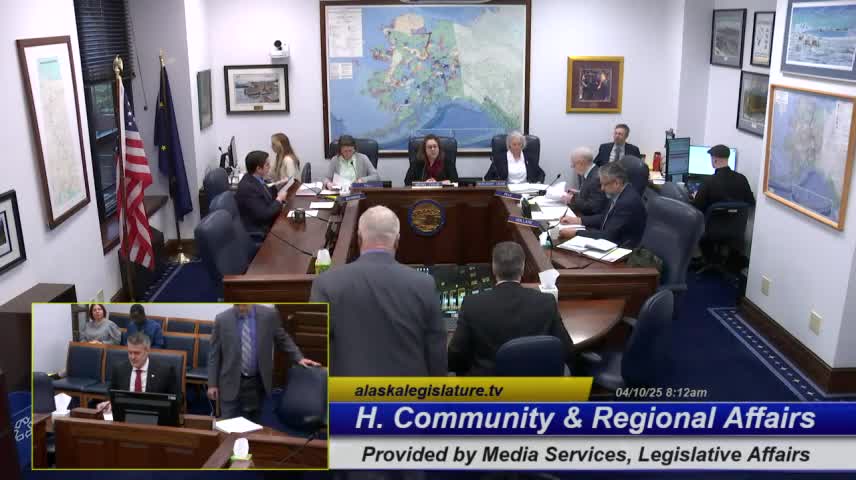
The House Community and Regional Affairs Committee adopted a committee substitute for House Bill 13 on April 10 allowing municipalities optional property-tax exemptions to encourage locally determined housing goals.
The House Community and Regional Affairs Committee on April 10 adopted a committee substitute for House Bill 13, a bill that would authorize optional property-tax exemptions municipalities could adopt to encourage types of housing and housing practices local leaders deem beneficial.
Sponsor Representative Andrew Gray told the committee the bill's goal is "to find optional ways of incentivizing more Alaska housing that Alaskans can afford." Staff explained several substantive drafting changes adopted in the substitute: the definition of a long-term rental was changed to 31 days or longer (down from 90+ days in an earlier draft); subsection CC was revised to target exemptions toward housing where rent does not exceed 30% of tenant income; subsection EE was revised to require owner-occupancy for a first-time homebuyer exemption; and other drafting refinements were made to align municipal language and address voter-approval concerns.
Committee members questioned how municipalities would verify the 30% rent-to-income test and whether the administrative burden would fall on municipalities or landlords. Kyle Johansen, staff to Representative Gray, said municipalities would have "flexibility to craft" structures for verification and that landlords seeking the exemption would likely provide income documentation because qualifying would be financially advantageous.
Testimony from local officials supported the bill as an optional tool. Felix Rivera, an Anchorage Assembly member, said the Anchorage Assembly supports HB 13 and the flexibility it offers; he described local work on a tax-abatement ordinance and said exemptions could be tailored by map or zone. James Devons, a Valdez city councilman, said exemptions could help communities with large shares of older mobile homes and that short-term rentals had "eaten up approximately 5% of all available rental inventory" in Valdez. Sandra Muller, director of the Division of Community and Regional Affairs at the Department of Commerce, Community and Economic Development, told the committee that municipalities may put exemptions to a voter referendum and that the bill is written as an optional authority.
Committee members debated whether municipalities could already place such exemptions before voters or adopt them by ordinance. Kyle Johansen referred to the notes to decisions for AS 29.45.050 and case law dating to "Valentine v. Juneau" to explain that municipalities lack a general power to exempt property taxes without explicit statutory authority from the Legislature; staff said that is why the Legislature periodically considers bills that add or clarify exemptions. Director Muller said municipalities "do have that option to put it to their voters," and the committee invited legal counsel and municipal representatives to continue refining how the bill would interact with local charters and statutory procedures.
Co-chair Donna Mears moved to adopt the committee substitute as the working document; after invited testimony and follow-up questions the committee adopted the substitute by unanimous consent and set the bill aside for further work. The hearing record shows no roll-call vote; the motion was resolved by objection/withdrawal and adoption on the floor of the committee.
Background: Sponsors and witnesses emphasized that HB 13 is optional for municipalities and optional for landlords to participate. Supporters said exemptions could be targeted to help low-income renters, mobile-home parks in need of infrastructure upgrades, conversions from short-term to long-term rentals, and incentives for first-time or owner-occupied buyers. Opponents or cautious members raised concerns about shifting tax burdens and the degree to which local voters should be asked to approve exemptions rather than leaving the decision to elected municipal councils.