Get Full Government Meeting Transcripts, Videos, & Alerts Forever!
Get email alerts on the Parking topic
No spam. Unsubscribe anytime.
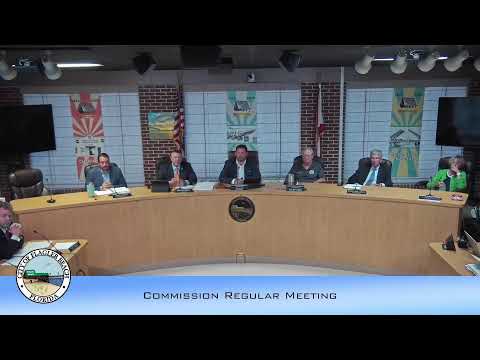
Flagler Beach holds paid-parking workshop; Passport presents app, merchants and resident-permit options
Summary
A Passport representative briefed commissioners on mobile-based paid parking, enforcement options and resident/permitted programs. Public comment at the workshop was sharply divided between business owners and residents over charging for beach parking; no formal action was taken.
Flagler Beach — City commissioners on April 10 heard a Passport demonstration of mobile-based paid-parking tools and discussed options for resident permits, merchant validation and enforcement, but took no formal vote, saying the topic will return during strategic planning.
Passport regional director Alexandra Wells, who said she has worked with the company since 2013, told the commission the system is designed to boost turnover and “increased parking turnover and efficiency,” which she said typically helps merchants by freeing curb spaces for more customers. “There’s enough parking for everyone; it’s just a matter of being able to, you know, better organize what you have and allocate those spaces accordingly,” Wells said.
The presentation described features the company calls guest checkout (text- or QR-based short flows for visitors who do not want to download an app), resident permits that register license plates for a discounted rate, merchant validation codes to reimburse customer parking sessions, and printable passes for unplated vehicles such as golf carts. Wells said Passport’s app uses GPS zone checks and optional session reminders and that the company can supply signage “initially at no cost.”
Why this matters: Commissioners framed paid parking as a tool to manage visitors, address congestion and produce discretionary municipal revenue that could be reinvested in mobility and sanitation. Several commissioners said they expect the item to be part of strategic planning this month.
Key technical and implementation points - Zones and time limits: Passport representatives said zoning is flexible and typically organized by differing time limits or rates; a city can have multiple zones to reflect local policy choices. Wells: “If you wanted different time limits in different areas throughout the city, those would be separate zones.” - Availability data and enforcement: Wells said real-time space-availability counts require sensors; without sensors, the system relies on active sessions associated with license plates. Passport supports handheld and fixed license-plate-recognition (LPR) enforcement tools and can integrate with third-party mobile LPR systems. - Resident permits and golf carts: Passport representatives described a permitting platform for resident plates and visitor passes; for unplated golf carts they recommended a printable permit to be displayed while enforcement would verify display rather than a plate. - Timeline and costs: Passport estimated a 60–90 day implementation window from scoping to launch, depending on signage and number of zones. Wells said Passport “provides all that signage for you initially at no cost.” - Data and payments: Wells said Passport hosts services on Amazon Web Services and is “PCI DSS level 1 certified” for payment security; the company representative said some user data may be subject to public-record requests and that redaction rules apply.
Public comment: supporters, opponents and practical concerns Public comment at the workshop was divided. Supporters including downtown business owners and residents who live in the Community Redevelopment Area (CRA) told commissioners paid parking could reduce long-term parking, camping and trash that they say fall to local taxpayers to clean. Laura Hackett, a CRA resident, said paid parking “may decrease some of the things that I’ve had to endure,” listing trash, people camping and public urination near her home.
Other speakers opposed charging for beach parking. Michael Taylor, who said he drove from Port St. Lucie to attend, said Flagler Beach’s shoreline should remain freely accessible: “There’s no point in friggin’ charging people to come to the beaches,” he said, adding that nearby counties maintain free beach access.
Environmental and usage tradeoffs were highlighted by Steven Combs, who identified himself as Regional Chair for Sir Potter Foundation (as stated at the microphone). Combs urged commissioners to balance public access, private commercial interests and surfers who may be out of the water longer than typical meter windows: “You can imagine surfing... you’re out the water, 2 hours later you’re going I gotta go pay my parking meter,” he said.
Business owners described different priorities. Jackie, who identified herself as a downtown business owner, said shops on Second Street “agree that something does need to be done about the parking,” especially during construction. Anthony Sonali, a private lot operator, said his paid lot is used and that businesses and the city bear cleanup and restroom costs when visitors do not patronize local merchants.
Commissioner questions and next steps Commissioners asked about resident exemptions, enforcement logistics and equity: whether residents would be given discounted resident permits, how the system would handle guests or merchant validations, and how enforcement would work for unplated vehicles. Passport said merchant validation codes permit merchants to validate a customer’s session; resident permitting can register plates and include a small number of visitor passes per household.
City staff and city manager said the workshop was informational and that additional study and public engagement would follow. The city manager told commissioners he would obtain further material from Passport and that implementation decisions would return to the commission during upcoming strategic planning sessions.
Ending: Commissioners gave no directive to adopt paid parking at the meeting; several said the matter will be discussed again during the city’s strategic planning and that staff will collect additional information on enforcement, signage and resident-permit options.