Get Full Government Meeting Transcripts, Videos, & Alerts Forever!
Get email alerts on the Unit Lot Subdivisions topic
No spam. Unsubscribe anytime.
Commission begins drafting unit-lot subdivision rules required by state law; raises density and utility questions
Summary
Staff introduced a required unit-lot subdivision (fee-simple unit lot) code amendment tied to 2023 Senate Bill 5258; commissioners discussed parking, common-area ownership (easement vs HOA), whether ADUs should be eligible, and utility/impact-fee implications; staff will return with a draft code before the June deadline.
City planning staff introduced a required amendment to Monroe's subdivision code to add procedures for unit-lot (fee-simple) subdivisions, a state-mandated option that lets a parent parcel be divided into separately owned unit lots while retaining some common areas. Commissioners discussed policy choices including allowable housing types, deviations from dimensional standards, parking, common-area mechanism (easement or homeowners association), utility connections and impact fees. Staff will draft code language and return for further policy direction.
What staff presented
Planning staff explained unit-lot subdivisions as a short-plat-like process created by 2023 Senate Bill 5258 that allows a parent lot to be divided into individually owned unit lots (fee-simple parcels) while portions of the parent lot not subdivided are owned in common or held by an HOA. Staff advised that the parent lot must meet zoning bulk standards while unit lots can get limited deviations (setbacks, lot width, coverage) to enable infill townhouse, cottage or small-multiplex development.
Policy issues commissioners flagged
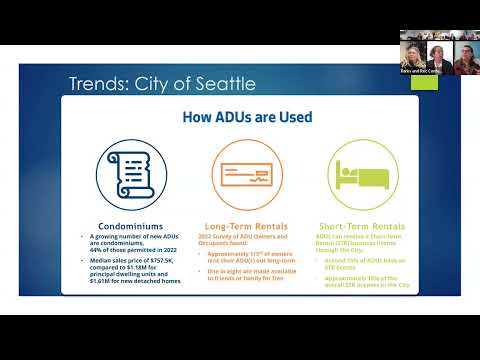
- Housing types: Commissioners and staff discussed allowing duplexes, townhomes, cottage housing and whether ADUs should be convertible into unit lots. Staff cautioned that treating ADUs as fee-simple lots could affect how density and impact fees are applied.
- Density and fee parity: Staff and commissioners noted a tension: some unit-lot configurations effectively increase sellable units without the same frontage, utility or impact-fee obligations that a conventional subdivision would trigger. Staff said accessory dwelling units are treated differently under Monroe's density rules and that using a unit-lot mechanism for ADUs could produce unequal outcomes or avoid impact fees.
- Utilities and frontage improvements: Staff said the unit-lot process would follow short-plat procedures, including separate utility connections and required frontage improvements; engineering would confirm technical details for connections and easements. Commissioners asked whether shared or easement-based utilities would be feasible on small infill parcels.
- Parking and common areas: Staff proposed allowing common parking areas (with required stalls per unit retained in the rules) and asked whether common areas should be handled by recorded easement or an HOA. Commissioners generally favored easements for lower cost and administrative simplicity, but left the final choice to staff recommendation.
Timing and next steps
Staff identified code sections to amend (definitions, subdivision chapter, permit-processing chapter) and a June 30, 2025 statutory timeline to meet. Staff said they will prepare a draft ordinance modeled in part on neighboring cities' examples (Snohomish) and return for a future Planning Commission meeting with proposed language and illustrations for commissioner review.
Quoted material in this story is taken from the March 10 Planning Commission meeting transcript and staff presentation.