Get email alerts on the Accessory Dwelling Units topic
No spam. Unsubscribe anytime.
Planning commission advances draft ADU code that would allow two accessory units and larger maximum size
Summary
Planning staff presented proposed accessory dwelling unit (ADU) code changes including permitting type, allowing two ADUs per lot, and a maximum size set as the larger of 1,000 sq ft or 50% of the principal dwelling; commissioners directed staff to prepare a formal amendment packet for public hearing.
The Monroe Planning Commission on March 10 reviewed proposed amendments to the city's ADU (accessory dwelling unit) rules aimed at implementing recent state law changes and speeding permit review. Planning staff presented options on permit type, unit counts, size limits, parking and short-term rental treatment, and commissioners directed staff to prepare a formal amendment packet and a public hearing date.
The proposal would move the land-use review of ADUs from a Type 2 permit to a Type 1 permit to shorten processing and reduce neighborhood notice requirements. Planning staff said the city currently allows one attached or detached ADU; the draft text would allow two ADUs in any combination on a lot. Planning staff reported the proposed maximum floor area would be “the larger of 1,000 square feet or 50% of the total floor area of the principal dwelling unit, excluding any related garage area.” Planning staff also proposed removing an owner-occupancy requirement and retaining a requirement for one additional off-street parking space per ADU.
Why it matters: The changes are driven in part by state legislation that limits the ways cities can restrict ADUs and by local priorities to make permitting faster. Commission members said the proposals affect neighboring property notification, design outcomes, parking demand and the potential uses of new units (for families, renters, or short-term rentals).
Key details discussed
- Permit processing and notice: Staff recommended changing ADU land-use review from Type 2 (includes mailed notice and a notice of decision/appeal period) to Type 1 (administrative, no mandatory neighbor notice). Staff said that while neighbors can still submit comments, if an application meets the adopted code the city must approve it.
- Unit counts and size: "We currently allow 1 attached or detached ADU, and we're proposing to allow 2, in any combination, either attached or detached," Planning staff Danielle Bridal said during the presentation. Bridal summarized the proposed size standard as "must not exceed a thousand square feet or 50% of the floor area of the principal dwelling, whichever is greater." Commissioners discussed whether the 50% test should apply differently to attached versus detached units and raised split-level and basement conversion scenarios as potential edge cases.
- Parking: Staff proposed keeping one additional required off-street parking space per ADU. Staff noted a state rule that can eliminate that requirement where robust transit (a bus every 30 minutes most of the day) is available; Monroe does not meet that transit threshold.
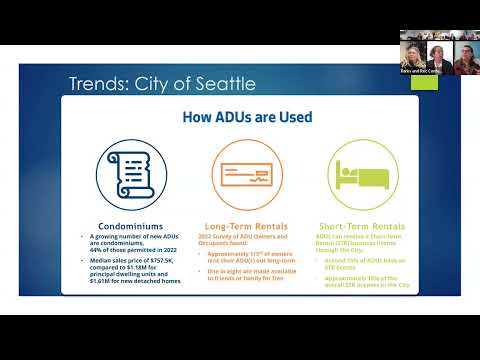
- Preapproved plans and building review: Staff reviewed experience from Seattle and other jurisdictions, saying preapproved building plans can reduce building-review time (one example cited a roughly 50-day savings at the building stage) but still often require multiple correction cycles. Seattle data presented by staff indicated a sharp rise in ADU permit applications after the city allowed two units; staff framed those figures as background, not local predictions.
- Short-term rentals and affordability: Staff said Monroe currently does not regulate short-term rentals and that roughly 10% of ADUs in Seattle reportedly operate as short-term rentals; the planning packet also noted Department of Commerce guidance that many ADUs end up in middle- to upper-income bands rather than the lowest-income affordability tiers. The commission discussed that ADUs alone are unlikely to meet the city's lower-income housing targets.
Next steps and public process
Commissioners, after discussion, moved to direct staff to prepare a formal amendment packet and schedule a public hearing before the Planning Commission. Staff will prepare draft code language and return with a public-notice schedule and materials for the hearing.
Staff and participants quoted in this report are drawn from the March 10 Planning Commission meeting transcript.
AI generated
The text on this page is AI generated. Summaries, highlights, analysis, and video transcripts are all produced from the original source material.
AI can make mistakes, so if you spot one, and we will fix it for everyone.
Note: the source content is unaltered by us. Any content source we link to, be it a video, an audio recording, or a document, is presented exactly as its publisher released it. That publisher is usually a government body, sometimes an individual official or another organisation.