Get Full Government Meeting Transcripts, Videos, & Alerts Forever!
Get email alerts on the Ethics topic
No spam. Unsubscribe anytime.
Wausau Ethics Board invites city attorney, city clerk to clarify testimony and summarize withheld materials before hearing
Summary
The Wausau Ethics Board voted 4-1 to ask the city attorney and city clerk to say whether they will testify in full or invoke privilege at an upcoming hearing and to provide a brief summary of categories of materials being withheld because of an ongoing DOJ investigation.
The Wausau Ethics Board voted 4-1 to invite the city attorney and the city clerk to clarify before the hearing whether they intend to offer full testimony or will invoke privilege or decline to answer certain questions, and to submit a general summary of categories of materials or statements being withheld and the reasons why.
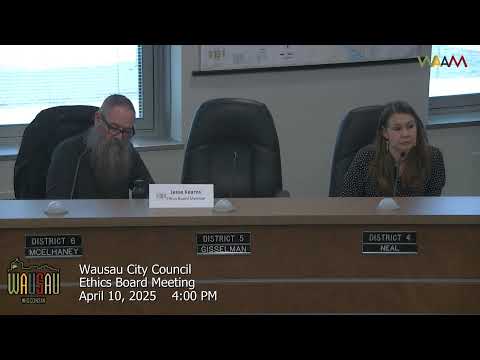
Board member Brian Mason made the motion in a meeting called to review respondents' written submissions; the motion passed after a brief debate. Mason said: "I motion that we invite the city attorney and the city clerk to clarify before the hearing whether they intend to offer full testimony or if they anticipate invoking privilege or declining to answer certain questions, and to invite the City Attorney and City Clerk to submit a general summary of what categories of materials or statements are being withheld and the reasons why." The board set an April 30 hearing date to examine the matter further.
The request grew out of several board members' concern that the city attorney's and the city clerk's written responses to investigative orders were limited. The respondents declined to provide sworn statements or certain documents by citing an ongoing U.S. Department of Justice investigation and attorney–client privilege, the board noted. Mason and other members said a short summary describing the types of materials withheld would help the board prepare more focused questions at the hearing and improve public transparency.
Not all members agreed the invitation would be useful. Several board members said subpoenaed witnesses can still invoke privilege on the stand and that the board may learn the same limits when testimony occurs under oath. Chair Calvin (last name not specified) framed the question as one of scope: whether the board should ask for the medium of withheld communications (for example, emails or personal messages) to better understand what evidence might be missing.
Attorney Larson, who has advised the board on hearing procedures, also outlined a proposed hearing format. "My suggestion is that as chair, Calvin should take the first crack at asking questions and if, because he might hit on questions that the other board members have," Larson said, explaining he expects a primary examiner role for the chair with opportunities for board members to follow up. Larson recommended that the chair rule on evidentiary objections at the hearing, with contested rulings resolved by motion.
Board members were also advised to review Section 2.03 0.08 of the board's ethics code and Wisconsin statutes chapters governing evidence (cited in the meeting as chapters 901 through 911) before the hearing. The board noted the city's written packet included an official opinion from the city attorney and attachments referencing guidance from the Wisconsin Elections Commission and the U.S. Election Assistance resources; members said those attachments appeared supplemental to the attorney's legal opinion.
The motion passed with four members in favor and one opposed. The vote tally was announced by the chair as "1 voting against and 4 in favor." The board then moved to discuss hearing procedures and adjourned after confirming the April 30 hearing scheduling plan.
Why it matters: Board members said the limited submissions and the invocation of an ongoing DOJ investigation affect the board's ability to evaluate the full record and to demonstrate transparency to the public. The invited clarifications are procedural — an invitation rather than a compelled disclosure — and the city attorney and city clerk may still assert privilege at the hearing.