Get Full Government Meeting Transcripts, Videos, & Alerts Forever!
Get email alerts on the Election Legislation topic
No spam. Unsubscribe anytime.
Monroe County clerk summarizes state election bills, including ban on university IDs and earlier presidential certification
Summary
The county clerk provided an update on several state bills affecting local elections, including Senate Bill 199 (signed by the governor), a bill that would prohibit using university IDs to vote, and measures that would move the presidential certification date earlier.
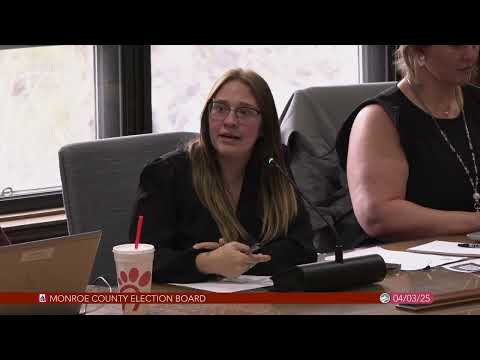
Monroe County’s clerk briefed the Election Board on multiple bills at the statehouse that could change local election procedures, noting one bill has already been signed by the governor and others were expected to advance.
The clerk said Senate Bill 199 was signed on April 1 and allows two or more candidates of a political party to sign a written statement naming a watcher to be present at the county primary election. “That talks about the primary only, but it was signed on April 1 by the governor,” the clerk said.
The clerk described additional legislation under consideration: House Bill 16-33, described as calling for a study of election issues and potentially addressing campaign finance; House Bill 16-79, which would require that every county clerk’s office be closed on election day, relieve clerks of judicial responsibilities on that day, allow county employees time off to serve as poll workers and move the presidential certification date to Sept. 1; House Bill 16-80, characterized as an election security and transparency bill for the Indiana Election Division; House Bill 16-81, which would require local public questions and referenda be placed only on the general-election ballot; and Senate Bill 10, a large voter-registration bill that would prohibit using a university identification as proof to vote.
The clerk also mentioned Senate Bill 526, which the clerk said would void an advisory opinion adopted by the Indiana Election Commission and add definitions for tabulation and for ballot retraction when a candidate dies.
Why it matters: Several of the items mentioned would change administrative responsibilities at the county level (for example, closing clerk offices on election day and shifting certification deadlines) or change who may use particular IDs to register or vote. The clerk told the board these items were expected to become law or continue to advance in the legislature.
No formal board action was taken on the bills during the meeting; the clerk’s update was informational.