Get Full Government Meeting Transcripts, Videos, & Alerts Forever!
Get email alerts on the Police Services Contract topic
No spam. Unsubscribe anytime.
North Bend reviews competing policing proposals; council presses on cost, oversight and communication
Summary
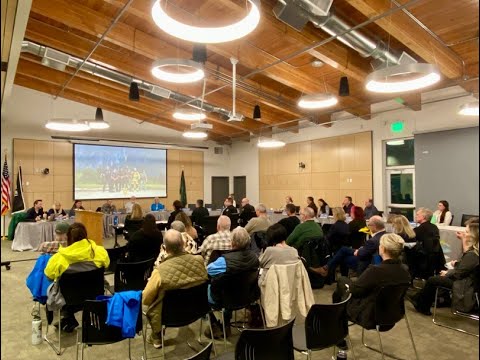
North Bend City Council on April 8 held a special work-study meeting to hear competing proposals for the city’s police services RFP from the Snoqualmie Police Department and the King County Sheriff’s Office.
North Bend City Council on April 8 held a special work-study meeting to hear competing proposals for the city’s police services RFP from the Snoqualmie Police Department and the King County Sheriff’s Office. The presentations — and about 90 minutes of council questions — centered on staffing models, projected costs, oversight and how each provider would share data and communicate with North Bend officials and the public.
The presentations matter because policing is North Bend’s largest general-fund expense and staff presented options the council is considering as it prepares for a contract decision. City officials told the panel that policing took roughly 20% of the general fund in 2024 and could approach one-third of the general fund in 2025 under some scenarios, a roughly 63% increase in the city’s single largest line item.
Snoqualmie proposal
Drew Ute, identified in the presentation as finance director for the city of Snoqualmie, and Gary Hirasi, identified as police captain for the Snoqualmie Police Department (SPD), framed Snoqualmie’s offer as a continuation of a decade-long partnership with North Bend. Snoqualmie proposed a “no call too small” model with dedicated coverage that, in its RFP response, would staff North Bend with two sworn officers between 8 a.m. and 8 p.m., one sworn officer overnight and a floating sergeant shared between the two cities. The presenting team said SPD currently staffs 30 full-time positions (25 sworn, five civilian) and reported an average of 81 hours of training per officer in 2024.
Snoqualmie’s price proposal for 2025 (presented as the biennial starting year) was $3,980,000. The city said the formula charges North Bend 100% of dedicated personnel assigned to North Bend, 50% of certain shared positions, a proportional share of shared operational and vehicle costs calculated from a rolling weighted calls-for-service average, and a 15% contract administration/facilities charge. Snoqualmie also proposed a biennial reconciliation to true up payments to actual costs at the end of each biennium and said it would apply a June-to-June CPI limit to operational cost increases in the contract.
Ute said Snoqualmie plans to seek accreditation over the next five years (citing the LEMAP report and benefits such as improved policies and less litigation exposure) and proposed an administrative specialist shared between the two cities to help manage records and reporting as volumes grow. He also proposed a quarterly joint advisory committee, nicknamed “Snowpack,” composed of equal numbers of Snoqualmie and North Bend council members and a parallel staff working group to provide quarterly budget and staffing reports.
King County Sheriff’s Office proposal
Sheriff Patty Holt Tindle (as introduced at the meeting) and a King County team described a 12-person “dedicated” model built to deliver a two-officer presence during peak hours plus investigative support (a full-time detective) and city-branded deputies, vehicles and uniforms. The Sheriff’s Office said North Bend would select a contract chief from eligible applicants within the sheriff’s office; that chief would work with the city to pick deputies assigned to North Bend.
King County presented its estimated total contract cost for 2025 at roughly $4,100,000 for the 12-officer model and said it expects 4–6% annual inflators thereafter. The county noted that 2026 includes a one-time startup labor cost for new deputies (the first step of a deputy salary/benefit while they complete training). The Sheriff’s Office emphasized its countywide support services that would be available to North Bend partners at no additional charge (dispatch, air support, major-crimes detectives, canine, crisis negotiation, data analytics and a therapeutic co-responder unit), and it showed an interactive crime-analysis dashboard the county uses to provide near-real-time data to contract partners.
Council questions and major themes
Council members pressed both presenters on several recurring concerns: budget predictability and whether contracts could include ceilings or phased service levels; how hiring, firing and chief-selection authority would work; access to data and public records; accountability and transparency after recent local turnover; and whether dedicated deputies would be pulled for county or regional responses.
Councilmember Ellwood said past friction left North Bend with “a deficit in data and access,” asking how Snoqualmie would change that dynamic. Ute pointed to the proposed advisory committee and quarterly reports as the starting point for improved communication.
Several council members, including Councilmember Collin and Councilmember Trimalata, asked about the frequency and depth of oversight and whether North Bend would have a “seat at the table” for decisions such as hiring or discipline of senior police leadership. Snoqualmie representatives said legal and liability doctrines limit formal decision rights and that hiring/firing authority would remain with the provider unless North Bend and Snoqualmie negotiate a different arrangement. King County said the city would select the contract chief from qualified applicants and that the chief would then staff the city’s deputies and detective positions.
Budget and cost-control questions recurred. Snoqualmie told Councilmember Torgerson it had calculated its “true and full value” cost using the Interlocal Cooperation Act as the guiding principle and said its analysis found prior contract fees underpriced the county of services by about $910,000 a year on average over 2020–2024. King County described its cost exhibit, explained its methods for smoothing pool costs across contract partners, and said cities receive proposed cost estimates before budget season and an actual- vs.-estimated reconciliation afterward so the city’s invoiced amount for a year is the lesser of proposed or actual.
On response times and dedicated staffing, both providers said dedicated models generally yield more reliable response and community visibility than the prior “flex” model that used unincorporated deputies. King County emphasized its communications center standard for answering 911 (noting its stated performance metric that ~91% of 911 calls are answered within 15 seconds) and said dedicated deputies would be assigned to North Bend but could be requested for major incidents elsewhere in rare, large events.
Direct statements from presenters
Drew Ute (Snoqualmie finance director) said, “the two cities are quite frankly better together, not separate,” summarizing Snoqualmie’s pitch as a continuity-and-improvement approach anchored in a decade of partnership with North Bend.
Sheriff Patty Holt Tindle (King County Sheriff’s Office) told the council, “You have my personal word. We will build and foster the trust with your community,” emphasizing countywide assets and investigative capacity.
Formal actions and next steps
No formal actions or votes were taken at the April 8 work study; the session was a presentation and question-and-answer meeting only. The city’s timeline presented at the meeting: written proposals are due April 15; council will receive scoring and discuss clarifying questions on April 22; and the regular City Council meeting on May 6 may include a vote if council is ready. Both proposers said they will post presentation materials and written proposals to their websites and that North Bend staff will post received RFP responses to the city’s police services landing page.
Ending
Council members told staff they expect follow-up written answers to outstanding legal and contract questions and that the advisory-committee proposals and cost exhibits will figure heavily in future deliberations. The council recessed for a short break at the close of the presentations; no decision was made and no public comment was taken during the work study, per the posted format.