Get Full Government Meeting Transcripts, Videos, & Alerts Forever!
Get email alerts on the Higher Education topic
No spam. Unsubscribe anytime.
Senate rejects amendment to restore voting rights for students, faculty and staff on public university boards
Summary
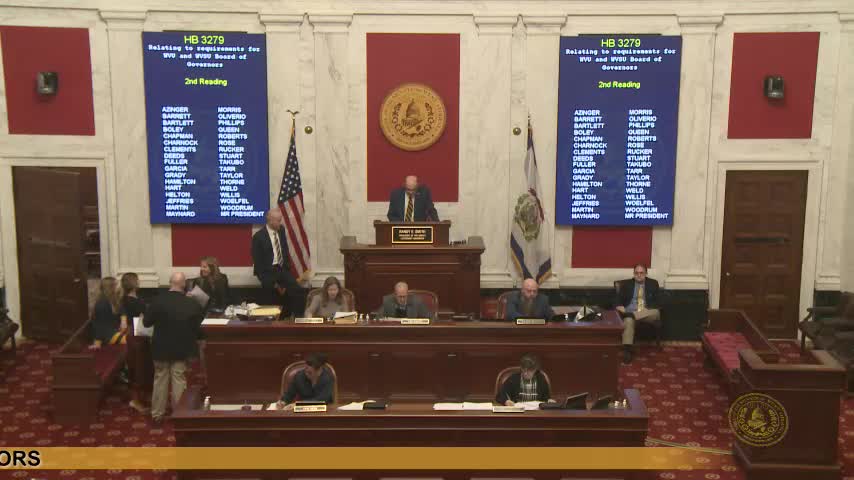
On House Bill 3279 (board composition at public institutions), the Senate debated and rejected an amendment to restore voting authority for student, faculty and staff representatives on institutional boards of governors; the amendment failed 14–19.
The West Virginia Senate debated House Bill 3279, which revises governing-board composition at public institutions of higher education, and rejected a floor amendment that would have restored voting rights for student, faculty and staff representatives at institutional boards of governors.
The amendment, offered by the senior senator from the thirteenth, would have reinstated voting authority for the student, faculty and staff representatives across institutions. The senator argued those representatives provide valuable perspectives and civic learning opportunities, and read a letter from Gordon Gee urging retention of voting authority for these campus stakeholders. Opponents, including senators who cited national benchmarks and concerns about conflicts of interest and the duty-of-loyalty principle, argued the change aligns West Virginia with common governance practices and urged the amendment’s rejection.
On the roll-call vote the clerk announced 14 yeas and 19 nays, and the amendment was rejected. The sponsor then offered additional amendments (including proposals about geographic representation and meeting attendance for nonvoting members) that the Senate considered; subsequent amendments to create geographic parity and to guarantee attendance were also rejected after recorded votes.
Why it matters: The bill and the defeated amendment directly change who may vote on institutional governance decisions at public colleges and universities. Proponents of the amendment emphasized stakeholder engagement and representative input; opponents expressed concern about conflicts with the duty of loyalty and argued most peer institutions do not provide voting status to employees or staff.
Key floor figures in the debate included the senior senator from the thirteenth (who sponsored the amendment), the senator from Jefferson (who spoke in opposition), the junior senator from the seventh, and other members who spoke to governance models and national benchmarks. The clerk recorded and announced machine votes when the amendments were put to a roll call.