Get Full Government Meeting Transcripts, Videos, & Alerts Forever!
Get email alerts on the Banking And Finance topic
No spam. Unsubscribe anytime.
Senate committee advances bill requiring FDIC coverage in bank sales, drawing credit union opposition
Summary
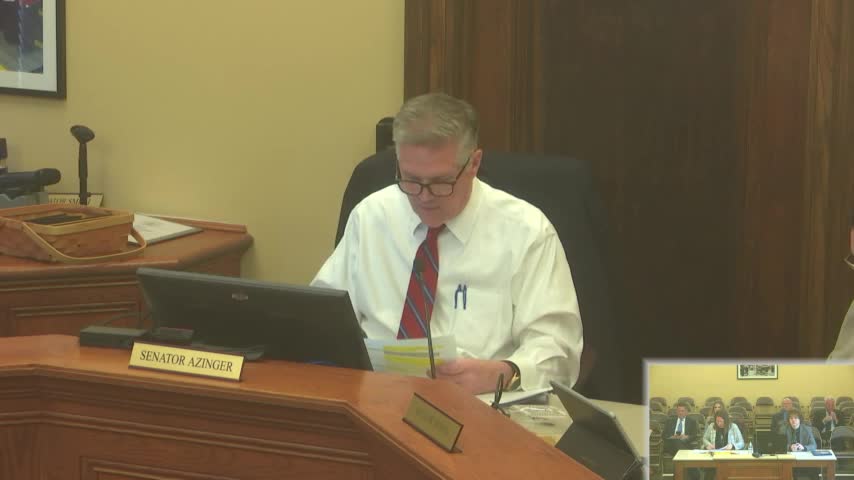
The West Virginia Senate Banking and Insurance Committee voted to report an engrossed committee substitute for House Bill 2963 to the full Senate with a recommendation that it pass, sealing the committee’s endorsement by voice vote on April 12, 2025.
The West Virginia Senate Banking and Insurance Committee voted to report an engrossed committee substitute for House Bill 2963 to the full Senate with a recommendation that it pass, sealing the committee’s endorsement by voice vote on April 12, 2025.
The bill would add a section to the state banking code requiring that a bank chartered in West Virginia may sell or transfer all or substantially all of its assets and liabilities by merger, reorganization, purchase and assumption, or similar business combination only if the acquiring entity is insured by the Federal Deposit Insurance Corporation (FDIC). The measure also would allow an interested person, including a bank or bank holding company, to seek equitable relief in court to enforce the provision.
The measure drew sharply different views from witnesses. Mark Adkins, representing the Community Bankers of West Virginia, told the committee the legislation responds to a growing national trend of credit unions purchasing banks, which he said can convert a taxpaying local institution into a non‑taxpaying entity. “We want to . . . protect our tax paying West Virginia banks from potentially being bought by out‑of‑state entities,” Adkins said, arguing that an out‑of‑state credit union that bought First Neighborhood Bank in Spencer had a competitive advantage when that sale occurred.
Mike Tucker, volunteer board member of the West Virginia Credit Union League and president of West Virginia Central Federal Credit Union in Parkersburg, testified in opposition and urged parity for the National Credit Union Share Insurance Fund. “The share insurance fund actually has an equity ratio of 1.3 at this point, and the FDIC has an equity ratio of 1.21,” Tucker said, adding that the National Credit Union Share Insurance Fund is backed by the federal government and should be listed alongside the FDIC. Tucker also told senators the bill could remove a bank’s ability to consider credit unions as buyers and limit free‑market options for sellers.
Committee members pressed witnesses on comparative advantages. Adkins told the committee there is no statutory requirement forcing a bank to sell, but said credit unions’ tax status and scale can create conditions that make competing offers difficult for community banks. He cited national transaction totals, saying that before 2014 there were six credit union purchases of banks nationwide and that 55 such transactions occurred from 2015 through 2024. Adkins also listed seven states that have enacted similar laws: Colorado, Iowa, Illinois, Mississippi, Minnesota, Nebraska and Tennessee.
Tucker said credit unions return earnings to members and community programs rather than to stockholders; he supplied figures for his institution and the industry, including a $3.6 million net income for his credit union in the prior year and about $250,000 in community donations from his institution the previous year. He warned the committee that excluding credit union insurance parity could harm low‑income communities if banks sell to larger institutions that later close branches.
After discussion, the vice chairman moved that the engrossed committee substitute for House Bill 2963 be reported to the full Senate with the recommendation that it do pass. The committee approved the motion by voice vote; the chair declared, “the ayes have it,” and the motion was adopted. No roll‑call tally was recorded in the committee transcript.
The bill now proceeds to the full Senate. The committee record shows testimony and questions on insurance parity, local tax and economic impacts, and whether state law should restrict buyers by type of deposit insurer; no amendments to the bill were recorded in committee.
Votes at a glance: The committee reported the engrossed committee substitute for House Bill 2963 favorably to the full Senate by voice vote.