Get Full Government Meeting Transcripts, Videos, & Alerts Forever!
Get email alerts on the Legislation topic
No spam. Unsubscribe anytime.
Senate advances wide range of bills on third reading; dozens move forward
Summary
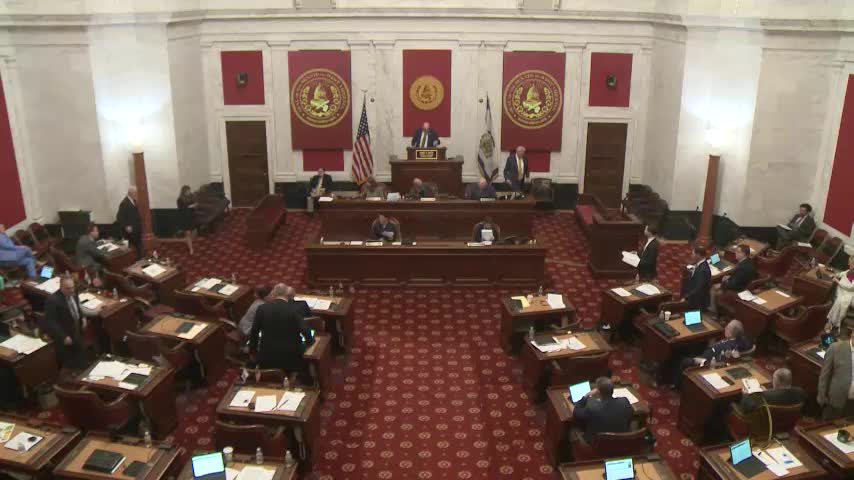
During a floor session, the West Virginia Senate approved a large package of bills on third reading, spanning property law, education, judicial jurisdiction, higher-education rulemaking and other areas. Several bills were adopted unanimously or by wide margins; a handful drew votes with recorded opposition.
The West Virginia Senate on a floor session advanced and passed a broad set of bills on third reading, approving measures addressing property rights, school policy, court jurisdiction limits and other subjects.
The measures taken up included an array of committee substitutes and engrossed house bills. Many passed with unanimous or near-unanimous recorded votes on the Senate floor when the clerk closed the machine and the results were announced.
Among the measures approved: Engrossed committee substitute for House Bill 2434 (described on the floor as the “Stop Squatters Act”), which clarifies that squatters are trespassers and establishes a removal process and a related criminal-mischief offense; the clerk recorded the result as 31 yays, 0 nays, 3 absent. A bill requiring in-person training for principals and certain school officials on the Individuals with Disabilities Education Act and related state policy (engrossed committee substitute for House Bill 2499) passed 33 yays, 0 nays, 1 absent; the Senate later adopted an effective date motion making that bill effective July 1, 2025. A change to trust law extending the permissible duration of certain trusts (engrossed committee substitute for House Bill 2711) passed 33 yays, 0 nays, 1 absent. A bill amending magistrate-court civil jurisdiction to raise the limit from $10,000 to $20,000 (engrossed committee substitute for House Bill 2761) passed 32 yays, 1 nay, 1 absent.
Other bills approved on third reading included measures on higher-education rule authorizations (33 yays, 0 nays, 1 absent), updates to West Virginia’s small-estate process (33 yays, 0 nays, 1 absent), amendments to negligent homicide statutes and related offenses (33 yays, 0 nays, 1 absent), and authorization for the legislative auditor to conduct periodic performance audits of the Department of Education (33 yays, 0 nays, 1 absent). Several additional measures were advanced to third reading or referred under their original double-committee references for further review.
Votes at a glance (selected items with recorded machine results announced on the floor): - House Bill 2434 (Stop Squatters Act): 31 yays, 0 nays, 3 absent — declared passed. - House Bill 2499 (principal training on IDEA / State Board policy 2419): 33 yays, 0 nays, 1 absent — declared passed; title amendment and an effective-date motion to make it effective 07/01/2025 were adopted. - House Bill 2711 (trusts / rule against perpetuities up to 1,000 years): 33 yays, 0 nays, 1 absent — declared passed. - House Bill 2752 (motorcycle safety — allow standing on foot pegs): 27 yays, 6 nays, 1 absent — declared passed. - House Bill 2761 (magistrate court civil-jurisdiction increase to $20,000): 32 yays, 1 nay, 1 absent — declared passed. - House Bill 2773 (Higher Education Policy Commission rules and Council for Community and Technical College Education rule): 33 yays, 0 nays, 1 absent — declared passed. - House Bill 2867 (small-estate changes excluding real probate property): 33 yays, 0 nays, 1 absent — declared passed. - House Bill 2871 (negligent/vehicular homicide reforms): 33 yays, 0 nays, 1 absent — declared passed. - House Bill 2897 (legislative auditor authority to audit Department of Education performance): 33 yays, 0 nays, 1 absent — declared passed.
Why it matters: The package contains changes that will affect property rights and eviction processes, K–12 operations (including required IDEA training for school leaders), judicial relief thresholds for small civil claims, and statutory updates in criminal law and administrative oversight. Several bills carry implementation deadlines or effective-date motions recorded on the floor.
The Senate clerk recorded and communicated each action to the House as required by chamber practice. Where title amendments or committee strike-and-insert amendments were adopted, the clerk announced adoption on the floor before the bills were communicated to the House.