Get Full Government Meeting Transcripts, Videos, & Alerts Forever!
Get email alerts on the School Safety Law Enforcement Training topic
No spam. Unsubscribe anytime.
Committee OKs bill letting officers earn in‑service credits by working in schools
Summary
A Senate committee voted to send House Bill 2802 to the full Senate with a recommendation that it pass. The bill would allow West Virginia’s Law Enforcement Professional Standards (LEPS) Committee to credit officers’ required in‑service hours for time spent working in schools on safety programs.
A Senate committee on an unspecified date voted to report House Bill 2802 to the full Senate with a recommendation that it pass.
House Bill 2802 would amend Chapter 30 to allow the Law Enforcement Professional Standards (LEPS) Committee to adopt a method by which active law‑enforcement officers can earn a portion of their statutorily required in‑service training hours by teaching or otherwise working in K‑12 school safety programs. Under current law, every officer must complete at least 16 hours of in‑service training (with supervisory officers required to take an additional eight hours every two years); HB 2802 would let LEPS provide for an hour‑for‑hour exchange (for example, up to eight in‑school hours credited toward eight in‑service hours).
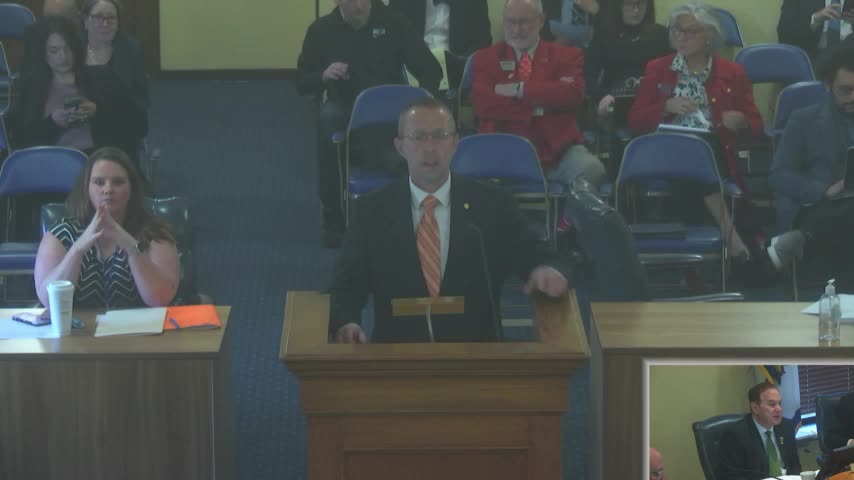
The bill’s lead sponsor, Delegate Pinson, described his background as a pastor and former police officer who spent nearly two years assigned inside a school of about 1,200 students. “School safety has been a priority of this legislature,” Pinson said, adding that the LEPS Committee has already taken administrative steps to allow an eight‑for‑eight exchange but lacks the statutory proviso in Chapter 30 to authorize the change in code.
Pinson said the change is intended to put officers “physically in the schools, walking up and down the hallways, checking the perimeter of the building, having lunch with the students, meeting with the faculty and the staff,” which would help officers learn school layouts and develop relationships with students and staff. He credited the Jackson County Sheriff’s Office under Sheriff Ross Mellinger for developing an early version of the concept.
Committee members asked how the program would be administered and whether officers could do the work while off duty; Pinson and counsel said those operational details would be set by the LEPS Committee and department supervisors. Pinson also said the policy could reduce travel and lodging costs associated with some out‑of‑state training courses.
Vice Chair moved that HB 2802 be reported to the full Senate with a recommendation that it pass; the motion passed on voice vote and the chair declared the motion adopted.
What happens next: the bill, now recommended for passage by this committee, moves to a Senate floor vote and any further amendments or debate will be determined there.