Get Full Government Meeting Transcripts, Videos, & Alerts Forever!
Get email alerts on the Local Government Financial Oversight topic
No spam. Unsubscribe anytime.
Senate Finance Committee advances bill giving state auditor broad powers over fiscally distressed local governments
Summary
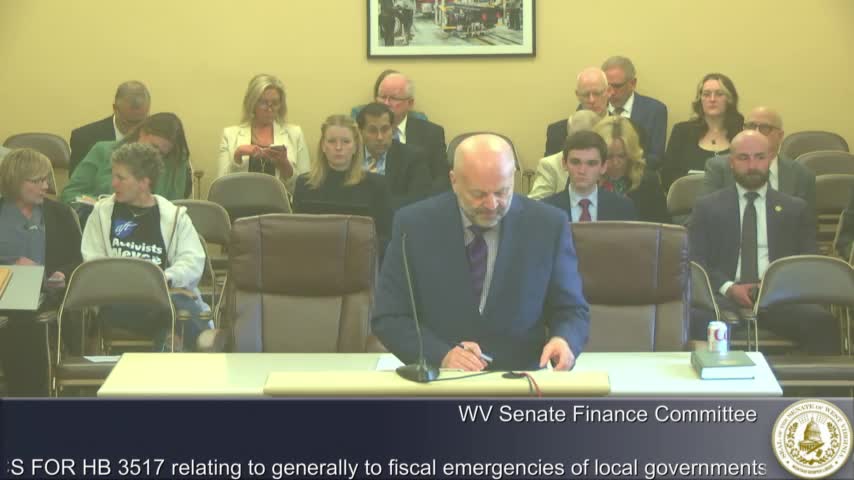
The Senate Finance Committee voted to report committee substitute for House Bill 35 17 as amended to the full Senate, advancing a bill that creates a statutory framework for identifying, monitoring and remediating fiscal emergencies in local governments and expands state oversight, including municipal dissolution procedures.
The West Virginia Senate Finance Committee voted to report committee substitute for House Bill 35 17, as amended, to the full Senate with a recommendation that it pass. Committee Counsel explained that the bill creates a new article in Chapter 6 of state code to identify, monitor and remediate fiscal emergencies in local governments and modernizes voluntary and involuntary municipal dissolution processes.
The bill matters because it would give the state auditor authority to intervene when local governments cannot meet fiscal obligations, require submission of financial recovery plans, and establish procedures for oversight and dissolution that could affect counties, municipalities and other local authorities. Committee Counsel said the measure defines terms such as fiscal emergency, fiscal watch, deficit fund, debt obligations and financial recovery plan and sets auditable conditions and trigger events for intervention.
Under the proposal, the auditor may initiate a fiscal watch or emergency based on factors including unpaid accounts, recurring deficits, covenant violations, defaults, unpaid employee benefits or longstanding debts. Committee Counsel said the auditor could require local officials to submit a financial recovery plan within 90 days; if a plan is not submitted or fails, the auditor may declare a fiscal emergency. The bill also requires written notice of a fiscal watch and allows local governments to appeal auditor findings to circuit court, while the auditor’s actions may continue during the appeal.
The bill would authorize the auditor to inspect local operations, promulgate rules defining practices that may trigger a watch or emergency, and impose deadlines and monitoring protocols. Committee Counsel said the auditor may offer technical assistance, create a financial planning and supervision committee, and establish local oversight committees once a fiscal emergency is declared.
House Bill 35 17 contains provisions affecting municipal dissolution, including voluntary dissolution via voter petition and involuntary dissolution when a municipality ceases to function or fails to hold elections. Committee Counsel explained that, following dissolution, the state auditor may serve as special receiver to secure and liquidate assets, prioritize municipal funds for debt repayment, and transfer property, subject to limits and prohibitions such as restrictions on insider purchases.
The bill also would prohibit a political subdivision from filing for federal bankruptcy relief without written permission of the state auditor and the governor, and it outlines duties of local officers and potential enforcement measures for noncompliance. Committee Counsel noted a strike-and-insert amendment drafted with county officials and the auditor’s office to make technical corrections, restructure sections and clarify rulemaking authority. After discussion and adoption of the amendment, the committee voted to report the bill to the full Senate with a recommendation that it pass.