Get Full Government Meeting Transcripts, Videos, & Alerts Forever!
Get email alerts on the Collective Bargaining Exec Session topic
No spam. Unsubscribe anytime.
Springfield City School Committee votes to enter executive session over collective bargaining
Summary
The Springfield City School Committee voted to go into executive session under MGL Chapter 30A §21(3) to discuss strategy on collective bargaining for clerks (Unit C), teachers (Unit A) and a student assignment services contract; the motion passed on a roll-call vote.
The Springfield City School Committee voted to enter an executive session to discuss collective bargaining strategy for clerks, teachers and a student-assignment services contract, citing Massachusetts General Laws Chapter 30A, Section 21, exemption 3.
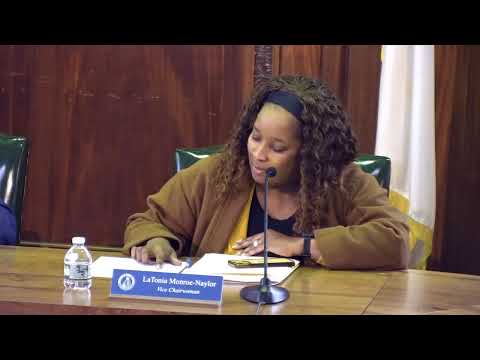
Vice Chair Naylor moved that the committee enter executive session "pursuant to MGL chapter 30 a section 21 exemption 3 for purposes of discussing the strategy with respect to collective bargaining for the clerks, unit C; updates to the collective bargaining teachers unit A; [and] updates of the student assignment services units contract," and said the open meeting could have a detrimental effect on the committee's bargaining position. The motion was seconded by Miss Gresham.
The committee took a roll-call vote. Members recorded as voting yes were Mister Collins, Miss Gresham, Miss Bruno Naylor and Mayor Sarno. Mister Gonzales, Attorney Murphy and Miss Hurst were recorded as absent. The motion passed. Committee members said they would return to open session at the conclusion of the executive session.
The executive-session vote invokes MGL Chapter 30A, Section 21(3), the statute that permits closed-door discussion of strategy with respect to collective bargaining. No substantive bargaining positions or contract terms were discussed in open session. The committee's stated purpose for the closed session was to protect its bargaining position on three separate personnel/contract items: clerks (Unit C), teachers (Unit A) and a contract related to student assignment services.
Meeting staff and the superintendent were noted as present or expected; the superintendent, identified in the record as Dr. Sonia, was mentioned as participating in related services. The committee did not take any other formal public actions during the portion of the transcript covering the executive-session motion and roll call.
The committee’s action now allows staff and negotiators to discuss bargaining strategy in closed session under the cited state law; any formal agreements or settlements would be expected to return to public session for action as required by law and committee rules.