Get Full Government Meeting Transcripts, Videos, & Alerts Forever!
Get email alerts on the Appropriations Budgets topic
No spam. Unsubscribe anytime.
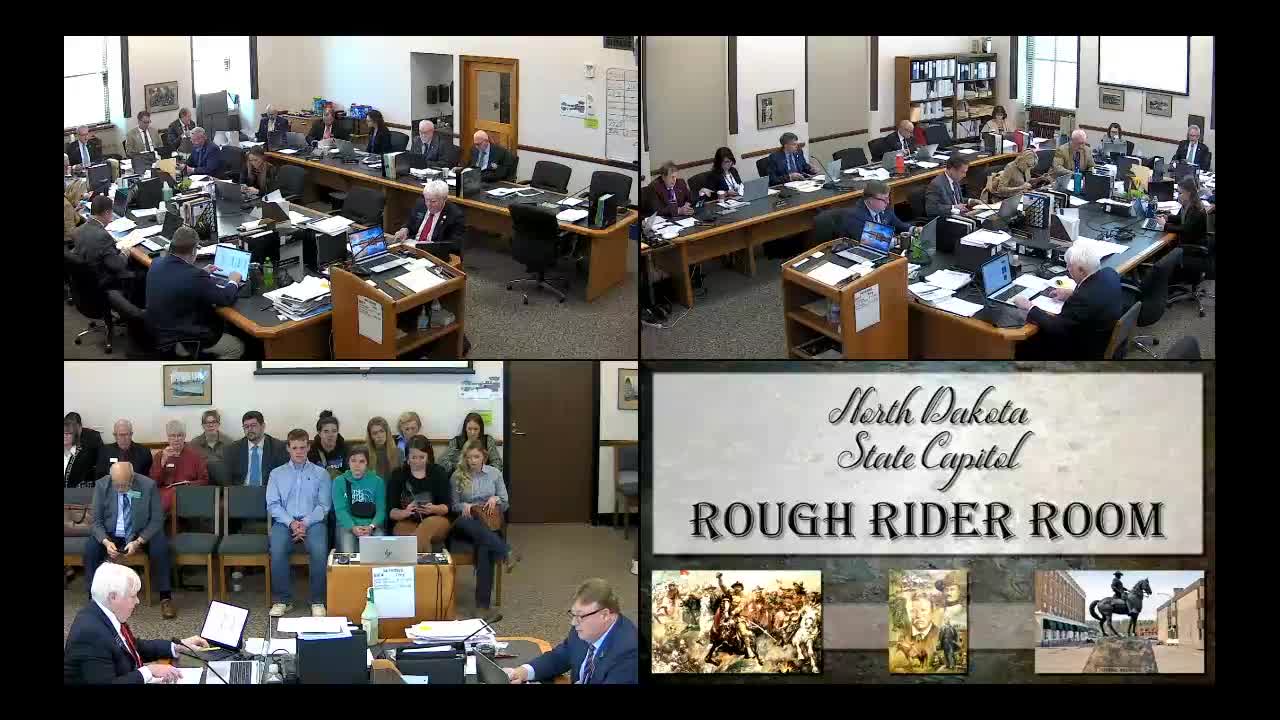
Appropriations committee advances three budgets after votes on amendments to ethics commission funding and processes
Summary
The House Appropriations Committee voted to advance three appropriation bills: the ethics commission budget (SB2004) with policy and process changes and a restored $50,000 one‑time case management allocation, the Department of Career and Technical Education budget (SB2019), and the Legislative Council and Assembly budget (SB2001).
The House Appropriations Committee on Tuesday approved three budget bills that the panel’s members said are needed to run the legislative branch and several education programs. Lawmakers voted to advance the budget for the North Dakota Ethics Commission (Senate Bill 2004) after adopting policy changes and restoring a $50,000 one‑time case‑management allocation; they also approved the Department of Career and Technical Education budget (Senate Bill 2019) and the Legislative Council and Assembly budget (Senate Bill 2001).
Ethics commission budget (SB2004): Representative Lausser, presenting the committee’s amendment, said the measure reflects the panel’s effort to balance the commission’s need to process a rising number of complaints with concerns about agency scope and constitutional limits. The amendment adds an automatic‑closure mechanism that requires each complaint be closed within 180 days of receipt unless the commission has taken further action; expands when an accused individual may speak publicly about an allegation; requires an annual public report on complaints and outcomes; and updates immunity and conflict‑of‑interest language for legislators.
Supporters said the changes are intended to limit long, unresolved complaints that officials told the committee can linger for years. Representative Nathie and others argued the 180‑day limit gives the commission a tool to clear matters that have stalled; Representative Hansen said the deadline risks impairing the commission’s constitutional work and objected to removing requested staff and a case‑management system. The committee ultimately restored one‑time funding of $50,000 (SIF) for a case‑management system after debate and votes.
Committee testimony included numbers showing complaint volume has risen: the commission reported 41 complaints in 2024 and 63 complaints so far in 2025. Jonathan Byers of the North Dakota State’s Attorneys Association testified the bill imposes additional duties on county prosecutors and could create new fiscal burdens because local prosecutors would need to investigate and, in some cases, hire outside counsel to avoid ethical conflicts.
Votes at a glance - SB2004 (Ethics Commission), amendment 02006 adopted: recorded as passed by roll call; amendment vote reported as 14 yes, 7 no, 2 absent. The committee later voted to restore a $50,000 one‑time case‑management allocation (SIF), a motion that passed 13–9 with 1 absent. Final due‑pass motion for SB2004 as amended passed on roll call 19–3 with 1 absent. - SB2019 (Department of Career & Technical Education), amendment adopted and final bill passed on roll calls reported as 22–0 with 1 absent. The amendment funds $12.75 million in new and expanded CTE grants, including $8 million for new/expanding programs and $750,000 for workforce‑training positions, plus a $1 million SIF for virtual‑reality career exploration and $150,000 placeholder for moving expenses tied to office relocations. - SB2001 (Legislative Council & Assembly), amendment adopted and final bill passed on roll calls reported as 22–0 with 1 absent. The assembly budget includes payments for 87 legislative session employees, increased session lodging limits tied to a separate law, a planned chamber technology and lighting upgrade, and a transfer of $290,000 from the Secretary of State for public printing tied to session law publications.
Context and implications: The ethics commission debate was the meeting’s most contentious. Proponents of the 180‑day closure and the related policy language argued the public and accused officials deserve timely resolution; opponents said staffing and process changes, not time limits, are the better way to clear backlogs and cautioned that statutory deadlines could conflict with constitutional protections for the independent ethics agency. The committee compromised by adopting policy language and restoring limited one‑time funds for a case‑management tool while declining to add an ongoing education/outreach FTE the commission had requested.
CTE and legislative council items were less controversial in committee. Representative Richter said the CTE amendment funds expanding regional workforce positions, support for CTE centers finishing construction and a $1 million SIF for VR career exploration aimed at middle‑school outreach. Representative Meyer said the Legislative Council amendment includes a planned chamber lighting and video upgrade and funding to accommodate additional legislative staff when the fifteenth floor of the Capitol is used for legislative offices.
What’s next: All three bills were reported favorably to the full House for floor consideration. Conference committees and floor pacing were discussed by the Appropriations chair; members were advised to be prepared if appropriations amendments for other bills are called on higher orders in the coming days.