
Committee approves study of state employee total compensation; language broadened to compare across departments and private sector
Get AI-powered insights, summaries, and transcripts
Subscribe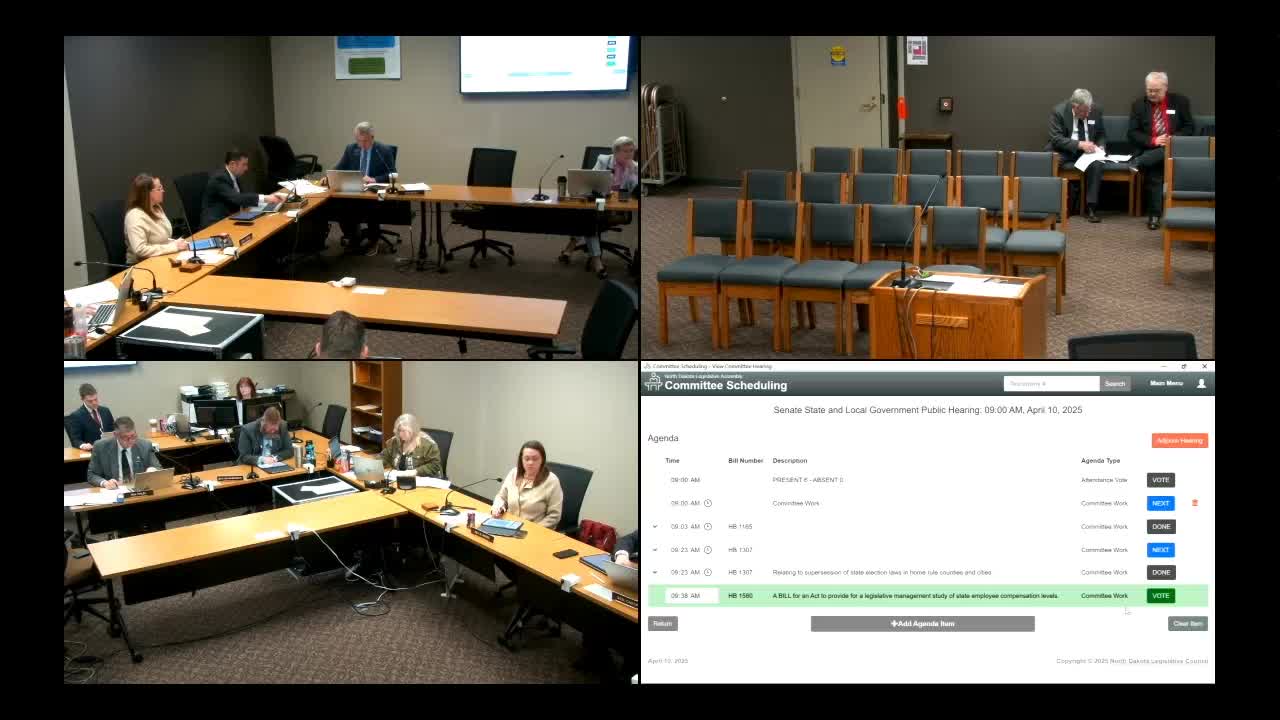
Summary
The committee approved an amendment directing Legislative Management to study classified state employee 'total rewards'—including pay grades, benefits and health plan impacts—with explicit comparisons among state departments and with similar private‑sector jobs.
The State and Local Government Committee voted to advance House Bill 15‑80 with amendments directing an interim study of classified state employee "total rewards" compensation, including pay‑grade classifications, health‑plan options and comparisons both across state departments and with similar private‑sector jobs.
Chair Rohrs said the bill would create space for a broader look at pay and benefits together after recent changes to pension and benefits. Senator Lee and other members pressed for comparisons not only with private‑sector equivalents but also among state employees across departments to identify pay disparities for substantially similar work.
Senator Lee said the study should assess whether employees with similar education and responsibilities receive significantly different pay because they work in different departments. The committee agreed to add language requiring comparisons "among state employees across all departments and between state employee compensation levels and similar private‑sector jobs," and to make the section on health benefits generic so the study examines the "impact of changes to health plan benefits" without assuming a particular plan change.
Why it matters: Supporters said a total‑rewards study—looking at wages, health benefits, equity funding and bonuses—could inform recruitment and retention strategies and identify unjustified pay disparities. Members also discussed how merit, performance and department size factor into compensation decisions and noted that deeper department‑level analysis would be needed to distinguish justified differences from inequities.
Formal actions: The committee adopted the amendment (substituting broadly worded study language) by voice/roll call 6–0 and voted 6–0 to give House Bill 15‑80 a due pass as amended.
Ending: The committee directed staff to assemble final draft language consistent with the committee's instructions so the interim study can proceed with the broader total‑rewards scope.