Get Full Government Meeting Transcripts, Videos, & Alerts Forever!
Get email alerts on the Trade Tariffs topic
No spam. Unsubscribe anytime.
Mass. governor, business leaders warn tariffs are harming investment; state to use Mass Leads Act and quasi agencies to help
Summary
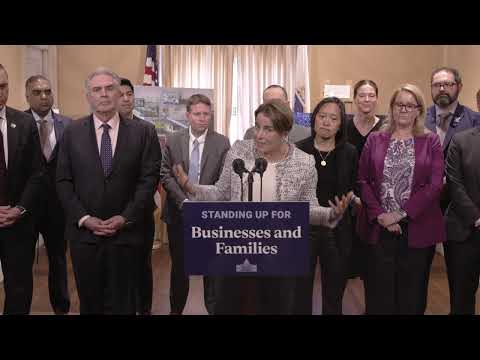
Massachusetts Governor Maura Healey convened state and business leaders at a news briefing to say President Trump’s recent tariffs are creating “chaos and uncertainty” that is forcing businesses to delay investments, pause hiring and, in some cases, lay off workers.
Massachusetts Governor Maura Healey convened state and business leaders at a news briefing to say President Trump’s recent tariffs are creating “chaos and uncertainty” that is forcing businesses to delay investments, pause hiring and, in some cases, lay off workers. She urged federal action while pledging that her administration will use existing state tools and the recently passed Mass Leads Act to help companies manage near‑term cost pressures.
The move brought together state economic officials, trade and business association leaders and company representatives to describe how tariffs and the threat of additional reciprocal duties have raised input costs and interrupted supply chains. “We cannot continue to have our economy in Massachusetts and around this country held hostage,” Healey said. “Families are not able to budget, businesses aren't able to invest, workers can't plan their retirements.”
Why it matters: Speakers described the tariffs as a drain on consumer purchasing power and on small and medium employers that rely on imported goods or integrated supply chains. Business leaders said the uncertainty — not only the duties themselves but the possibility of sudden changes — is the primary cause of halted contracts and postponed capital spending.
State response and near‑term tools Healey said the state will first lean on programs and quasi‑public agencies that already provide grants, credits and technical assistance. She named the Mass Life Sciences Center, Mass Clean Energy Center and MassTech as examples of entities the administration intends to “make the most of,” and said implementation of the $4,000,000,000 Mass Leads Act passed last year is a central focus. “This year is all about implementing that,” she said.
Secretary of Economic Development Yvonne Howe said the briefing included both large, global firms and small, family businesses, and that officials heard consistent reports of disrupted cash flow and supply chains. “What is clearly happening right now is very bad for business, and we're already seeing it,” Howe said, adding that the administration will announce specific programs “in the next coming days,” some run through existing quasi‑public partners such as MassTech and an advanced manufacturing center.
Business leaders describe damage Jim Rooney, president and CEO of the Greater Boston Chamber of Commerce, summarized members’ experience as paralysis: “the uncertainty is paralyzing, in terms of their decision making and their ability to think about how they are going to move forward.” He said firms are postponing capital expenditures, pausing hires and reassessing contracts that assumed stable input prices.
John Hurst, president of the Retailers Association of Massachusetts, stressed that tariffs act like a tax on consumers and said small businesses are especially at risk. “Tariffs are [a] direct tax upon the consumer,” Hurst said, and that rise in consumer prices will reduce sales for local retailers.
Brooke Thompson, president and CEO of Associated Industries of Massachusetts, gave specific company impacts officials reported: one industrial contractor put about “50% of their contracts on hold,” and a paper manufacturer that imports roughly $15,000,000 in Canadian product annually could face an added $3,000,000 to $5,000,000 in costs under some scenarios, a change that leaders said could jeopardize operations.
Limits on state authority and fiscal choices Reporters asked whether Healey could offer direct state tax relief to businesses. Healey declined to announce new tax cuts at the briefing and said the administration’s immediate approach is to deploy existing resources and programs while continuing to press Congress and the federal administration. “We have tools at our disposal,” she said, and emphasized implementing the Mass Leads Act and existing grant programs as the starting point.
When asked whether she would alter her budget proposal in response to the economic uncertainty, Healey said she has sought to be “fiscally prudent and responsible” in past budgets and would continue to sign only budgets that match revenue and are sustainable. She did not commit to a different or smaller budget at the news event.
What remains unresolved Officials declined to specify program amounts or precise eligibility criteria for the promised near‑term support; Howe said more details would follow “very, very shortly.” The administration also called on Congress to act if the federal administration does not reverse course.
The briefing concluded with Healey saying the state will continue discussions with business leaders and with other governors and international partners to protect Massachusetts employers and consumers while the national tariff situation evolves.