Get Full Government Meeting Transcripts, Videos, & Alerts Forever!
Get email alerts on the Budget Appropriations topic
No spam. Unsubscribe anytime.
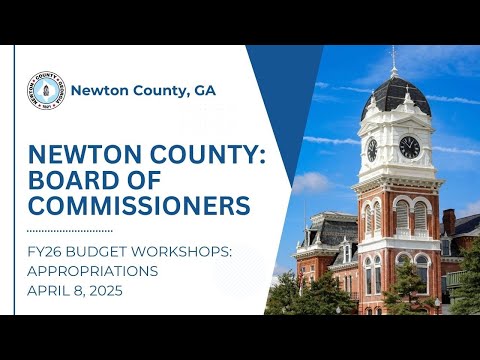
Newton County hears funding requests from libraries, health providers and youth programs during budget workshop
Summary
At a Newton County budget workshop, local nonprofits and county agencies presented FY26 appropriation requests to the Board of Commissioners, seeking level funding or increases for services including public health, social services, libraries, youth programs and economic development.
Newton County commissioners heard presentations from a range of nonprofits and county agencies during a budget workshop where organizations requested continued or increased appropriations for fiscal year 2026. Presenters described services ranging from public-health screenings and environmental health inspections to youth after-school programs, library operations, and head-start and behavioral-health services.
The presentations matter because many of the organizations are county-funded safety-net providers: the Newton County Health Department, DFACS (Division of Family and Children Services), Viewpoint Health, the library system and several community centers said county support makes their day-to-day work possible and in some cases helps secure outside matching funds or grants.
Most organizations asked the commission to hold funding steady or to restore dollars cut in earlier years. Requests highlighted rising operating costs, staff shortages and growing service demand. For example, the Newton County Library asked the commission to increase its appropriation after 16 years at essentially the same local allocation, citing rising benefit and health insurance costs that have forced staff reductions. Viewpoint Health requested restoring its appropriation to FY2017 levels to help sustain behavioral-health services, and the Willing Helpers Medical Clinic described growth in uninsured patients and the value of free primary care it provides to the county’s hospital system.
Presenters and requested amounts (selected highlights): - Alcovy CASA: requested $15,666, level with the prior two years; Alcovy CASA’s director Lindsay Dicus thanked the commission for long-term support. - Newton County DFACS (director Kenya Wooden): requested $109,619, the same as FY25; Wooden outlined caseload and staffing: 91 active TANF clients (February snapshot), about 202,560 SNAP active clients countywide (figures compared to neighboring Rockdale County were cited), and eight case managers responsible for dozens of child-welfare cases. Wooden framed county supplements as important to staff retention and local service continuity. - Newton County Health Department (COO Joseph Sternberg): requested level funding of $187,550, noting that the county appropriation primarily supports a nurse and an environmental health specialist. Sternberg emphasized the environmental-health team’s role in preventing restaurant and septic failures — “when we see this stuff, we fix it,” he said — and flagged a state bill (House Bill 665) under consideration that could move environmental health to the state level and change fee and staffing arrangements. - Economic development (presenter identified as staff member): requested $350,000 level funding; the presenter summarized economic-development metrics (population ~122,000; median household income growth and declining unemployment) and noted $5.5 million in pilot funds and roughly $11 million in other returns from Stanton Springs developments (including Rivian and Takeda-related revenue returning to the Joint Development Authority). - Highway 278 CID: requested $30,000 (to support a program manager); the CID representative described a multi-phase, largely federally and state-funded Highway 278 streetscape and roundabout plan (Phase 1 total ~ $21.4 million with local matches and CID leverage), and asked the commission to continue SPLOST support approved for earlier phases. - Newton County Library (Board Chair Zach Ames, Director Lise Keaton, Treasurer Frank Turner): requested $966,452 (a $50,000 increase over FY25). Library leaders said the system has operated at the same local appropriation for years, has cut staff from 41 to 12, and is drawing down reserves; Turner warned reserves and federal grant support have declined and said rising employer benefit costs will further pressure operations. - McIntosh Trail Head Start: requested $4,147 (level); manager Cassandra Brooks described free birth-to-five services, multiple playground needs and that the program serves a high-need population with no parental fees. - Viewpoint Health (CFO Eric Norton): requested $254,282 (an increase of $19,962 versus prior year) and asked the board to restore funding to FY2017 levels; Norton described detox-bed expansion (from 8 to 10 beds) and said the community-service board serves roughly 18,000 people across its region and about 1,900 Newton residents in a year. - Washington Street Community Center: requested $55,000 (an increase of $10,200); leaders said the center’s after‑school, summer and literacy work serves high-need children and families and detailed a 30-day reading intervention goal for regular participants. - TaylorMade Foundation and TaylorMade University (Darnell Taylor) and partners including the Newton County Sheriff's Office (Deputy Tim Smith): presented plans to expand after‑school and summer programs at Nelson Heights Community Center and requested the county consider funding and local management consistent with other county community centers; the sheriff’s office explained a proposed summer Law & Leadership Academy intended to reduce at‑risk youth involvement in crime. - Willing Helpers Medical Clinic (Executive Director Christine Boggs): requested county support; the clinic reported about 654 active patients, 4,000 prescriptions dispensed in 2024 and an estimated $3.4 million in free care to county residents last year; staff said about 48% of their patients reported no income and many lack access to primary care elsewhere.
Commissioners, presenters and staff used the workshop to compare service metrics, ask about staffing and fee schedules, and explore coordination across agencies (for example, how health‑department environmental fees are set and how library grant funding can or cannot be used for operational payroll). Several commissioners emphasized the need for measurable performance and community partnerships if centers such as Nelson Heights are reopened and county funds are invested there.
The workshop produced no formal votes; it functioned as presentations and information-gathering ahead of budget decisions to be made later in the process. County staff noted audits and additional documentation are available on request.
Looking ahead, presenters asked commissioners to consider: restoring previously reduced appropriations, preserving local environmental‑health authority (should state legislation move that program), increasing library operational funding to prevent further staff reductions, and cooperating with nonprofit and sheriff’s‑office partners to reopen and staff Nelson Heights as a year‑round community center with measurable program outcomes.
Ending: Commissioners did not take votes at the workshop and recessed after the presentations; budget decisions and appropriation determinations remain for a subsequent formal budget process.