Get Full Government Meeting Transcripts, Videos, & Alerts Forever!
Get email alerts on the Housing Affordability topic
No spam. Unsubscribe anytime.
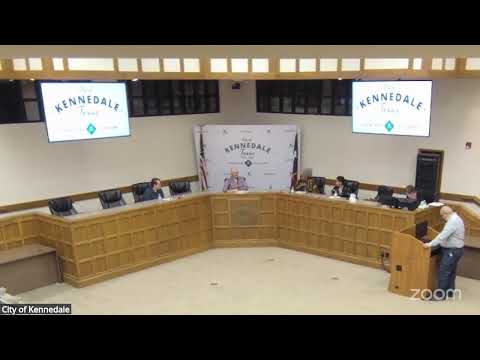
Planning commission forwards Trinity Habitat planned development for New Hope raceway site after long public hearing
Summary
The commission voted 4-0 to recommend a Planned Development for a multi‑phase Trinity Habitat for Humanity neighborhood proposed on the former Kennedale Raceway property, after a lengthy public hearing that included wide public comment on roads, emergency access, flood risk and housing affordability.
The Kennedale Planning & Zoning Commission on a 4-0 vote recommended City Council approve a Planned Development (PD) submission by Trinity Habitat for Humanity for a multi‑phase residential project on the former Kennedale Raceway / Kennedale Campers parcel along New Hope Road (PZ case 25‑03). The commission’s recommendation will proceed to City Council for final action.
Trinity Habitat representatives presented the project as a workforce homeownership subdivision with a mix of lot sizes, a public park dedication and a multipurpose hike‑and‑bike trail. Gage Yaeger, identified as CEO of Trinity Habitat, told the commission the affiliate plans homes priced at lower than the local market and said the organization provides mortgage servicing, homeowner education and deed‑restriction mechanisms to keep the homes owner‑occupied and affordable for many years.
Steve Smith, Trinity Habitat’s land development director, described the conceptual layout presented to the commission: a preliminary plan the applicants said currently shows roughly 230 lots (the applicant’s engineering team described the plan as a 230‑lot layout), a mix of 50‑foot and 60‑foot lots, and a three‑phase development approach. Smith said final lot counts and phasing depend on an in‑depth drainage/floodplain study and the eventual alignment of the planned Little School Road extension. He said the applicant expects to construct about 100 houses in the first phase, with additional phases to follow as engineering and the right‑of‑way schedule allow.
Trinity Habitat said it will dedicate parkland within the development; Smith and other representatives said a minimum 100‑foot‑wide strip is proposed for public park use and would include a trail connection that could eventually link to Sonora Park. The applicant described neighborhood design standards to require owner‑occupancy, background checks for initial buyers, a deed restriction enforcing owner occupancy for an 80‑year term with an annual resale cap (applicant described a 3% annual cap in the plan example), and an internal policy to service mortgages to reduce foreclosures. Trinity Habitat representatives said their affiliate’s foreclosure rate historically is low and that the organization also provides 20 hours of homeowner education, financial literacy and ongoing support for buyer families.
The public hearing drew extended testimony from more than a dozen neighbors and residents. Those opposed cited: New Hope Road’s narrow two‑lane carriageway and a history of crashes and heavy truck traffic; the nearby railroad crossing and a perceived risk that trains could block emergency access; lack of existing sewer and other utilities along portions of New Hope Road (staff and applicants described a city‑led sewer extension and a developer‑funded connection plan); concerns about the site’s floodplain and drainage and requests for a full hydrology/detention plan; and potential impacts to property values and insurance availability for current homeowners. Multiple speakers, including former councilmember James Connor and residents Jeff Madrid, John Roan, Ronnie Hipp, Jerry and Louann Hull, and others, asked the commission to ensure infrastructure improvements—particularly the Little School Road extension and road reconstruction on New Hope Road—are planned and funded before significant building activity begins.
Supporters and Habitat representatives spoke in favor of the project. Cassandra Lawrence, who identified herself as a Trinity Habitat homeowner, and Micah Hogue, Habitat home‑buyer success coordinator, described the affiliate’s homebuyer requirements, the program’s emphasis on homeowner stability and community engagement, and the potential to provide attainable homeownership for local workers. Gage Yaeger and Christine Panagopoulos (Trinity Habitat COO) cited Redfin median sales data and the applicant’s internal financing structure to argue the development would add opportunities for employees and teachers to live closer to Kennedale jobs.
Trinity Habitat said the plan is conceptual and that the final buildout will proceed only after full civil engineering, drainage studies, coordination on the Little School Road extension and city approvals. The applicant said it will pay for on‑site infrastructure to extend sewer service into the site and that some public road reconstruction projects already scheduled by the city are expected to precede or run concurrently with the project’s early phases.
After hearing testimony from residents, staff and the applicant, a commissioner moved to recommend approval of PZ case 25‑03; another commissioner seconded and the commission voted 4‑0 to forward the PD rezoning to City Council for final action. Commissioners and staff noted many issues—drainage, railroad access, sewer extension and phasing—will be addressed during the detailed engineering, preliminary and final plat reviews and that those subsequent steps, plus Council review, will provide further public hearings and opportunities for revision.