Get Full Government Meeting Transcripts, Videos, & Alerts Forever!
Get email alerts on the Public Health Fentanyl topic
No spam. Unsubscribe anytime.
Resident urges city, county and campus action on local fentanyl deaths and naloxone access
Summary
Dr. Heather Bliss called on Manhattan leaders to expand naloxone and fentanyl-test-strip access after several local deaths, saying community distribution by volunteers is already widespread but that county and university policies restrict lifesaving tools.
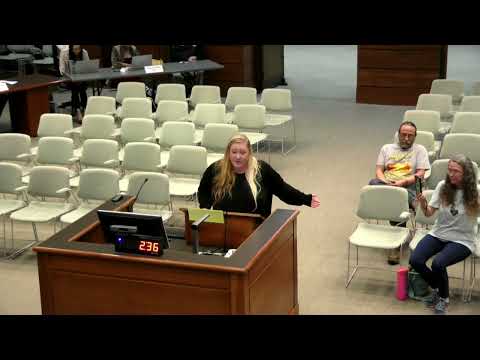
Dr. Heather Bliss, a Manhattan resident, told the City Commission on March 18 that the community is “not prepared” for a local fentanyl problem and urged the city to help expand naloxone and fentanyl test-strip access.
Bliss said fentanyl has already caused multiple deaths in Manhattan, naming three people she said died from fentanyl-laced drugs: Maxwell Donadue (18), Richard Macaulay (39) and Ivan “TJ” Holmes (18). She said between January and June 2023 there were eight fentanyl-related deaths in Manhattan and that Riley County averaged about 10 overdose emergency-department visits per month in 2022, citing Kansas Department of Health and Environment data as the most recent available to her.
Bliss told commissioners she has placed two 24/7 low-barrier naloxone and fentanyl-test-strip stations in Manhattan and stocks them weekly. “I have provided over 600 boxes [of naloxone]…and over 2,000 fentanyl test strips in Manhattan,” she said, giving a distribution period from Dec. 23, 2023, to the meeting date and saying roughly 24 naloxone boxes leave the stations each week.
She criticized local institutional policies, saying Kansas State University does not provide students with naloxone or fentanyl test strips, and contrasted that with the University of Kansas, which she said now maintains naloxone stations and offers test strips and education after a campus overdose. Bliss said the Riley County Health Department received a $200,000 grant in 2023 to provide education and naloxone but, in her view, has not used the grant to distribute supplies broadly; she said the department hired two people who gave a limited number of school presentations.
Mayor McCullough and commissioners thanked Bliss and suggested next steps. The mayor encouraged Bliss to bring the matter to the law board and offered to help place the issue on the city–county agenda so she could speak to county officials. Bliss said she has been invited to speak to the Riley County Police Department and to the Riley County Health Department but that communications stalled when those groups moved to closed-door settings.
No formal action or vote was taken during the commission meeting on Bliss’s remarks. Commissioners recommended she contact the law board and invited her to coordinate with staff to seek a fuller agenda slot at a future meeting so she can present more detailed proposals.
Bliss asked the commission to help her get in front of officials because, she said, “they will listen to you.”