Get Full Government Meeting Transcripts, Videos, & Alerts Forever!
Get email alerts on the Parking Policy topic
No spam. Unsubscribe anytime.
City staff outlines parking study recommendations: progressive pricing, expanded enforcement and pilot residential permits
Summary
The city’s parking manager presented a downtown parking study recommending progressive on‑street pricing, expanded enforcement hours, a neighborhood residential-permit pilot, and investments to address $4.3 million in garage deferred maintenance over 10 years.
City parking staff presented a multi-part review on Feb. 11 that recommends using price and technology changes to improve turnover, close a projected funding gap for garage maintenance, and pilot a residential parking-permit program in neighborhoods near downtown and the university.
Parking Manager Brad Harrell and consultant Eric Haggett (Walker Consultants) told the commission the downtown system includes roughly 2,602 spaces, that the city’s two-hour meters are $1 per hour, and that annual parking revenues and expenses have diverged as maintenance needs increased. Harrell said current reserve levels (about $1.8 million at the end of 2024) would not cover projected garage repairs without rate or policy changes; the consultants estimate approximately $4.3 million in deferred maintenance in the parking garages over the next 10 years.
Major recommendations and tradeoffs: Staff outlined a menu of options the commission can consider, including: - Progressive on‑street pricing for Massachusetts Street (a $1 initial rate for the first two hours, then an additional $1 per hour after two hours), implemented with credit-card–enabled meters to increase turnover. Harrell said the progressive model would preserve short-term access while discouraging long-stay on-street parking. - Extending enforcement hours into the evening (options were discussed; staff asked for guidance on whether to extend to 8 p.m. or 9 p.m.). Extended enforcement would require hiring additional parking-control officers. - A pilot neighborhood residential-permit (RPP) program for areas with chronic spillover; staff estimated startup costs (signage, license-plate‑recognition enforcement vehicle and installation) and suggested a phased approach. Harrell said typical RPP startup costs can be high; he cited an initial implementation estimate in the presentation of about $2,200,000 (startup) with modest ongoing permit income projected. - Targeted investments in payment technology: expand mobile app zones and consider kiosks in high-volume locations where single-space meters are not cost-effective. Harrell said app payments have become common (roughly 1,100,000 paid hours via the app reported and more than 52% of users on Massachusetts Street now pay by app).
Budget and enforcement details: Current parking rates in the materials presented: two-hour meters $1/hour; 10-hour meters $0.20/hour; meter and overtime violations $10 (staff discussed increasing violations to $15 to encourage compliance); monthly garage permits $20; reserved spaces $75/month. Harrell said kiosk installations are capital‑intensive (staff noted an earlier kiosk purchase of about $365,000 for 21 machines) and that any shift in equipment would require analysis of subscription and maintenance fees and anticipated revenue.
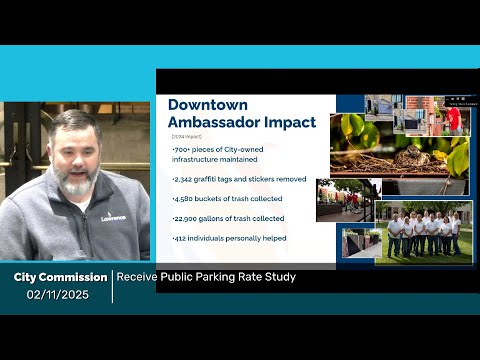
Public comment and commissioners’ reaction: Downtown Lawrence Inc. Executive Director Andrew Holt said the city should keep downtown employees’ parking affordable while improving turnover. Commissioner discussion favored exploring progressive pricing and filling the long-term maintenance funding gap; several commissioners praised the downtown ambassador program and the presentation’s data-driven approach. Some public commenters questioned residential-permit fairness and urged cash-payment options for those without cards; others encouraged staff to pilot programs rather than make wholesale changes.
Next steps: Staff requested guidance and signaled these items will be further developed for the 2026 budget process. Harrell said the parking division allocated $50,000 this year for a pilot program and indicated staff will return with more detailed cost-recovery projections and implementation timelines.
Ending: Commissioners signaled support for further study of progressive pricing, neighborhood pilots, and reserve-building measures to address garage maintenance needs; staff will return with costed options during budget planning.