Get Full Government Meeting Transcripts, Videos, & Alerts Forever!
Get email alerts on the Land Development Code topic
No spam. Unsubscribe anytime.
Lawrence commission narrows post‑adoption change to occupancy limits after hours of testimony; amendment passes 4–1
Summary
After more than two hours of public comment, the City Commission voted 4–1 to modify recently adopted land development code changes by limiting unrelated adults in R1/R2 districts to four (rather than five). Commissioners also approved broader code cleanup edits on first reading.
The Lawrence City Commission on Tuesday voted to modify occupancy limits in the city’s newly adopted land development code, reducing the maximum number of unrelated adults allowed in lower‑density residential zones. The commission approved ordinance-level code cleanup on first reading and a separate amendment narrowing occupancy increases after an extensive public-comment period.
The change was part of a broader package of post-adoption corrections and clarifications to Chapter 20 (the Land Development Code) that staff brought back for the commission’s consideration. The commission voted 5–0 to adopt the main text-amendment ordinance on first reading, then reconsidered occupancy language and voted 4–1 to approve a targeted amendment to Section 20‑204 limiting unrelated adults in R1 and R2 districts to four and keeping other districts at higher limits.
Why it matters: The land development code rewrite had initially increased the allowable number of unrelated adults in many residential zoning districts to address housing affordability and shared-living arrangements. Opponents worried a blanket increase would accelerate conversions of single‑family homes into student or investor-owned rentals and strain neighborhood services; supporters said higher limits would expand affordable options for low‑ and moderate‑income residents, cooperatives and multigenerational households. The commission’s modification is intended as a compromise while staff and the community monitor early impacts.
What the commission approved
• First-reading adoption of AMDT-25-001, a set of post-adoption edits and clarifications to Chapter 20 of the Land Development Code (ordinance No. 10120). Staff described these as primarily editorial fixes, clarified density calculations, added user-friendly tables, restored missing stormwater definitions and added a definition for permanently affordable housing. Planning staff presented the packet and track‑change draft to the commission ahead of the vote.
• A separate motion amending Section 20‑204 (occupancy standards). The commission moved to set a maximum of four unrelated adults in R1 and R2 districts while maintaining higher limits in other residential districts; that motion carried 4–1. The motion was recorded on the floor as a change to the occupancy standard and adopted on first reading as an ordinance (referenced in the minutes as ordinance No. 10121).
Public testimony and key concerns
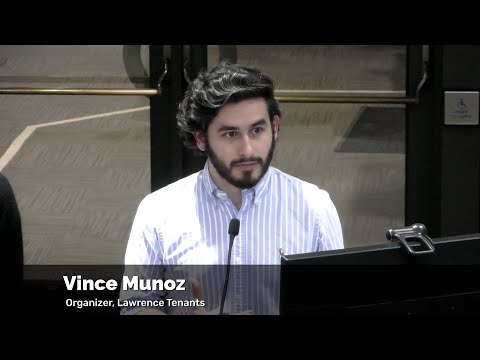
The meeting drew lengthy public comment. Supporters of the higher occupancy limits — including tenants, housing advocates, cooperative housing organizers and members of the Lawrence music and arts community — said expanding occupancy helps preserve and create affordable housing without new construction.
Joy Foster, a homeowner and landlord, told commissioners she purchased an old church to rehabilitate as shared, affordable housing and said reversing occupancy increases would make the project financially infeasible: "By repealing the approved increase in occupancy, we are only protecting couples and families that can afford 3,000, 4,000 square foot homes ... We would be protecting the elite and privileged at the expense of individuals and families that can't afford a high mortgage or rent payments." (public comment)
Other speakers described discrimination and practical barriers caused by stricter occupancy rules. Taylor Hall said earlier limits had been used to restrict housing for unmarried families, and said the policy had violated state and federal fair-housing protections in prior cases.
Opponents of the change, including neighborhood association leaders and long‑time residents, raised concerns about conversions of single‑family homes into investor‑owned rentals, increased parking demand, nuisance parties and loss of owner‑occupied housing. Maren Bradley, president of the Old West Lawrence Association, asked the commission to accept the planning commission’s recommendation (which had favored retaining lower limits) to slow what neighborhood groups call the "studentification" of historic neighborhoods.
Commission deliberations
Commissioners described a range of views in deliberations. Several members said they supported the overall code cleanup but wanted to respond to neighborhood concerns about sudden shifts in occupancy patterns; others stressed the city’s affordability challenges and the need for flexible household options.
Amendment sponsors framed the 4‑person cap in R1/R2 as a compromise between the previously adopted citywide increase and the planning commission’s motion to retain stricter limits. One commissioner noted staff planned ongoing monitoring: applications and development patterns will be tracked through October, with the possibility of further ordinance refinements after the city has seen how the code works in practice.
Formal actions
• Motion: Approve the text amendment AMDT-25-001 (Chapter 20 cleanup) and adopt ordinance No. 10120 on first reading. Mover: Commissioner Sellers; Second: Vice Mayor Finkelstein. Vote: 5–0 (motion passed).
• Motion: Amend Section 20‑204 occupancy standards to set a maximum of four unrelated adults in R1 and R2 districts and a maximum of five adults of any relationship in residential districts that permit residential uses; adopt on first reading as ordinance No. 10121. Mover: Commissioner Dickle Dye; Second: Commissioner Littlejohn. Vote: 4–1 (motion passed).
Next steps and monitoring
Staff told the commission they will track permit applications and development activity from April through October and return with an update and suggested follow-up amendments as needed. The commission also discussed the timing of any effective date for changes to avoid disrupting signed leases.
— Ending note: The commission’s action modifies the land development code’s implementation of household definitions and occupancy standards while leaving in place the broader code rewrite’s other clarifications and editorial changes adopted on first reading.