Lifetime Citizen Portal Access — AI Briefings, Alerts & Unlimited Follows
Lawrence police present Fair and Impartial Policing training to review board; sergeant stresses bias awareness and procedural justice
Loading...
Summary
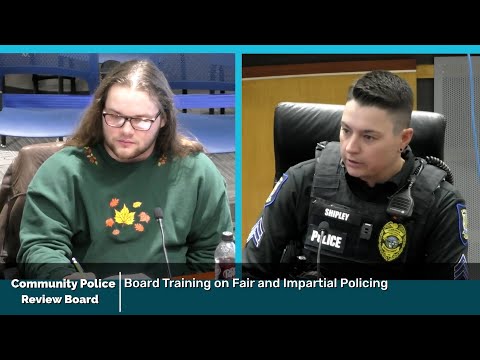
Sergeant Meghan Shipley presented an overview of the department’s Fair and Impartial Policing training to the Civilian Police Review Board, outlining implicit bias concepts, procedural justice principles, and departmental measures such as body-camera review and traffic-stop data collection.
Sergeant Meghan Shipley, who oversees Fair and Impartial Policing training for the Lawrence Police Department, gave the Civilian Police Review Board an overview of the department’s bias‑awareness program and annual training requirements. Shipley said FIP training emphasizes implicit association, attentional bias, confirmation bias and in‑group/out‑group (“we‑they”) dynamics and teaches officers skills to reduce and manage bias.
Shipley described the department’s training cadence: an eight‑hour FIP class for new sworn hires and annual refresher sessions of one to two hours, with classroom discussion and scenario exercises. “Bias is a normal human attribute. Everyone has it,” Shipley said, adding that the training focuses on recognizing and managing bias rather than assigning blame.
Board members discussed how training translates to practice. Shipley and Chief Lockhart told the board the department conducts random body‑camera reviews (generated by the body‑camera program) and collects traffic‑stop data; supervisors review video for potential misconduct and bias. The department also reviews complaint trends and uses multiple pillars—hiring, training, supervision, policy and community engagement—to reduce biased policing.
Members raised concerns about over‑policing in lower‑income neighborhoods and how enforcement strategies intersect with profiling by proxy. Adam said he worried that frequent enforcement in high‑call areas could recreate cycles of disadvantage; Shipley responded that officers should reduce ambiguity and “slow it down” to give themselves more time and distance to make measured decisions. Shipley and Lockhart told the board the state requires annual training, and the department continues to deliver its locally tailored version.