Get Full Government Meeting Transcripts, Videos, & Alerts Forever!
Get email alerts on the Budget 2026 topic
No spam. Unsubscribe anytime.
Lawrence staff outline $6.6M preliminary 2026 shortfall; commission urges fund‑balance restoration and wage maintenance
Summary
City staff presented a preliminary 2026 budget showing a roughly $6.6 million deficit and a list of department reduction targets. Commissioners signaled support for restoring fund balance and keeping market compensation; staff will return with refined revenue and program proposals ahead of the July budget.
Lawrence — City staff told the Commission April 1 that preliminary figures for the 2026 budget show a $6.6 million deficit and recommended a combination of spending reductions, fee increases and one‑time measures to close the gap.
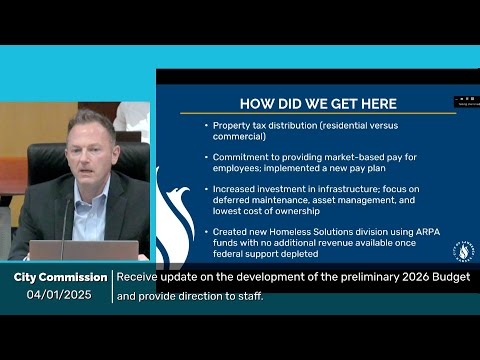
Budget staff and department directors presented background and suggested targets. City Manager Craig said the city faces four principal structural pressures: a growing residential share of property valuation relative to commercial property; an $11 million permanent increase in payroll costs created by a prior market pay plan; increased infrastructure and regulatory costs for utilities and stormwater systems; and ongoing investments to address homelessness that were initially funded with one‑time ARPA dollars.
Budget Manager Ally told commissioners the city’s preliminary 2026 revenue projection is about $116.47 million with updated assessed‑valuation growth at 5 percent (the staff projection had been 6.25 percent earlier). With updated expenditure assumptions the preliminary shortfall stood at approximately $6.6 million. Ally said the city used a public engagement tool called Balancing Act to collect 637 public submissions and developed four priority tiers to translate qualitative community priorities into target reduction percentages (tier 2 ~6 percent, tier 3 ~13 percent, tier 4 ~20 percent) to inform department proposals.
Staff presented department‑level target ranges rather than final plans. Highlights included: MSO (Municipal Services & Operations) potential reductions and revenue moves targeting roughly $730,000–$1.1 million; Fire/EMS preferred option with additional EMS capacity and an estimated $1.5–$1.9 million net cost shift that would require increased county revenue participation; an alternative for Fire that would eliminate an engine and remove up to nine sworn FTEs if county revenue were not forthcoming; Police targets around $1.2–$1.3 million achieved largely by eliminating six sworn positions and two civilian support positions (staff noted many of the positions listed are currently vacant); Parks, Recreation & Culture net target about $1.7 million including access fees projected at $500,000–$700,000 and elimination or reduction of seasonal positions equivalent to roughly 4 FTEs; and Homeless Solutions general‑fund exposure around $2.7 million with a proposed 10 percent contract reduction for a partner (about $350,000) and a possible reduction of one contracted FTE.
Ally and department directors emphasized these are preliminary proposals and that staff intends to pursue revenue enhancements where feasible (charging staff time to bond projects, shifting transfers between funds, user‑fee adjustments) and to return with refined numbers. She also described early retirement incentives and vacancy‑management strategies intended to create vacancies in targeted areas rather than conducting across‑the‑board layoffs.
Multiple public speakers urged the commission to protect public safety and homeless services. Seamus Alberton, president of the Lawrence Professional Firefighters, said the fire department had already cut nearly $2 million from its operating budget in prior cycles and asked the commission to “fund our core services,” adding, “You can change hours to facilities, fees like that. But what you can't change ... is the number of heart attacks that are going to happen in the city of Lawrence.” John Inman, vice chair of the Lawrence Police Officers Association, urged caution about cutting sworn positions and noted the department regularly operates below full authorized staffing. Howard Callahan, an outreach case manager with Bert Nash, warned that cutting homeless‑services staff would have “a downstream effect” and urged retention of the city’s case management capacity.
Commissioner feedback at the meeting showed a mix of priorities but a general desire to protect market compensation for employees and to rebuild the general fund. Several commissioners said they supported a $2 million target to restore fund balance as a step toward stabilizing reserves; others asked staff to return with more definitive year‑end 2024 actuals, updated sales‑tax receipts (new sales tax revenues are expected to begin arriving), and refined estimates on fee revenue potential for parks and rec. Commissioners asked for clearer metrics for code‑compliance and rental‑inspection workloads before cutting code‑compliance staff, and asked staff to continue talks with Douglas County about EMS funding and the county’s share of costs if the preferred Fire/EMS option is adopted.
Staff listed next steps: continue community and employee engagement, refine departmental proposals and fee estimates, return in June with a proposed CIP, and present the city manager’s recommended budget July 8.
No final budget votes occurred at the April 1 meeting; commissioners provided policy direction and asked staff to return with more detailed, quantified proposals.