Get Full Government Meeting Transcripts, Videos, & Alerts Forever!
Get email alerts on the Affordable Housing topic
No spam. Unsubscribe anytime.
Planning commission approves Ninth Street Missionary Baptist ‘HOPE’ affordable housing project and related map changes
Summary
The Lawrence/Douglas County Planning Commission on March 26 recommended approval of a package of land‑use actions to allow Ninth Street Missionary Baptist Church and Family Promise to create 10 permanently affordable housing units at 909–913 Tennessee Street.
The Lawrence/Douglas County Joint Metropolitan Planning Commission on March 26 recommended approval of a set of planning applications that will allow Ninth Street Missionary Baptist Church and partner Family Promise to redevelop 909 and 913 Tennessee Street to provide 10 permanently affordable housing units.
Staff planner Avery Kerner told commissioners the package before the commission included a comprehensive plan amendment, a rezoning to RM‑32 with a planned development overlay (which will convert to R‑4 when the new code takes effect April 1), a preliminary development plan and a variance request from subdivision design standards for an alley right‑of‑way. Kerner said the proposal would retain the existing four‑unit building at 913 Tennessee Street and construct a new six‑unit building at 909 Tennessee Street for a total of 10 units to be used by Family Promise as supportive housing (Kerner: s=814.23004–s=914.355).
Why it matters: the package would create permanently affordable family housing near the West Ninth Street corridor and KU stadium and was supported by staff as advancing Plan 2040 goals for infill and affordable housing while conflicting with the Oread neighborhood plan’s current future land‑use map (which recommends neighborhood commercial center for the parcels). Kerner said staff recommended approval of the comprehensive plan amendment and forwarding all applications to the City Commission and Douglas County Commissioners (Kerner: s=1140.955–s=1463.26).
Key project details and conditions - Units: 6 new units at 909 Tennessee plus 4 existing units at 913 Tennessee for a total of 10 permanently affordable units. (Kerner: s=1595.51–s=2067.075) - Density: staff calculated net density of about 24.6 units per acre for the planned development. (Kerner: s=1992.88–s=2067.075) - Parking: applicant requested modification to reduce required off‑street parking from 23 spaces to 10 spaces; staff supported the reduction given the site context and the units’ use by Family Promise. (Kerner: s=2121.3599–s=2188.05) - Planned development area: applicant requested reduction of the minimum planned‑development district size from 0.5 acres to 0.26 acres; staff supported that modification because of the public benefit of permanently affordable housing. (Kerner: s=2121.3599–s=2188.05) - Landscaping/buffer: the applicant requested alternative compliance for buffer yards along the north property line; staff recommended the commission make any final approval conditional on the applicant working with staff to reach an acceptable alternative compliance plan (Kerner cautioned the alternative would likely provide planting elsewhere on site rather than a full Type 2 buffer because of site constraints). (Kerner: s=2191.585–s=2350.2998) - Historic review: the Historic Resources Commission approved the project subject to conditions about exterior stone cladding and the front porch size; the Historic Resources administrator must approve revised elevations. (Kerner: s=1022.055–s=1098.1699; s=2650.53–s=2705.935) - Alley variance: the applicant requested maintaining the existing 16‑foot alley right‑of‑way rather than dedicating the extra two feet required by current standards (minimum 20 feet). Staff found the variance met approval criteria and recommended approval. (Kerner: s=2706.83–s=2755.4548)
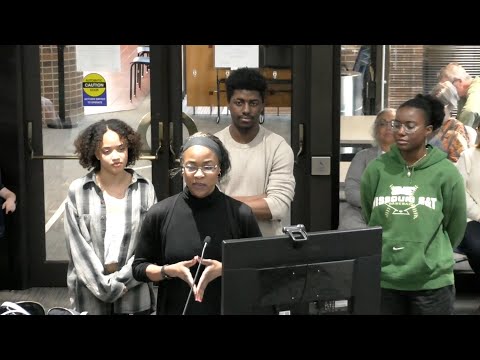
Public comment and community partners Representatives of Family Promise and Ninth Street Missionary Baptist described the project as supportive housing for families with children and urged approval. Christina Gentry, chair of the Affordable Housing Advisory Board, noted the board recommended a $300,000 Affordable Housing Trust grant toward the project after originally requesting $850,000; she said the project aligns with the community’s strategy to address family homelessness (Gentry: s=2919.39–s=3258.735). Meg Pearson, Family Promise director of operations, said Family Promise served 980 individuals in Douglas County last year and that more affordable units would expand options for families seeking stable housing (Pearson: s=3435.91–s=3542.56). Leah Roseland, the city’s affordable housing administrator, told commissioners the city previously supported the project with a $300,000 Affordable Housing Trust Fund award and urged approval (Roseland: s=3564.455–s=3736.325).
Commission action The Planning Commission voted on each element in turn. Motions and votes recorded in the meeting transcript show: the comprehensive plan amendment was moved and approved and the Commission adopted the planning commission resolution (unanimous); the rezoning to RM‑32/PD (to convert to R‑4/PD on April 1 under the new code) was recommended for approval subject to adoption of the preliminary development plan (the motion was amended on the record and approved); the preliminary development plan, and the two requested modifications (reduce minimum PD area; reduce required parking) were all recommended for approval; and the alley variance to allow a 16‑foot right‑of‑way was recommended for approval. The transcript records the votes as unanimous on these items (see actions array). (See transcript motions and recorded votes: s=4181.75–s=4215.4697; s=4252.725–s=4334.555; s=4438.08–s=4504.75; s=4522.3203–s=4545.985.)
What remains: a final development plan (administratively reviewed) and any alternative compliance landscaping plan must be approved by staff; final design revisions must satisfy the Historic Resources administrator’s direction. The Planning Commission forwarded its recommendations to the Lawrence City Commission and Douglas County Board of County Commissioners; those bodies have final approval authority on the comprehensive plan amendment, rezoning and planned‑development overlay.
Ending: The applicants and staff thanked commissioners and public commenters after the votes; commissioners repeatedly emphasized support for affordable housing and the Family Promise program.