Get Full Government Meeting Transcripts, Videos, & Alerts Forever!
Get email alerts on the Federal Budget topic
No spam. Unsubscribe anytime.
Lake County officials warn federal staffing cuts, budget moves could disrupt local safety-net services
Summary
County social services staff told the Board of Supervisors that proposed federal budget changes, HHS staffing reductions and other enacted federal actions are already affecting program administration and could delay or reduce benefits for Medi-Cal, CalFresh, IHSS, housing vouchers and other services in Lake County.
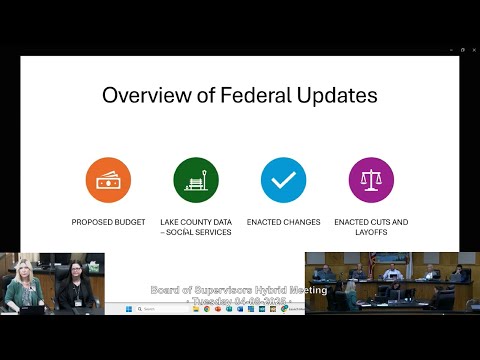
Rachel Dillman Parsons, Lake County social services director, told the Board of Supervisors on April 24 that recent federal actions and proposed budget language could slow funding streams and disrupt locally administered programs that serve seniors, veterans, people with disabilities, children and families.
Dillman Parsons said the House and Senate budget negotiations have proposed cuts to Medicaid (Medi-Cal in California), Medicare, the Affordable Care Act, SNAP (CalFresh locally) and other programs, and that the federal government has been operating on a continuing resolution that preserves 2024 funding levels through September. She said the Senate passed an amended budget April 5 and that reconciliation could produce a final budget by May.
Why it matters: Dillman Parsons and county staff described a chain of operational effects: staffing cuts at federal agencies can delay reimbursements and approvals the county and its community partners rely on, while enacted changes (for example to Social Security identity proofing and recoupment policies) can increase demand for local services even as federal administrative capacity is reduced.
County data cited by Dillman Parsons shows large local reliance on federal programs: about 50% of Lake County residents are on Medi-Cal, 25% receive CalFresh (bringing roughly $3,000,000 into the local economy monthly, she said), 892 families receive CalWORKs (about $900,000 monthly), and 2,716 people receive IHSS, for which the county pays roughly $6,000,000 a month to providers. The county's HUD Section 8 voucher program serves about 89 families and issues roughly $145,000 monthly, and the area agency on aging coordinates about 70,895 meals in partnership with senior centers.
Dillman Parsons said the Department of Health and Human Services has lost 25–38% of staffing in some divisions, a change she described as likely to cause funding delays and program disruptions because fewer federal staff are available to process grants, issue waivers and provide technical assistance. She added that the Administration for Community Living (ACL) has been “entirely eliminated” at the federal level and that no implementation plan has been released for absorbing ACL functions into HHS, raising specific concerns for older adults and people with disabilities.
County fiscal staff added that even if federal funding formulas are unchanged, a cut in federal reimbursements or delays would force the county to use realignment funds to backfill programs. Realignment revenues are tied to state tax collections and vehicle license fees, and could decline in an economic downturn, making county backfill capacity uncertain.
The presentation also reviewed other federal-level developments the county is watching: proposed reductions to some HUD voucher programs and administrative reimbursement rates, temporary pauses in certain federal enforcement actions (for example a court order pausing a proposed elimination of the Consumer Financial Protection Bureau), and revocations or pauses in specific grants, including the Library Services and Technology Act. County staff said some HUD regional-office consolidations are proposed and that changes to FEMA, NOAA and U.S. Forest Service staffing could affect disaster preparedness and response.
Board members and community partners asked for concrete contingency planning. Supervisors urged county staff to prepare prioritized "plan B" options for how the county would allocate reduced funds if federal reimbursements are cut or delayed. Dillman Parsons said local counties, County Welfare Directors Association and state departments (CDSS, CDPH, California Department of Aging) are analyzing impacts and that she is coordinating with those groups to refine contingency options.
Ending: Dillman Parsons said she will provide the board with her presentation materials and notes and that county staff and partner organizations will continue to monitor developments closely and report back as more federal guidance or decisions arrive.