Get Full Government Meeting Transcripts, Videos, & Alerts Forever!
Get email alerts on the Zoning topic
No spam. Unsubscribe anytime.
Tyler commission denies zoning change to legalize multiunit use at West Eighth Street property
Summary
The Planning and Zoning Commission denied Z‑25‑005, preventing a rezoning that would have brought a converted duplex and accessory unit into legal conformance as R‑2; staff found the request inconsistent with approval criteria and neighbors opposed the spot rezoning.
The City of Tyler Planning and Zoning Commission voted to deny zoning change Z‑25‑005, a request to rezone a West Eighth Street property from R‑1B (single‑family) to R‑2 (two‑family). The denial was unanimous by a recorded vote reported as six in favor of denial and none opposed.
Staff recommended denial, finding the proposal inconsistent with approval criteria and incompatible with the established single‑family character of the block. Staff reported that 22 notices were mailed, three were returned in opposition and none in favor; the resulting protest calculation was 9.97 percent. The staff report cited concerns about property maintenance and neighborhood character.
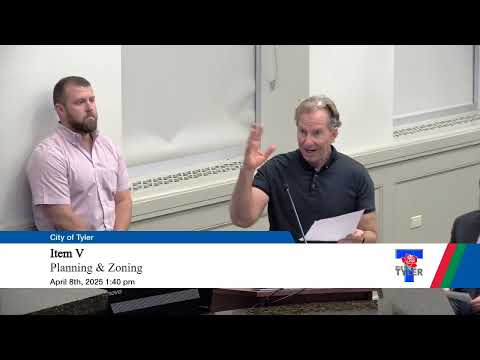
Ronnie Godfrey of Bold Real Estate Group spoke for the applicant and the property owner, identifying the owner as Mr. Monroe. Godfrey said the house had been used as multifamily housing for many years and that denying the rezoning could cause “financial harm to Mr. Monroe” and force displacement of current occupants. Godfrey said the property had been occupied as multiple households when his client bought it in 2023 and that a contract to sell to an FHA buyer was terminated after the zoning issue was discovered.
Staff and commissioners discussed legal nonconforming status, rebuilding limits and the practical effects of denial. City staff said the property appears to have been converted from a single‑family house (built in 1948) and that demonstrating the conversion was legal at the time would be difficult; staff noted that denial would leave the structure nonconforming and without the protections of a conforming zoning designation, and that code enforcement could be pursued if appropriate.
Commissioners asked whether approval would fully resolve nonconforming elements; staff said R‑2 zoning would allow up to two dwelling units but might not legalize all existing conversions (staff noted an accessory dwelling plus a duplex could create up to three households). After discussion the commission moved, seconded and voted to deny the request; the chair announced the denial was approved by a vote of 6–0.
The record shows the property was constructed in 1948 and currently contains a duplex plus an accessory dwelling unit housing three households, according to the applicant’s representative. Staff noted no active code enforcement cases were known to staff at the time of the hearing.