Get Full Government Meeting Transcripts, Videos, & Alerts Forever!
Get email alerts on the Opioid Abatement Funding topic
No spam. Unsubscribe anytime.
Framingham finance subcommittee backs $107,600 in opioid-abatement appropriations
Summary
The finance subcommittee recommended favorable action April 8 on $57,600 for FY25 opioid task force programming and $50,000 in matching funds for a regional transportation pilot, voting 5-0 to send both items to the full City Council.
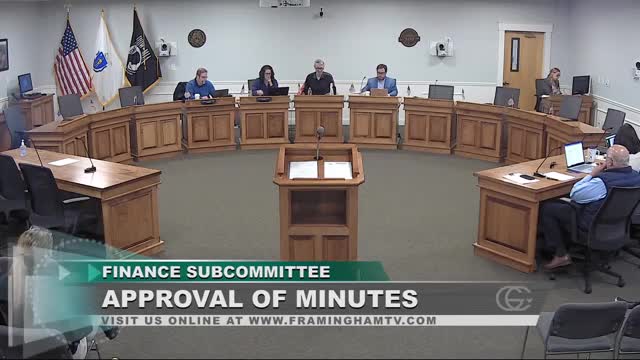
Framingham City Council Finance Subcommittee voted April 8 to recommend that the full council approve two appropriations from the city's opioid-related funds: $57,600 to finish Fiscal Year 2025 opioid task force programming and $50,000 in matching funds for a multi-community transportation pilot. The subcommittee's roll-call vote on both items was 5-0 in favor.
The $57,600 request covers the remainder of the grants manager position and near-term programming costs, grants manager Megan Todd told the subcommittee. "We are requesting, I believe it's $57,600 for budget for the rest of this fiscal year," Todd said, describing salary, office supplies and end-of-year programming. Prevention and outreach specialist Renee Vogel, who manages the opioid abatement funds, said part of the allocation would support supplies and a regional destigmatization event described in committee materials as the "You Can Save a Life" campaign.
The subcommittee heard a line-item breakdown: $1,000 for office supplies, $7,500 for a regional training/seminar tied to the destigmatization campaign, and other items to support an adult resource fair and outreach. Vogel told members the outreach will include hygiene kits distributed at events; she said the project is consistent with the terms of the city's opioid-abatement funding.
Councilors raised questions about oversight and frequency of appearing before the subcommittee. One councilor said he supported approving annual budgets for programs but asked whether opioid funds could be placed in a revolving or standing account to avoid piecemeal requests; another said bringing an annual FY26 budget would address that concern. The subcommittee's motion to recommend favorable action on the $57,600 request was made by a member who identified themselves as moving approval; the motion carried on a roll-call vote: Cannon, yes; Malek, yes; Steiner, yes; Alexander, yes; (chair) yes.
Separately, the subcommittee recommended approval of $50,000 in matching funds for a transportation pilot coordinated by JRI (Justice Resource Institute) in partnership with MOSAIC and the RISE Foundation. Megan Todd described the award and partners: "This is a request for an appropriation of $50,000. These are matching funds for a grant. We pursued this MOSAIC and RISE Foundation grant with partnerships with Natick, Hudson, and Program RISE at JRI." Todd said Framingham's pledge is $50,000, Natick's pledge is $25,000 and Hudson's pledge is $15,000; state funds will match the regional contribution.
Todd and Vogel told the committee the state/private grant will be administered through a contract between JRI and MOSAIC; MOSAIC is funded by the state portion of opioid settlement funds, and RISE is a privately funded foundation. JRI will run the pilot and collect program data, the presenters said. "They'll be collecting data based on where a ride is requested from, where it goes to, what service," one presenter said, explaining that rides will be attributed to communities by either origin/destination or rider residence so settlement funds align with municipal beneficiaries.
Subcommittee members asked how success will be measured and requested regular reporting; presenters said data reporting is a grant requirement and offered to return with program results. The motion to recommend favorable action on the $50,000 match carried on a 5-0 roll-call vote: Cannon, yes; Malek, yes; Steiner, yes; Alexander, yes; (chair) yes.
Both recommendations will be forwarded to the full City Council for final action. Staff told the subcommittee they will return with the FY26 opioid-abatement budget and with program data from the transportation pilot as it becomes available.