Get Full Government Meeting Transcripts, Videos, & Alerts Forever!
Get email alerts on the Parking topic
No spam. Unsubscribe anytime.
Planning commission leans toward eliminating citywide parking minimums under CFEC rules
Summary
Staff explained options under the state's Climate Friendly and Equitable Communities (CFEC) parking rules, including three compliance paths. Commissioners signaled a preference for Option 1 (no parking minimums citywide), while asking for more detail on tree‑canopy, solar and design requirements for larger lots.
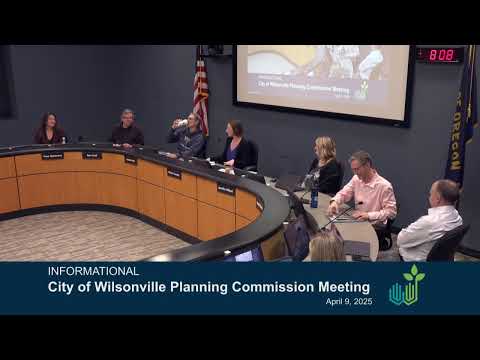
Wilsonville planning staff returned to the Planning Commission on April 9, 2025, for a third work session on parking changes required by the state's Climate Friendly and Equitable Communities (CFEC) program. Staff reviewed draft development code amendments and three compliance options for the parking B phase of CFEC; commissioners responded that their prevailing preference was Option 1 — eliminating parking minimums citywide for the areas covered by the rule — while requesting additional analysis and visual examples of lot‑level design impacts.
Daniel Polley, planning manager for the city, described the three compliance paths under Parking B that staff reviewed: (1) remove parking minimums citywide (Option 1); (2) retain minimums in some areas but add a menu of programs (Option 2) — such as unbundled parking, a mandatory flexible commute benefit for large employers, limits on multifamily parking ratios and a commercial parking tax — and choose at least two menu items; or (3) map‑based approaches that exempt certain areas from minimums and keep them elsewhere (Option 3). Staff recommended Option 1 for Wilsonville and presented draft code edits consistent with that approach.
Commissioners agreed that Option 1 has the lowest implementation cost and is unlikely to change the amount of parking supplied in the city over the next two decades, given the limited areas where CFEC would apply. Several commissioners, however, asked for more detail on the CFEC design requirements that apply to larger parking areas, and on how staff would implement and enforce the menu‑style programs under Option 2 if the city chose that path.
Key technical points discussed
- Scope and timing: Parking A (already in place) includes the transit proximity rule and EV‑ready requirements. Parking B adds further options for reducing minimums and addressing climate mitigation on larger lots. Staff stressed that the code changes discussed are a work session draft and that public hearings will follow.
- Menu programs and enforcement costs: The Option 2 menu includes unbundled parking (separating the cost of parking from residential or commercial leases), a flexible commute benefit that would be mandatory for employers above a threshold (staff discussed an employer size of 50 or more employees), a cap on multifamily parking (for example, 0.5 spaces per unit), and a potential tax on commercial parking. Staff warned that unbundling and a mandatory employer commute benefit would create significant new administrative and enforcement needs; enforcing lease‑level changes could require a new full‑time equivalent (FTE) or an equivalent monitoring program.
- Climate mitigation and lot design: CFEC requires climate mitigation measures on parking lots over a threshold (staff cited a half‑acre as the practical size trigger, and noted some cities apply the enhanced standards at larger thresholds). The rule offers three mitigation options: increased tree canopy (staff cited a 40% canopy target at maturity for the “full enhanced” standard), solar canopy generation sized to the lot, or a fee in lieu (staff cited a $1,500 per space minimum for a fee in lieu). In addition the rule requires a 30% tree canopy over new parking areas, which applies independently. Commissioners raised practical questions: how the canopy percentage is calculated (trees along aisles vs. interior canopy), how solar arrays would coexist with canopy targets, and whether fees in lieu would return to the city or be remitted to a regional/state fund.
Commissioner discussion and guidance
Several commissioners said Option 1 best balances cost and effect for Wilsonville given the limited geographic scope in the city where CFEC applies. Commissioner Andrew Carr said Option 1 “has the lowest implementation cost” and would not likely result in significant changes to parking on the ground. Commissioner Rob Heuerlein and others urged caution about Option 2 because its enforcement needs would be substantial relative to the likely changes in built parking supply.
Some commissioners asked staff to return with concrete visual examples (satellite imagery or parcel‑level diagrams) showing how 30% or 40% tree canopy and the other enhanced standards would affect typical Wilsonville parking lots (half‑acre to two‑acre examples). Commissioners also asked staff to clarify whether solar arrays used to meet the climate mitigation option must be located over the parking area or could be placed elsewhere on the property, and how the city would treat situations where large rooftop or off‑site solar could be proposed instead of on‑lot canopy.
Staff said the draft code removes citywide parking minimums in the primary development code table, edits Village‑zone minimums, updates bicycle parking requirements and carries forward Parking A EV‑ready requirements into the code. Staff also flagged that some portions of the CFEC requirements address right‑of‑way items that will be handled in separate transportation planning updates.
Public comment
One resident who attended both the open house and the commission meeting praised the open house format and urged clear public messaging about what removing parking minimums does and does not do. The speaker said market forces, lenders and underwriting will still affect developers’ choices about how much parking to build.
Next steps
Commissioners asked staff to refine the materials and return with: parcel‑level visuals showing the tree canopy and solar options on representative parking lots, a clearer comparison of the middle “enhanced” standards versus the large‑lot thresholds, and an implementation assessment that quantifies staffing or administrative needs (FTE estimates) for enforcing menu items such as unbundled parking or a mandatory employer commute benefit. Staff will carry the Planning Commission’s preference for Option 1 forward when briefing City Council, while providing the additional analysis requested.