Get Full Government Meeting Transcripts, Videos, & Alerts Forever!
Get email alerts on the Housing topic
No spam. Unsubscribe anytime.
Wilsonville planners review draft 'Housing Our Future' strategy, set hearings next month
Summary
City staff presented a draft housing needs and capacity analysis and a housing production strategy that identifies seven near-term actions and a six-year implementation window. Commissioners pressed staff on forecasts, Town Center delivery, and staffing and funding for implementation.
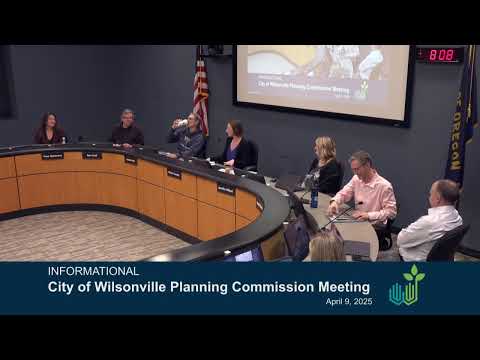
Wilsonville planning staff presented a draft housing needs and capacity analysis (HNCA) and a draft Housing Production Strategy (HPS) at a work session of the Planning Commission on April 9, 2025, asking commissioners for feedback before public hearings next month.
The presentation laid out the technical HNCA, which staff said shows Wilsonville has sufficient buildable residential land to meet expected growth, and a housing production strategy that focuses on unmet needs — especially for households at or below 120% of area median family income (about $140,000 for a family of four) — and a set of seven actions the city believes it can implement over the next six years.
The HNCA and the HPS together form a framework for changes to zoning, development review and future programs intended to increase housing production and affordability in Wilsonville. Staff noted the HPS is not being adopted into the comprehensive plan; the HNCA will be adopted as a subelement of the comprehensive plan. Both documents will go to City Council after the public hearings, with the HNCA adopted by ordinance and the HPS considered as a standalone strategy by resolution.
Kim, senior planner for the city of Wilsonville, told the commission the project team and city leadership had narrowed the package to “a set of actions, that 7 actions that we believe are feasible to implement during the next 6 years.” Consultant Beth Goodman said the HNCA answers the question “Does Wilsonville have sufficient buildable residential land to accommodate expected growth,” and added, “And the answer is yes.”
What the draft proposes
Staff described a mix of planning and non‑regulatory actions intended to address different facets of housing need. Planning and code actions include rezoning or map changes to convert underused sites (including nonperforming industrial land) to residential use where appropriate; incentives and standards to increase housing variety and accessibility (drawn in part from the Frog Pond East and South examples); and an administrative review pathway for residential projects that meet clear-and-objective standards to shorten entitlement time. The HPS also recommends targeted measures to preserve income‑restricted units that were developed with expiring Low-Income Housing Tax Credits, and a set of “foundations for future actions,” notably creation of a housing specialist position and establishment of a dedicated funding source to support housing programs.
The HPS lists examples of future housing program actions that could be implemented if staffing and funding allow: a rental housing inspection program, partnership options such as a community land trust, homebuyer assistance, and land disposition for publicly owned parcels.
Forecasts, monitoring and flexibility
Commissioners pressed staff on the forecast and on how the city will track progress. Commissioner Rob Heuerlein asked whether a local historical growth rate would change the numbers; staff replied that state rules require cities to use the official regional forecast (Metro) for this HPS cycle. Staff emphasized the HPS contains a three‑year midpoint check to allow swapping actions in or out if circumstances — funding availability, staffing, or state law — change.
Commissioner Jennifer Willard raised a specific concern about timing: “My concern is that is that overly ambitious? Is town center actually gonna provide the multifamily housing that we need in the next 20 years? And if it doesn't, if it's not on pace to do that, what is our backup plan?” Staff and other commissioners noted that redevelopment timing can be uncertain, which is why the HPS includes actions (such as rezoning or code changes) that could provide additional options outside Town Center, and why monitoring and midpoint checks are important.
Staffing and funding questions
Commissioner Andrew Carr asked whether planning‑work‑program actions would be completed with existing staff or would require hiring the proposed housing specialist. Staff said many planning actions could proceed with current staff and outside technical assistance, but specialized programs — for example, a rental inspection program — would likely need dedicated staff expertise. Staff and commissioners discussed funding sources; the draft lists options including a construction excise tax (CET) among other potential revenues. Staff cautioned that if other funding options are not pursued, the general fund would be the default source for city expenditures.
Process and next steps
Staff reiterated the work session is an informational, pre‑hearing discussion and not a decision meeting. A public hearing package will come to the Planning Commission next month; the HNCA will be adopted as a comprehensive‑plan subelement by ordinance and the Housing Production Strategy will be considered by resolution. The HPS implementation period in this draft is six years, with a year‑by‑year monitoring and an evaluation checkpoint at year three.
No formal vote was taken at the work session. Commissioners generally endorsed the direction of the drafts while asking for clarification and edits on implementation details, staffing, monitoring language and the relationship between Town Center build‑out and near‑term multifamily supply.
The Planning Commission asked staff to bring the revised, hearings‑ready package back next month and to include additional clarity on implementation timelines, staffing implications and funding options.
Where to find documents
The HNCA and draft Housing Production Strategy are available in the meeting packet and on the city website; hearings are scheduled next month before the Planning Commission and then will proceed to City Council for final action.