Get Full Government Meeting Transcripts, Videos, & Alerts Forever!
Get email alerts on the Capital Requests Public Safety topic
No spam. Unsubscribe anytime.
Police and fire lay out capital requests: Axon contracts, interview-room upgrade, AEDs and a ladder truck replacement
Summary
Police sought funding to continue Axon body-worn-camera services and to replace interview-room recording equipment; police also requested AED replacements and station lobby upgrades. Fire requested a new south-side ladder truck due to age and long manufacturer lead times and a pickup to replace an inefficient vehicle.
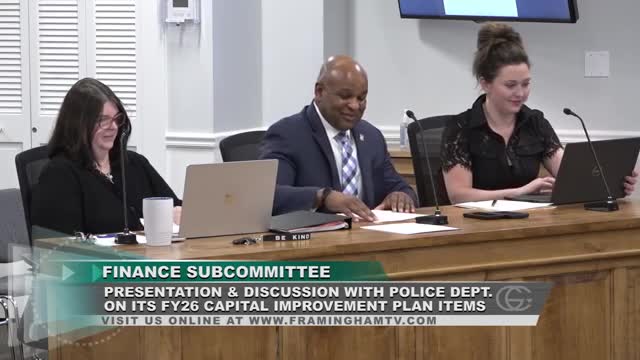
The Framingham Police and Fire departments presented capital requests to the Finance Subcommittee on March 25, asking for multi-year contract funding for evidence management and body-worn cameras, replacement of life-saving AEDs, lobby security upgrades and replacement of a front-line ladder truck that has reached the end of its recommended service life.
Police representatives requested funding to support year three of a five-year software and storage contract with Axon for the body-worn camera program, and separate funding to upgrade interview-room evidence-management equipment to Axonproducts that integrate directly with the department's digital-evidence platform. The police presentation said the interview-room package would cost $103,929 over five years, or about $20,786 per year, with the vendor providing installation and a five-year warranty.
The police chief told the committee the body-worn camera pilot has progressed and the department expects a full roll-out by this summer. The chief described technical issues such as automatic call tagging and multi-vendor integration challenges, and said the department chose Axon as a sole-source vendor for the interview-room upgrade because it ensures integrated evidence upload to a single repository.
Police also requested funds to replace expiring AEDs across the fleet, noting many devices are expired or nearing expiration and are essential "to save lives" as first-responder equipment. The department additionally requested lobby upgrades to address security and Criminal Justice Information Services (CJIS) compliance issues in the public entrance area.
Fire Department officials requested capital for a new south-side ladder truck, noting the current ladder (a 2012 model) has been frontline for 13 years and that NFPA guidance recommends removing apparatus from frontline service at 15 years. Fire leadership said the truck has required about $53,000 in repairs in recent years and that continued service would likely increase maintenance costs and testing requirements. The department reported current manufacturer lead times of 36 to 44 months (with some industry estimates higher), a significant increase from pre-COVID lead times of 8 to 10 months.
Fire also requested replacement of an aging fleet pickup (a 2008 Crown Victoria was cited as one older vehicle in rotation) with a newer pickup that can tow equipment trailers and allow transport of contaminated protective gear in the truck bed to reduce cross contamination. Department officials said parts and repair costs for the oldest vehicles are now exceeding vehicle value.
No formal capital appropriations were voted by the subcommittee on March 25. Committee members asked clarifying questions about sole-source procurement, equipment life cycles, lead times, and how many vehicles would be cycled. Administration and department staff said some items appear in the mayor's proposed budget or departmental capital plans and would return in capital budget hearings.