
Sterling Heights police outline cadet program, DOJ-funded CARE team, drone-first-responder trial and jail renovation in budget presentations
Get AI-powered insights, summaries, and transcripts
Sign Up Free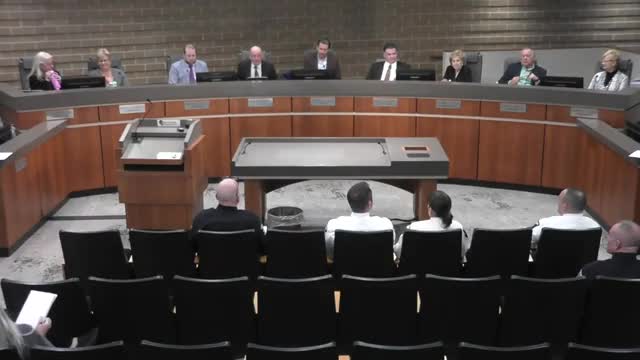
Summary
Sterling Heights police outlined plans for a cadet pipeline, a DOJ‑funded co‑response CARE team, a drone-first‑responder subscription and a jail‑space renovation as part of FY26 budget presentations.
Sterling Heights police leaders presented several new public-safety initiatives during the city’s budget workshop, including a plan to revive a cadet/cadet‑to‑academy pipeline, a federally funded co‑response CARE team to respond to behavioral‑health calls, a proposed drone-first‑responder (DFR) service, and a renovation of unused jail space for staff and training needs.
Why it matters: the proposals are intended to address recruitment and staffing challenges, add behavioral‑health response capacity, and speed situational awareness for first responders. Several ideas are funded in part by outside sources: the CARE team is supported by a $250,000 U.S. Department of Justice grant, and the proposed drone program would run under a multi-year service contract.
What police proposed - Cadet and academy sponsorship: Interim Chief Ken Pappas described reviving a cadet/cadet-to‑academy sponsorship program to build a local recruitment pipeline. The department would hire paid cadets to perform non‑sworn duties (front desk, non‑criminal reports, special events support), give them additional points on hiring exams and potentially sponsor academy attendance. Pappas said an available MCOLES grant could recover academy costs and part of cadet wages while in training. - CARE (co‑response) team and DOJ grant: Lieutenant Jason Bizdorf explained the department’s award of a $250,000 DOJ grant (the department is one of four nationwide selected) to create a CARE team that pairs two uniform officers with an embedded case manager who will co‑respond to mental‑health calls. "We were one of only 4 law enforcement agencies that were selected nationwide and awarded this grant," Bizdorf said. The grant will pay wages, transportation support for clients, equipment and supplies and fund a data collection plan to evaluate the team’s impact during the grant year. - Drone first responder (DFR) program: Captain Mario Bastinelli presented a vendor model in which specialized drones, stationed across the city, self‑dispatch to 9‑1‑1 calls and provide near‑instant overhead views, thermal imaging and other situational awareness. Bastinelli reported vendor claims such as average drone time‑to‑scene near 70 seconds and that some agencies clear one in four 9‑1‑1 calls using drone capability. The proposed DFR contract cited in the presentation was about $155,000 per year on a five‑year contract and would include multiple drones, maintenance and upgrades; the department intends to evaluate multiple vendors before committing. - Jail renovation and space reuse: Captain Scott Lucas summarized a plan to repurpose roughly 7,000 square feet of unused jail facility that was closed when jail operations were outsourced. The estimated cost for demolition, renovation and furnishing is about $2,400,000; some of the project may be funded with narcotic forfeiture funds and the department will pursue federal funding as available. - School Resource Officers and school panic alert: Police asked for an additional SRO, with Warren Consolidated Schools agreeing to pay 50% of the new SRO’s wages and 25% of a marked vehicle; Captain Kelli Hopper explained the SRO role and the district cost‑sharing arrangement. The department also proposed a mobile panic alert system for school staff; the presenter referenced two bills under consideration in the Michigan Legislature and called the effort part of broader school-safety work.
Council discussion and next steps Councilmembers asked clarifying questions about CARE team staffing (Bizdorf said the case manager is a case manager-level position embedded in patrol, not necessarily a licensed social worker), grant timing (the DOJ grant award is in hand but federal funding processes include additional administrative checks) and procurement for the drone service (staff said they will consider multiple vendors and put the contract through competitive review). Several councilmembers expressed support for the mental‑health co‑response approach and for adding a second SRO in Sterling Heights' portion of Warren Consolidated Schools.
Attributions (selected) - Interim Chief Ken Pappas: overview of department strategic initiatives and staffing pipeline. - Lieutenant Jason Bizdorf: CARE team details and DOJ grant award. - Captain Mario Bastinelli: drone-first-responder program and vendor quote. - Captain Scott Lucas: jail renovation scope and estimated cost. - Captain Kelli Hopper: school resource officer role and cost‑sharing details.
What’s not decided: no formal council vote was recorded on police program funding at the workshop; many items were proposed within the FY26 budget and require council amendment or final adoption in the remaining budget steps.