Get Full Government Meeting Transcripts, Videos, & Alerts Forever!
Get email alerts on the Stormwater topic
No spam. Unsubscribe anytime.
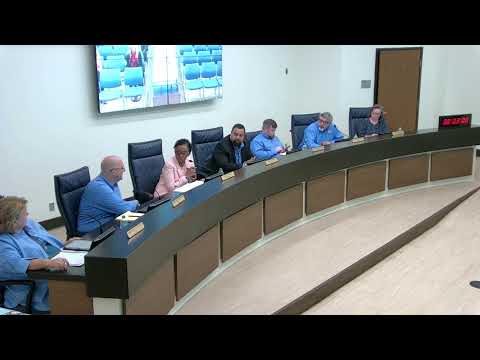
Lynn Haven commission adopts five-year stormwater plan with 50% revenue increase and annual 3% escalator
Summary
The Lynn Haven City Commission voted to adopt a five‑year stormwater assessment plan that increases stormwater revenue by 50% in the first year, applies a 3% annual increase thereafter, and reduces the vacant‑parcel charge to 18%, moving the fund from near‑deficit operations toward capital funding.
The Lynn Haven City Commission voted to adopt a five‑year stormwater assessment plan that increases stormwater revenue by 50% in the first year, applies a 3% annual increase in subsequent years, and reduces the vacant‑parcel charge from 23% to 18%. The measure passed by roll call (tally: yes 3, no 2) on first action after extended discussion and public comment.
The change is intended to move the stormwater fund from near‑deficit operations into a position that supports capital projects, reserves and required consent‑order work. Consultant Peter Napoli of Stantec presented the revised rate structures and said the proposal was designed to place the equivalent residential unit (ERU) nearer the center of a four‑tier structure and to spread the burden more equitably across parcels. "We added an additional scenario… where after the major adjustment of 50% in 2026 the commission considers adopting 3% increases to the stormwater assessment rate afterwards," Napoli said during the presentation.
Why it matters: City staff and the commission said the fund needs more predictable revenue so the city can pursue major stormwater capital projects rather than rely solely on intermittent grant or surtax dollars. Finance staff reported the stormwater account was already short on cash: "As of today, the stormwater is in the hole $481,000 in cash," said a staff member identified in the meeting as Kiki. Commissioners cited repeated shortfalls and deferred increases in prior years as reasons to act now.
What the commission approved - A five‑year plan that targets a 50% increase in stormwater revenue in the upcoming fiscal year (the implementation year named by staff) and a 3% annual rate increase in years after that. - A revised four‑tier rate structure for single‑family parcels that repositions the ERU and narrows large jumps between tiers. - A reduction in the vacant‑parcel factor from 23% to 18%; vacant parcels remain capped at 5 acres.
Consultant findings and staff analysis Stantec's presentation (Peter Napoli) showed two four‑tier options to address an uneven current distribution that placed too many parcels in the lowest tier. Napoli said the firm reworked tier breaks so more parcels fall into an expanded middle tier and proposed a second four‑tier option that softens the immediate impact on lower‑impervious parcels.
Stantec calculated the revenue scenarios assuming an annual $300,000 contribution from the county sales surtax fund toward stormwater capital; if the surtax contribution is maintained it reduces pressure on the assessment, Napoli said. The consultant also presented a model that added a 3% yearly increase after the initial 50% revenue rise to build reserves and reduce future reliance on surtax.
Staff told the commission changing the billing method from a property‑tax non‑ad valorem assessment to monthly utility billing would require software work and operational changes. Munis, the city's billing software vendor, estimated an implementation cost around $47,000 and staff said an added full‑time position would likely be required to maintain the more detailed monthly role. "We previously did collect stormwater on the utility bill… The change, which would justify the cost, is restructuring the billing to account for this house has a different impervious surface than this house," a staff member said.
Consent order context and funding considerations Staff also reminded the commission of a DEP consent order executed March 6 that carries a fine and in‑kind work requirement. The transcript recorded a fine estimate of about $170,000 with an in‑kind requirement roughly 1.5 times the fine; staff said the city had already proposed a lift‑station SCADA in‑kind project to satisfy part of the obligation and planned to bring a task order for consultant work once the mid‑year budget adjustment is approved.
Opposition and public comment Several residents spoke in the public comment period before and during the discussion. Public commenters and at least one commissioner said a 50% revenue increase is financially painful for residents; others argued the city must secure long‑term funding to prevent home flooding and complete capital projects. One resident noted a history of the stormwater charge being used in the past for other purposes and urged transparency in how the new revenue will be applied.
Next steps and implementation The commission directed staff to proceed with implementation consistent with the adopted five‑year plan, incorporate the revised four‑tier structure and the 18% vacant‑parcel factor into rates, and take the assessment on the tax roll notice timeline so the city can avoid an additional mailing expense. Staff estimated one‑time consultant updates and mailing costs if the city misses the county tax‑roll deadline. Stantec noted annual roll updates would still be required and estimated recurring update work if the commission asks the firm to adjust the structure in future years.
The commission and staff said they plan to continue communicating with residents about planned capital projects funded by the assessment and to pursue grants where feasible. No construction schedule was set in the meeting; the motion and timing require staff to finalize rate notices and administrative steps before collection begins.