Get Full Government Meeting Transcripts, Videos, & Alerts Forever!
Get email alerts on the Arpa Homelessness topic
No spam. Unsubscribe anytime.
Council earmarks $5 million in ARPA funds for homelessness services; remainder to be split among council
Summary
Detroit City Council approved a motion to allocate $5 million of available ARPA funds toward homelessness services, leaving roughly $9 million to be divided among council members for district projects; staff must prepare contracts before funds are spent.
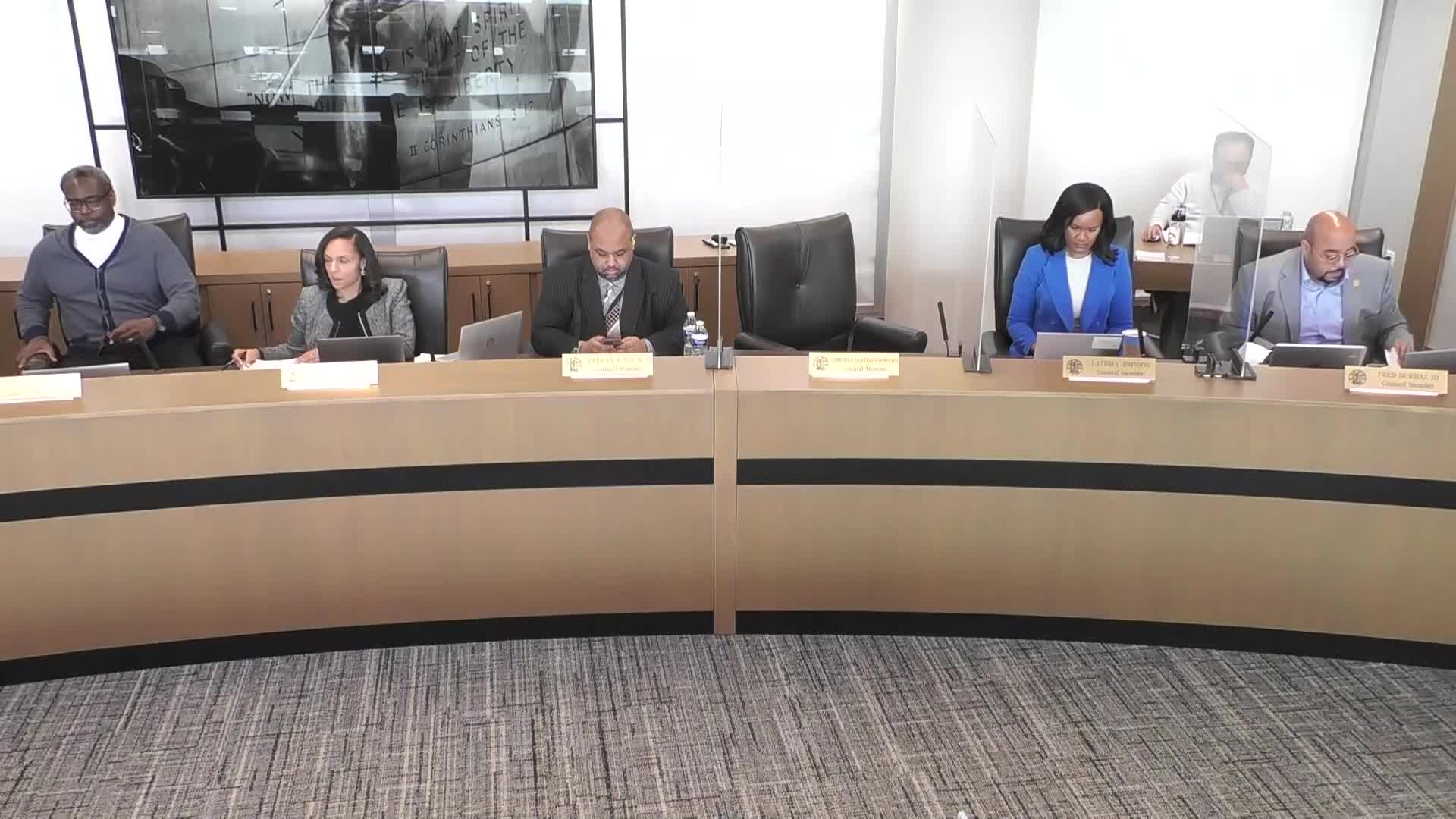
Detroit City Council voted on Monday to allocate $5 million of the city's available American Rescue Plan Act (ARPA) funds to homelessness services, including emergency shelter, street outreach and case management.
Council member Waters moved to set aside $5 million for homelessness; the motion passed on a voice vote with no objections. Council members said the remaining approximately $9 million of the ARPA allocation will be divided among council members for district-level projects and returned to the council for formal action at a later meeting.
Why this matters: The action directs federal ARPA dollars to homelessness response at a time when city housing officials told council they estimate a $21.5 million need to sustain current services and implement a recently developed seven-point plan.
Julie Schneider, director of the Housing and Revitalization Department, told the council "overall, we're looking at a need of of $21,500,000 for homelessness, next year," and outlined that the total need would rely on multiple funding sources. Schneider said the proposed $5 million is intended to help complete that budget and support expanded outreach begun after a February tragedy.
Staff and council discussed permissible uses and timing under ARPA rules. Officials noted some supportive-housing projects and shelter expansions have already used ARPA dollars; staff cautioned that contracts must be in place before funds are spent. Council member Johnson asked whether ARPA could be used for utility assistance; staff said they would confirm the contractual status and provide an answer.
The council also discussed how the $5 million would be allocated within homelessness spending. The motion was presented with a breakdown indicating $2 million for emergency shelter beds, $1 million for street outreach, $1 million for family-focused case management and $1 million for homelessness-response coordination. Staff said these allocations are components of the $5 million commitment.
The council approved a procedural waiver to consider ARPA allocation matters on the special-session agenda. Staff told members that individual council allocations of the remaining $9 million would be the subject of a future formal session and that members should submit project lists so the administration can draft resolutions and contracts.
Ending: Council members asked staff to prepare contract documents and a resolution so the remainder of the ARPA funds can be apportioned and approved at a later public meeting. Officials also said final use of the funds will follow ARPA rules and existing contract deadlines.