Get Full Government Meeting Transcripts, Videos, & Alerts Forever!
Get email alerts on the Stormwater Infrastructure topic
No spam. Unsubscribe anytime.
Public works updates council on stormwater system inspections, aging pipe risks and next steps
Summary
Public works staff briefed the Kennesaw Mayor and Council on the city’s stormwater inspection program, aging infrastructure, inspection technology and steps to model and prioritize repairs; staff said the city inspects roughly 20% of the system annually on a five-year rotation and is moving toward system modeling and vertical mapping.
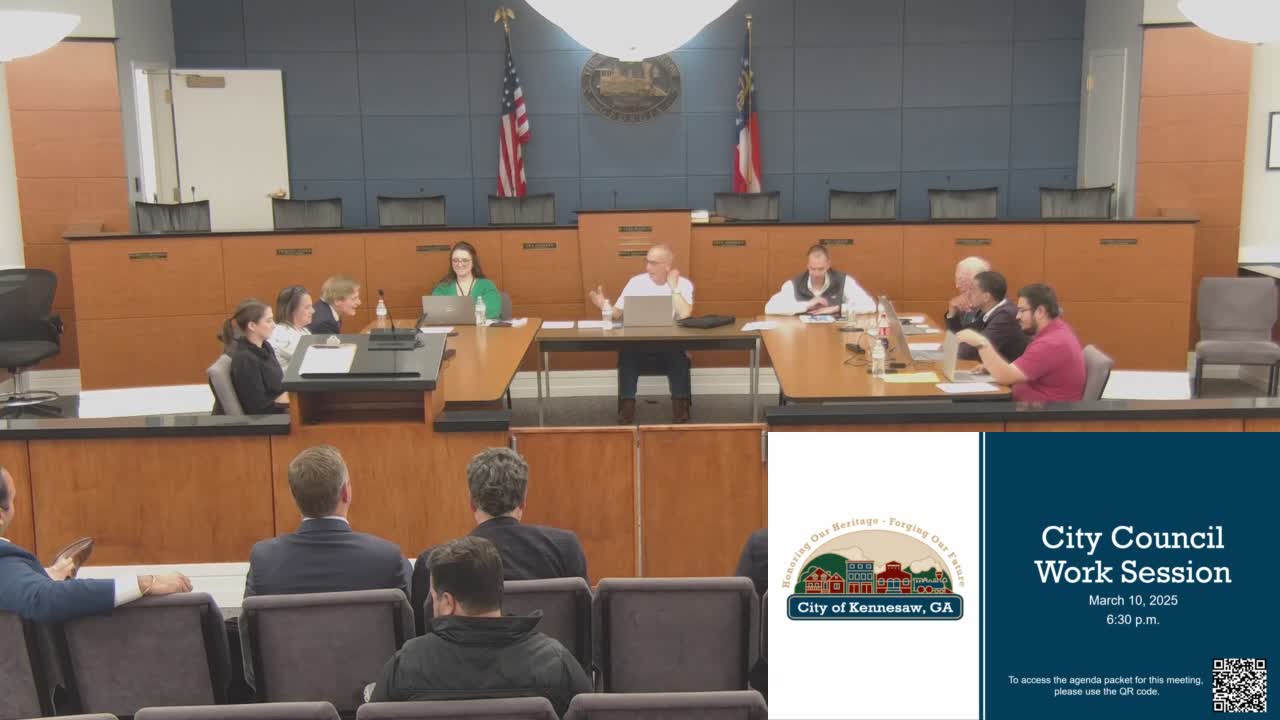
Public works staff updated the Kennesaw Mayor and Council on March 10, 2025, about the city’s stormwater infrastructure inspection and repair program, the condition of older pipe, and planned next steps to improve mapping and system modeling.
Staff said the city inspects about 20% of the stormwater system each year—on a five-year rotation—meaning the entire system is inspected periodically; the utility’s formal operations began around 2014, putting the program on its third rotation. Inspectors use both visual inspections and a remotely operated rover (camera robot) to create pictures and video of pipes and structures. Staff said they retain thousands of photos and videos on department drives; a consultant is working to add vertical (invert) elevations to the city’s horizontal GIS so the system can be modeled.
Staff described the condition mix: newer infrastructure performing well and older corridors with corrugated metal pipe that are vulnerable to corrosion and collapse. Staff said corrugated metal in flow conditions often lasts only five to 10 years; where it sees only intermittent flows, durability can extend to 20–30 years—the latter being the range where the city is now seeing collapses. City crews perform a lining program that relines roughly 300–500 feet annually and clear structures where needed.
Council members asked why some recent emergencies (for example a failure on Pine Hill after heavy rains) were not identified earlier. Staff said one collapse was first brought to the city’s attention by a homeowner after high-intensity rain events accelerated the failure; staff emphasized they have the system on their radar and noted the inspection program is more robust than required by the MS4 permit.
On next steps, staff said that when the consultant provides vertical elevations the city will model hydraulic capacity to identify where upsizing or regional detention would be more cost-effective than wholesale pipe replacement—allowing prioritization of repairs and more strategic investment. Staff noted that detention ponds and privately maintained ponds are generally the responsibility of HOAs or trusts; the city maintains regional ponds or ponds on city property only. Code enforcement or legal remedies would be pursued where private pond owners fail to maintain required features.