Get Full Government Meeting Transcripts, Videos, & Alerts Forever!
Get email alerts on the Residential Development Mixed Use topic
No spam. Unsubscribe anytime.
Developer seeks to rezone 2615 South Main Street to CBD for 300-unit mixed-use project; council members pressed on density, traffic and mobile-home displacement
Summary
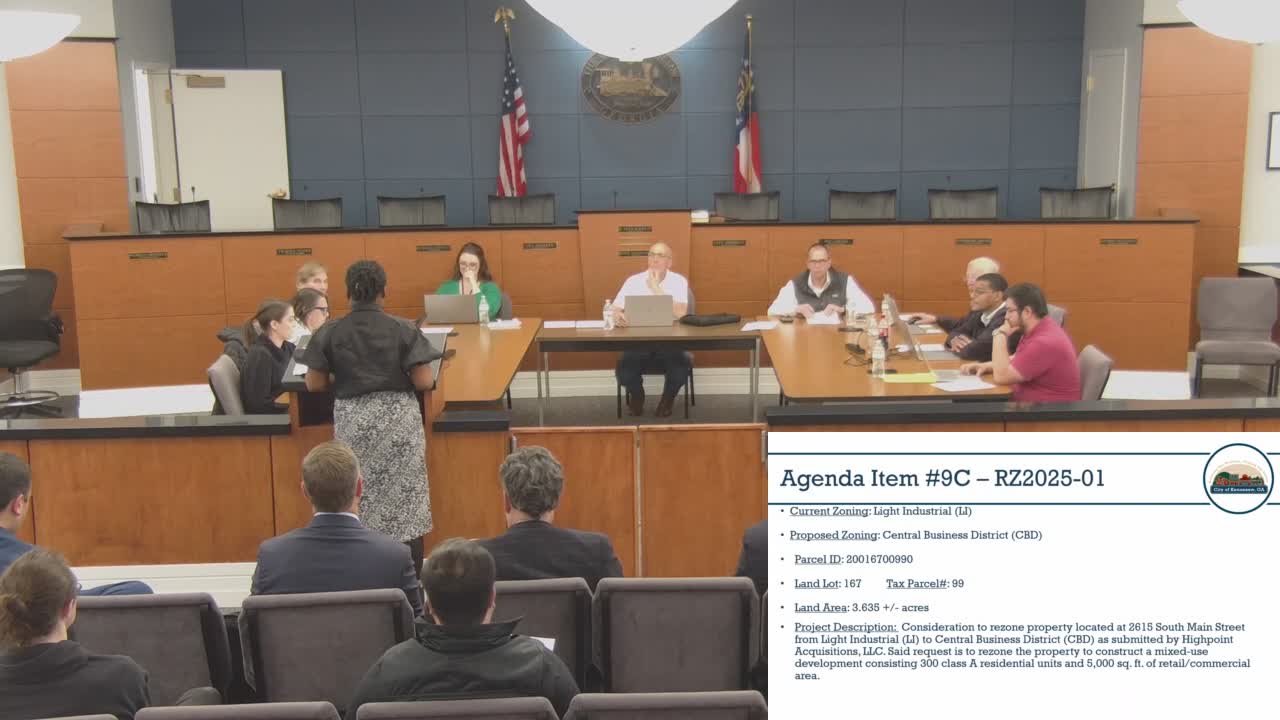
High Point Acquisition LLC asked the Kennesaw Mayor and Council on March 10, 2025, to rezone 2615 South Main Street from light industrial to central business district for a mixed-use development that the applicant said would include about 300 apartment units, a parking deck and roughly 5,000 square feet of retail.
High Point Acquisition LLC asked the Kennesaw Mayor and Council on March 10, 2025, to rezone 2615 South Main Street from light industrial to central business district (CBD) for a mixed-use development that the applicant said would include about 300 apartment units, a parking deck and roughly 5,000 square feet of commercial retail space.
Planning staff reviewed the request against the city’s land-use documents, including the LCI and the Unified Development Code, and recommended approval with conditions as outlined in the staff packet. Staff said the application was properly advertised (MDJ, Feb. 14) and posted on the property. The CBD application and a concurrent variance request (file number 2681) were described as running concurrent with the rezoning and contingent on the rezoning decision.
Councilmembers and staff pressed the applicant on phasing and construction conditions. Staff reminded the council that the zoning ordinance requires withholding the final 20% of residential certificate-of-occupancy (CO) until the commercial certificate of completion is obtained; the applicant and staff said the commercial and residential portions are expected to be built concurrently. An applicant representative said the planned project horizon for ownership would be “probably a 7 to 10 year horizon.”
Council members raised traffic and infrastructure concerns. A traffic-engineering memo in the packet estimated roughly 54 PM peak-hour vehicle trips attributable to the project; staff and the applicant discussed turn-lane work on Main Street that will require restriping existing medians to provide northbound and southbound left-turn lanes into the phases. The applicant estimated the project could generate on the order of 400–425 resident vehicles at full occupancy.
The project would displace residents of an existing mobile-home community on part of the site. The applicant said there were 19 tenants remaining in November; that number had fallen to about 12 at the time of the work session. The applicant said tenants do not own the homes and are month-to-month; the plan is to provide 90 days’ notice before forced vacancy (state law requires 60 days). The applicant said it would return security deposits (equal to one month’s rent, roughly $700) and pay $1,000 in relocation assistance to any remaining tenants displaced when construction begins.
The applicant and the Historic Preservation Commission discussed façade design and massing; the applicant said it will introduce additional façade variation to break up long, linear front elevations and will take HPC feedback into account. The applicant also said that without the variances the project would not be financially feasible: “I’d respectfully ask that you vote on everything together because without the variances, the project doesn't work,” the applicant stated on the record.
No final council vote on the rezoning, the CBD application or the variance was recorded in the work-session transcript. Staff indicated a fuller presentation will be provided at the upcoming Monday meeting for formal consideration.
Notes: where the transcript provided exact numbers or commitments (security deposit amount, relocation payment, tenant counts, traffic estimate), those are reported as stated; where the transcript lacked precise details (for example final phasing schedule), the article states what was discussed rather than inferring outcomes.