Get Full Government Meeting Transcripts, Videos, & Alerts Forever!
Get email alerts on the Education Legislation topic
No spam. Unsubscribe anytime.
PGCPS staff outline changes from Maryland's 'Excellence in Maryland Public Schools' law; system to assess local impacts
Summary
Staff briefed the Policy and Governance Committee on the new state law (House Bill 504) that adjusts per-pupil funding, extends workforce-development funding, adds accountability for community schools and creates teacher recruitment incentives; PGCPS will evaluate operational and budget impacts.
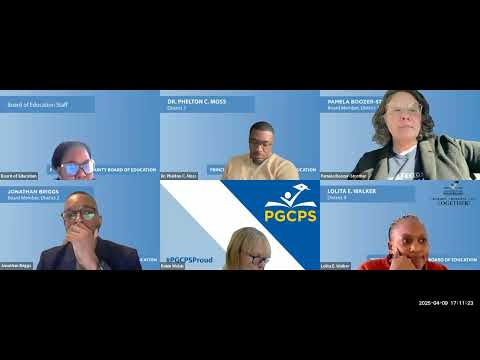
Prince George's County Public Schools staff told the Policy and Governance Committee on April 9 that the Excellence in Maryland Public Schools Act (House Bill 504) passed with numerous amendments and will require systemwide review to determine operational and fiscal effects.
Committee member Robin Welsh, who presented the legislative update, said the bill restored some per-pupil funding for fiscal 2026 but set lower increases in following years and preserved a revenue trigger that would stop per-pupil increases if general fund revenues fall "3.75 percent below the March general fund estimate." Welsh said the law also extended funding for local workforce-development partnerships through 2028 while adding extensive data and accountability requirements for those programs.
Why it matters: the bill alters funding formulas and program requirements that affect local budgets, staff duties and school programming. Committee members said PGCPS divisions including finance, academics and human resources will need to evaluate the bill's implications for hiring, services and budget reconciliation.
Welsh summarized other provisions she said the committee should expect to affect operations. The law creates two Maryland School Leadership Academy tracks for school and system leaders, continues a national teacher recruitment campaign that includes a $2,000 Maryland teacher relocation incentive grant for eligible newly hired candidates, and funds an Academic Excellence Program that places department-funded instructional coaches in participating schools. "The department shall enter into a cooperative agreement with the county board that elects to participate in the program," Welsh said of the coaching program, meaning local participation will be voluntary and require a memorandum of agreement.
The bill authorizes new wraparound services for community schools, including evidence-based in-school tutoring during the school day and requires community-school reporting at the countywide level when counties use up to 50% of community schools funds for central or administrative functions. Welsh said the State Department of Education is increasing staffing and auditing practices for community-school funds and that PGCPS will likely need to revise its community-school policy to add systemwide implementation and reporting requirements.
On teacher workforce strategies, Welsh described a state-funded "Grow Your Own" program that will fund collaboratives (multi-district and labor partnerships) to implement registered teacher apprenticeships and residencies; she said grants will be competitive and the department will consult a national nonprofit to design the state-level program.
Committee members asked for follow-up analyses. Board member Walker asked staff to model the bill's per-pupil and compensatory-education changes for budget reconciliation; other members asked Human Resources and academic leadership to estimate operational impacts of in-school tutoring, collaborative time and any new staffing needs. Welsh said PGCPS will compile division-level responsibilities and fiscal projections and return with recommendations.
The committee also discussed recently enacted school-related bills of note, including changes to comprehensive health education and a youth suicide-prevention measure that was amended from a "must" to a "should" and therefore is less prescriptive. Staff said opportunities exist to participate in the forthcoming regulatory process that will spell out how the law will be implemented.
Committee Chair Dr. Felton Moss closed the discussion by directing staff to continue cross-divisional analysis and to brief the committee with budget and implementation impacts ahead of reconciliation work.