Get Full Government Meeting Transcripts, Videos, & Alerts Forever!
Get email alerts on the Budget topic
No spam. Unsubscribe anytime.
Detroit council trims some budget requests, pins $5 million in ARPA for homelessness and debates police cellular-surveillance purchase
Summary
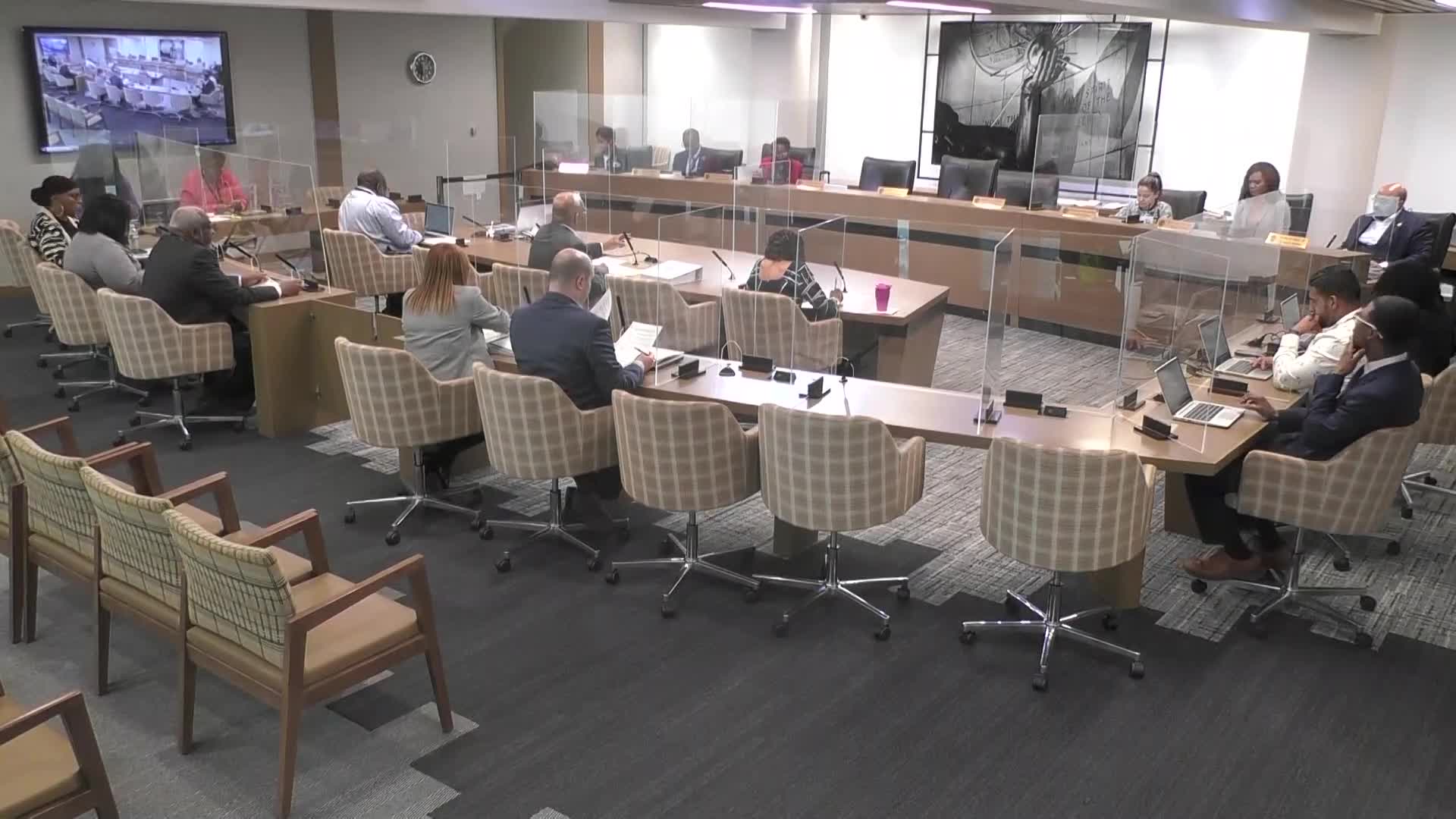
Detroit City Council members and administration staff revised multiple items on the budget spreadsheet during a marathon Oct. 12 work session, agreeing to scale back some one-time requests, leave the city—s risk-management fund intact and pin $5 million in unspent ARPA money for homelessness projects while flagging a separate $975,000 cellular-surveillance vehicle for further review.
Detroit City Council members and administration staff revised multiple items on the budget spreadsheet during a marathon Oct. 12 work session, agreeing to scale back some one-time requests, leave the city—s risk-management fund intact and pin $5 million in unspent ARPA money for homelessness projects while flagging a separate $975,000 cellular-surveillance vehicle for further review.
The session produced a string of accepted motions to change line-item amounts or move items to the closing resolution and executive session. Council and administration officials repeatedly emphasized the December 2026 deadline on ARPA obligations and concerns raised by credit-rating agencies about risk-management reserves.
Why it matters: The changes affect how the city would spend both general-fund and ARPA dollars on homelessness services, demolition and clean-up programs, department staffing and a police-funded cellular surveillance capability. The council—s decisions shape which programs can proceed before ARPA deadlines and how much recurring general-fund burden the city will accept going forward.
Most consequential adjustments
Budget staff asked the council to lower a proposed general-fund surplus draw from $12 million to $10 million; that reduction was accepted and will be reflected in an updated spreadsheet. The council also approved a separate proposal to increase a February line item from $10 million to $12 million.
Administration and council members debated a separate proposal to cut $15 million from the risk-management fund to the general fund. After presentations about the city—s recent and projected claims activity and questions from rating agencies, council members and administration staff agreed not to take money from risk management; the $15 million cut was removed.
The council approved other changes recommended by administration staff or council members, including: - Reducing the construction-and-demolition line from $10 million to $5 million and cutting a related cleanup line from $2 million to $1 million; those reductions were accepted. - Lowering a package of turnover-savings assumptions for Human Resources & Development (HRD) items so one-time savings in the current plan drop from approximately $51 million to $28 million after accounting for positions that administration says must move to the general fund. - Adding $600,000 one-time for citywide alley cleaning (GSD) and $975,000 one-time for a cellular-surveillance vehicle; the surveillance item was placed in the closing resolution for follow-up questions.
ARPA funds and homelessness
Council members discussed whether and how to use remaining ARPA dollars. Administration staff identified $5 million of ARPA funds available from demolition projects and urged council to direct those dollars to homelessness projects. Council members agreed to place a $5 million ARPA homelessness package on the executive spreadsheet and pin it for further review and drafting in the closing resolution.
Several council members pressed for transparency about which ARPA-funded contracts and vendors would receive the money and how ARPA timing rules (spend-by deadline) would be met. Council member Angela Callaway asked, "When we received those ARPA dollars and hired the folks that we hired, we understood that when the ARPA dollars run out, those positions were no longer going to be funded," and said she wanted lists and project-status reporting before more reallocations. Administration staff replied that some ARPA-funded positions are being transitioned to one-time general-fund support and that remaining ARPA balances can be used for eligible homelessness contracts if projects meet ARPA timing and scope requirements.
Department staffing and program items
Council members approved a series of smaller stand-alone motions and placements into the closing resolution or executive session, including: - Adding a $50,000 recurring line for a Citizens— Blight Patrol mileage stipend program. - Approving $1 million recurring for a skilled-trades apprenticeship program focused on electricians, plumbers and carpenters (council member motion). - Increasing funding for a homelessness case-management and legal-services item (CREO/HRD) by $1 million to $2.2 million and adding that to the executive session. - Amending a Department of Neighborhoods expansion from $1.1 million to $1.4 million to fund additional district-level FTEs (the amendment passed after discussion and a recorded objection was entered to the proposed increase).
Several line items were explicitly moved to the closing resolution for later action or study, including accessibility and guaranteed-income items, a music-hall request (placed in executive session for discussion) and a proposal to create a legislative search portal for public ordinances (one-time funding for the portal was added for future consideration).
Vehicles and financing
Council members clarified that vehicle purchases in the budget can be funded through an existing master installment-purchase agreement previously authorized by the council and that new vehicle requests could be folded into a supplemental installment schedule (SEPA) rather than requiring new one-time general-fund appropriations. Council members noted the city previously authorized a $55 million installment purchase program for vehicles.
Privacy and oversight questions about cellular surveillance
Members raised questions about a proposed cellular-surveillance vehicle and supporting equipment, priced at $975,000 as a one-time item. Council member James Tate and others asked whether the system would collect content or only metadata; the administration said the technology is intended to "ping" cell phones for priority-one investigations and does not capture conversations. Council members asked for additional written detail and said they wanted more discussion with the police department and technology staff before final approval; the item was moved into the closing resolution for follow-up.
Debate over Department of Neighborhoods staffing
A lengthier debate focused on a proposal to add district-facing staffing in the Department of Neighborhoods. Proponents argued additional DON staffing improves constituent service and on-the-ground problem solving. Opponents said the department—s scope has shifted from its original blight-removal purpose and questioned creating permanent recurring costs while many one-time priorities compete for limited funds. After discussion, council amended the department—s increase to $1.4 million total (up from $1.1 million) to add the proposed positions; council recorded objections from several members during that vote.
Other notables
- Members reduced or removed several council requests after discussions with department staff: for example, a DBA/airport allocation was lowered from $1 million to $250,000 to retain limited contingency for expected construction-price increases. - Members asked for detailed lists of ARPA-funded projects (such as the Lee Plaza affordable-housing award), with regular status reports so council can reassign funds if projects cannot spend ARPA by the federal deadline. - Council asked administration for counts and timelines: administration said about 300 positions were originally funded by ARPA, and roughly 80 of those have been transferred to general-fund or one-time funding so far. Administration also told the council rating agencies have raised questions about risk-management spending trends; the city—s recent and projected payouts are nearer prior-year levels, roughly $60 million annually, administration said, which informed the decision not to raid the risk-management fund.
What remains unsettled
Several items were pinned for further work or moved to the closing resolution: the $5 million ARPA homelessness package will be refined with program language and a list of proposed contractors; the surveillance vehicle will be documented and verified with the police department; and various one-time requests without dollar amounts were left for council review overnight. Council members asked staff to prepare written follow-ups and to add a separate ARPA column to the executive spreadsheet so members can see which requests are proposed from ARPA vs. general fund.
The council scheduled continued budget work for the next day and signaled that members expected more detailed memos and fund-source confirmations before final votes.
Ending
Council President Mary Sheffield closed the session after public comment and set the next work-session reconvening for 10 a.m. the following day. Several council members said they planned to return on Friday if needed to finish remaining decisions.
Votes at a glance (procedural outcomes recorded during the session) - Reduce proposed general-fund surplus draw from $12M to $10M: agreed (spreadsheet to be updated). - Increase a February line item from $10M to $12M: agreed. - Do not take $15M from the risk-management fund (leave at current funding): agreed. - Construction & demolition cut from $10M to $5M; cleanup from $2M to $1M: agreed. - HRD one-time turnover savings reduced from ~ $51M to $28M after accounting for positions to be funded: agreed. - Alley cleaning (GSD) +$600,000 one-time: agreed. - Cellular-surveillance vehicle $975,000 one-time: placed in closing resolution for verification and follow-up. - Move accessibility and guaranteed-income items to closing resolution: agreed. - Music Hall expansion $1M placed in executive session for discussion: agreed. - CREO/HRD case management/legal services +$1,000,000 (total $2.2M): added to executive session. - Apprenticeship skilled-trades program $1,000,000 recurring: added to executive spreadsheet. - Citizens— Blight Patrol mileage stipend $50,000 recurring: added to executive spreadsheet. - Department of Neighborhoods amendment from $1.1M to $1.4M (additional FTEs): amendment adopted; objections recorded. - $5,000,000 ARPA homelessness package (identified from demo reassignments): placed on executive spreadsheet and pinned for closing resolution.
(Several other line-item edits, removals and pins were approved by unanimous voice or —hearing no objections— statements; the administration will supply updated spreadsheets and memos reflecting final numbers.)