Get Full Government Meeting Transcripts, Videos, & Alerts Forever!
Get email alerts on the Disability Services topic
No spam. Unsubscribe anytime.
Disabled Detroiters press council to fund Office of Disability Affairs and home‑access programs
Summary
Advocates and residents urged City Council to increase funding for disability services in the FY2026 budget, requesting $1.4 million for the Office of Disability Affairs, $2 million to continue the Detroit Home Accessibility Program and additional resources for Detroit Home Connect and polling‑place accessibility pilots.
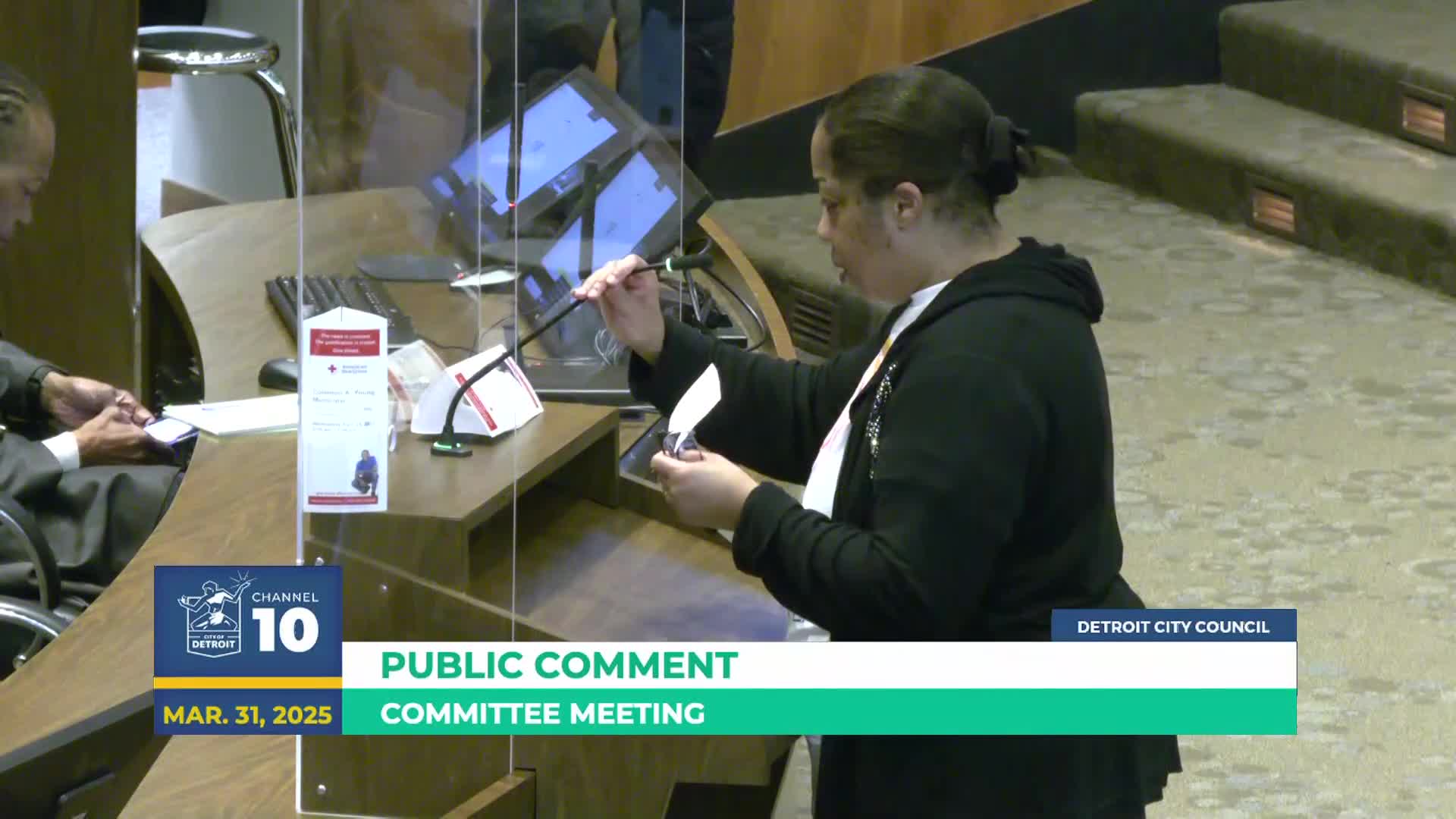
Residents and disability advocates told the Detroit City Council at a public hearing that the FY2026 budget should include specific investments to make housing, transit and public services accessible.
Speakers asked the council to increase the Office of Disability Affairs’ budget to $1,400,000 to allow the office to staff coordination across departments. Nasjorie Nixon, community organizer for Detroit Disability Power, said the funding would allow the office to become “the one‑stop shop that disabled Detroiters deserve.”
Advocates asked the council to allocate $2,000,000 for the Detroit Home Accessibility Program so homeowners can get ramps, lifts and widened doorways; speakers said the current pipeline approved roughly 250 of about 850 eligible households and left more than 600 households without funding. Casey Peller, policy manager at Detroit Disability Power, urged $2,000,000 “to help homeowners stay at home with our families and in our communities.”
Speakers also requested $75,000 for Detroit Home Connect to improve listing detail on unit accessibility, and asked for a $1,000,000 pilot at the Department of Elections to fix accessibility barriers at polling locations so voters with disabilities can reach the ballot box. Eric Willsby, advocacy director for Detroit Disability Power, described poll‑audit findings showing narrow doorways, failing ramps and other structural barriers at some polling places.
Testimony tied accessibility funding to transit as well. Many disability advocates supported doubling DDOT to expand accessible stops and argued that accessible transit, housing modifications and accessible polling places are interdependent elements to enable independent community life.
There was no formal council action at the hearing; the council will consider amendments in executive session as allowed by the Detroit City Charter.