Get Full Government Meeting Transcripts, Videos, & Alerts Forever!
Get email alerts on the Board Of Ethics Budget And Operations topic
No spam. Unsubscribe anytime.
Detroit Board of Ethics asks council for recurring funding, staff and independent counsel; council approves executive session on staffing
Summary
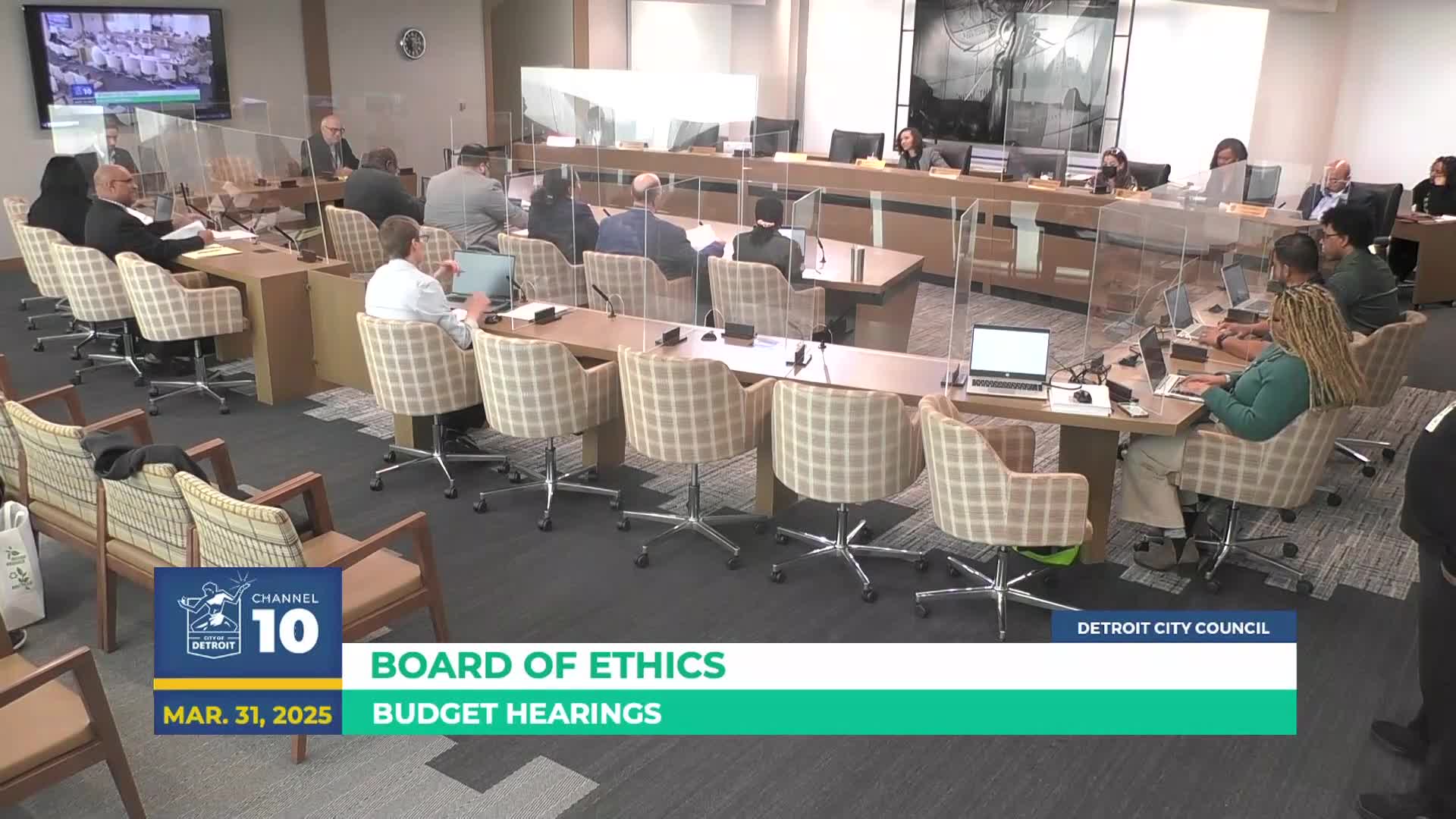
At a Detroit City Council hearing, Board of Ethics leaders reported 2024 workload and performance metrics, outlined a learning-management-system procurement and requested recurring funding and additional staff; the council approved an executive-session motion to discuss a staffing position.
Crystal Phillips, executive director of the Detroit Board of Ethics, told the Detroit City Council that the board is seeking recurring funds to support a new learning management system and additional staff to carry out oversight of the city’s roughly 10,000 public servants.
The request includes a $95,000 recurring annual cost for the learning management system and $85,640 to hire two part‑time workers — a part‑time investigator and a part‑time marketing/outreach coordinator — for a supplemental total of $180,640 that would raise the board’s annual budget from a baseline request of $591,477 to $772,047. Phillips also described a proportional‑funding proposal the board has prepared that would total $1,383,664 and would fund three additional full‑time positions, including an in‑house attorney/independent counsel if proportional funding is adopted.
The board emphasized workload and timeliness metrics in explaining the request. Phillips said the board received a record 108 disclosures after working with the mayor’s office in 2024, compared with three disclosures in 2022 and 15 in 2023. She reported the board addressed requests for advisory opinions in an average of 44.2 days, sent opinions an average of 6.59 days after a board meeting, handled complaints in an average of 50.5 days and completed investigations in an average of 175.5 days; she added that no matter extended past a 182‑day deadline.
"My name is Crystal Phillips. I'm the executive director of the board of ethics," Phillips said during her presentation. She credited cooperation from other oversight offices and legislative staff for recent gains and said the office held eight board meetings last year.
Michael O'Connell, the board’s training specialist, described the procurement status of the learning management system. "This honorable body approved $125,000 in the current fiscal year for the purchase of a learning management system," O'Connell said. He said an initial round of bids exceeded the allotted budget, the board reissued the RFP, selected a vendor, and is negotiating a contract that he expects to be before the council for approval in April 2025. O'Connell said the board will request recurring funding to sign a longer‑term contract that would sustain training for Detroit public servants.
Vice Chair David Teeter told council members the board is considering a separate request for independent counsel in future budgets. "That really seems to give certainly the appearance of a conflict of interest," Teeter said of the current practice of using Law Department‑appointed counsel for both respondents and board representation; he said the board has cycled through multiple Law Department‑appointed counsel and believes an independent counsel would reduce delays and avoid the appearance of conflicted representation.
The board also said it plans an annual spring disclosure request to the mayor’s office going forward, is developing a public‑facing information platform, and expects to hold a board retreat to produce a five‑year strategic plan and propose ordinance or administrative‑rule changes.
Council members asked for additional detail on several topics. Member Santiago Romero raised concerns about repeated complaints from a single resident and whether dismissed complaints would remain public; Phillips responded that the board publishes only advisory opinions online and that summary dismissals are not posted, and that complainants are informed when matters fall outside the board’s jurisdiction. Member Angela Whitfield Calloway requested the board’s expense details for last year’s Council on Governmental Ethics Laws conference; Phillips said seven people attended (three board members and four staff), the conference lasted three days with travel added and rooms booked at government rates, and that the board uses OCFO and the city travel agent for reimbursements. Several council members pressed the board on meeting frequency and response times; Phillips said meetings are currently scheduled monthly but that the charter requires only four meetings per year and vacancies in prior years reduced meeting count to eight in 2024.
During questions about staffing the board's training specialist and senior investigator described their workload: senior investigator Don Whitman handled 164 matters last year, many related to gifts, gratuities and complaint analyses. Phillips said the board needs additional investigative capacity to maintain timeliness and outreach.
Council member Durhall moved to take an executive session on a staffing position; the council chair said, "Hearing no objections, that action will be taken," and the motion was adopted without recorded roll‑call votes.
The board said the procurment contract for the learning‑management system should be before the council in April 2025 and requested follow‑up with council offices on the proposed part‑time positions and proportional‑funding plan. Council members said they expect to receive the board’s travel expense report for the COGEL conference and asked the board to propose specific cost‑savings measures as part of future budget discussions.
The board's presentation concluded with a request that the council consider proportional funding mechanisms to create permanent funding for the learning system and the additional staff the board says are necessary to meet oversight obligations.