Get Full Government Meeting Transcripts, Videos, & Alerts Forever!
Get email alerts on the Land Bank topic
No spam. Unsubscribe anytime.
Cherokee regional land bank proposed as a tool for workforce housing, presenter says
Summary
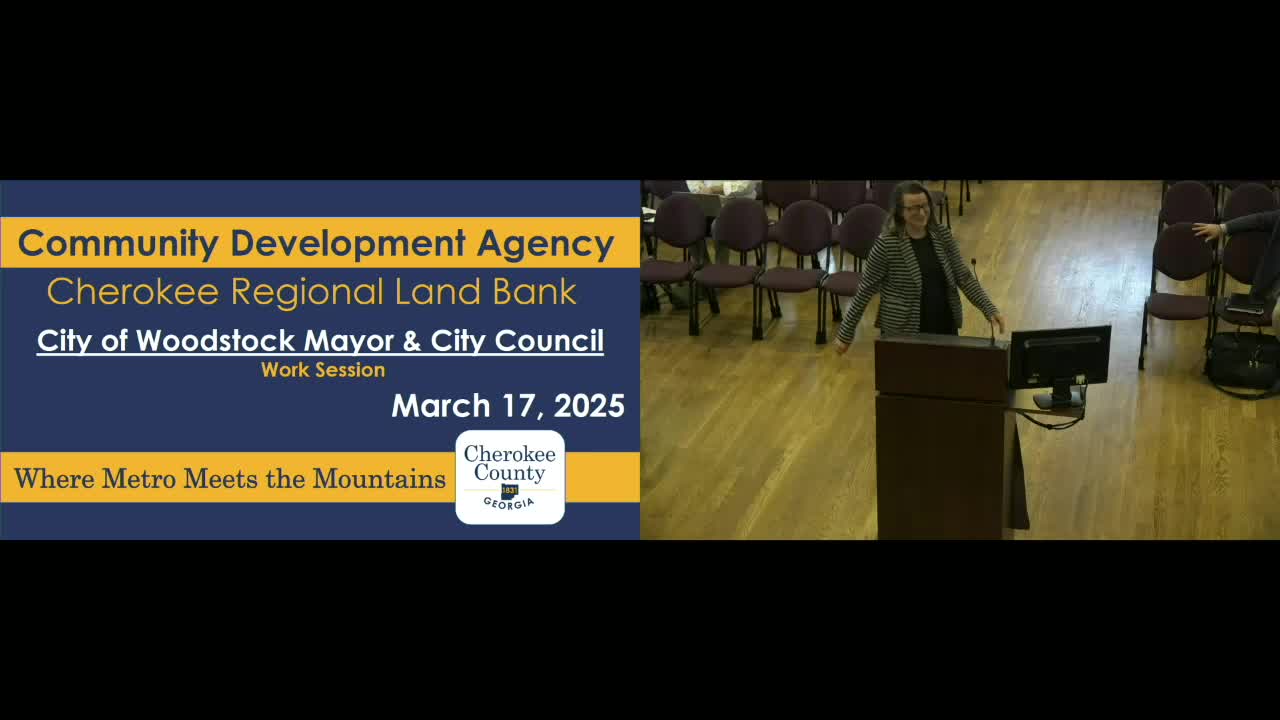
Cherokee County representative Brantley Day told the Woodstock City Mayor and Council on March 17 that the county and one or more cities are exploring a Cherokee Regional Land Bank to acquire, hold and repurpose tax-delinquent or donated property for workforce and attainable housing.
Cherokee County representative Brantley Day told the Woodstock City Mayor and Council on March 17 that the county and one or more cities are exploring a Cherokee Regional Land Bank to acquire, hold and repurpose tax-delinquent or donated property for workforce and attainable housing.
Day said the tool is authorized under Georgia law and described the basic structure and powers that counties and cities have used elsewhere. He said the draft intergovernmental agreement (IGA) the county has prepared would give each participating jurisdiction one vote on the land bank board and require jurisdictional approval before a project could proceed.
Day said the land bank would act as a depository of property and could, in some cases, extinguish tax liens after the statutory waiting period to return blighted or delinquent parcels to the tax rolls. "Think of land banks as depositories of property, tax delinquent property, sometimes blighted, sometimes donated," Day said. "The land bank holds the property until it's conveyed and repurposed for a project consistent with the purpose of the land bank." He added that the board would adopt bylaws and policies and that local jurisdictions would retain zoning and land-use authority.
Why it matters: presenters and councilors framed the land bank as a potential tool to address rising housing costs and the concentration of investor-owned single-family homes. Day said the county has "about 5,000" investor-owned units and argued a land bank could "short circuit the market" by lowering land acquisition costs and combining public and private financing to deliver homes affordable to teachers, firefighters, nurses and other local workers.
Key details from the presentation: - Statutory basis: Day said land bank statutes in Georgia date back to 1990 with a revision in 2012 and that a land bank requires a county and at least one city to form it. (Day identified the legal framework generally; the transcript did not provide a statute citation.) - Governance: Day proposed an odd-numbered board with one appointed representative per participating jurisdiction, plus a representative from the Cherokee Office of Economic Development ratified by a majority of jurisdictions. - Powers: Day described the land bank's typical power to take title to tax-delinquent property, to extinguish liens after the statutory period, and to convey property for redevelopment consistent with the land bank's purpose. - Funding and staffing: Day said initial operating costs are typically transaction-related and that land banks can be seeded with donated property sold at below-market rates to create an operating fund. He said many county land banks begin without dedicated staff and use shared support from county and city personnel. - Intended outcomes and targets: Day said the county hopes land-bank projects would target workforce households, citing a planning target of 60% to 80% of area median income (AMI) as an example of an affordability range the land bank might support; he stated Cherokee County AMI was "about 105,000 and change" in his presentation and illustrated how 60'to'80% AMI maps to household incomes of roughly $63,000'$84,000.
Questions from councilors focused on checks and balances, marketing and long-term affordability. One councilor asked whether a participating jurisdiction should have veto authority over purchases in its limits; Day said he had considered that and would work on language to address it. Another asked how land banks market and list properties; Day said many land banks list properties and work with real estate agents and that Woodstock could learn from peers including the Bartow-Cartersville example.
Councilman Moon, who said he has served on the Cherokee County Development Authority, urged that Woodstock take a seat at the table even if the city never directly uses the land bank's services: "If we don't have a seat at the table, we won't be part of the discussion," he said.
No binding decision: Day confirmed the county previously adopted a nonbinding interest resolution on Feb. 20 and that Canton was considering the measure; the interest resolution does not obligate cities to join the IGA. He asked cities to consider a similar nonbinding resolution if they want the county to continue working on the IGA.
What was not decided or remains unspecified: the draft IGA text was described as near ready but not yet finalized in the packet; specific funding commitments, the exact makeup of the initial board, and the detailed process to preserve long-term affordability (for example, deed restrictions or resale controls) were discussed as options but not specified in the presentation.
Next steps: Day said staff will share the draft IGA for attorney review and asked the council to schedule discussion time if it wants to consider the interest resolution or join at a later date. "If you want to involve the land bank, then involve it; if you don't, you don't have to," he said.