Get Full Government Meeting Transcripts, Videos, & Alerts Forever!
Get email alerts on the Emergency Communications topic
No spam. Unsubscribe anytime.
Goodhue County outlines 911 dispatch operations, radio infrastructure and new mobile command vehicle
Summary
Emergency services captain Chad Stefan described Goodhue County’s 911 operations, location technologies, staffing, radio tower infrastructure and a federally funded mobile command vehicle, and said the county continues to receive Highway 52 calls into its dispatch center rather than routing them directly to state patrol.
Chad Stefan, emergency services captain in the Goodhue County Sheriff’s Office, gave a detailed briefing on the county’s 911 operations, radio system and recent investments, including a mobile command and communications vehicle purchased with federal and county funds.
Stefan said Goodhue County’s public safety answering point — commonly called a PSAP or 911 center — is a 24/7 operation that answers both emergency and nonemergency calls and provides dispatching services at no charge to municipal and tribal partners. “We provide full time dispatching services to six different law enforcement agencies in Goodhue County and seven different fire departments and two ambulance services,” he said.
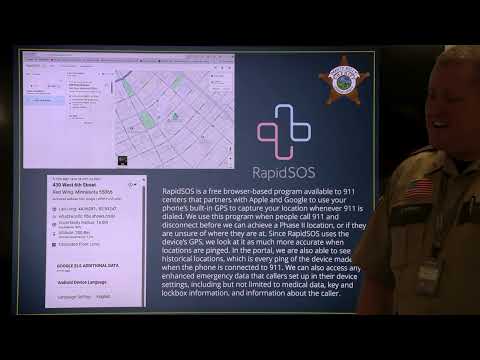
The presentation covered how modern location technology is improving response while exposing gaps that dispatchers must manage. Stefan described RapidSOS, a nationwide service that can show a caller’s latitude and longitude for most Apple and Google phones and updates about every 10 seconds; he illustrated the difference between older ANI/ALI (automatic number identifier / automatic location identification), wireless phase 1 and phase 2 location data, and VoIP limitations for businesses and hotels. He also noted that smartwatches can automatically call 911 and often cause accidental calls at locations such as Welch Ski Hill.
Stefan explained emergency service number zones (ESNs) — the mapping that tells dispatch which law enforcement, fire and EMS agencies should respond to a given address — and said Goodhue County is divided into 42 ESNs. He said the county has opted to continue taking 911 calls placed on State Highway 52 in Goodhue County rather than routing those calls directly to the Minnesota State Patrol, because county intake can begin fire and EMS response a few seconds earlier before transferring the law-enforcement portion of the call.
On staffing and operations, Stefan said the county is authorized for 14 full‑time public safety telecommunicators (dispatchers), including four supervisors, and that the county board in 2024 authorized two additional full‑time telecommunicator positions. He described the job as demanding, noted minimum staffing of two dispatchers on duty, and gave pay ranges: starting hourly rates near $24 per hour and experienced salaries “in that $40,000 range,” with supervisors at the top of the county scale.
Stefan reviewed the county’s radio infrastructure and maintenance. Goodhue County is on the statewide ARMER radio system and uses a nine‑site simulcast configuration; five sites are state‑owned (MnDOT/MnDOT radio) and four are county‑owned. He said the county has about 1,300 subscriber units on the system, that a typical site value (including hardware and software) is about $1.5 million, and that annual operating costs for the county’s radio system are roughly $175,000 from levy dollars. He also described tower operations (batteries, generators, monitoring alarms), the cost and logistics of temporarily relocating antennas for water‑tower repainting, and past copper‑theft damage that prompted installation of cameras at shelters.
Stefan described a new mobile command and communications truck the sheriff’s office deployed in August 2024. He said the truck cost about $802,000; funding included a $565,000 FEMA Port Security Grant, approximately $225,000 in ARPA funds and other state 911 fund contributions, with only about $8,000 from the local levy to cover exterior graphics. The vehicle includes a 25 kW diesel generator, HVAC, slide‑outs and two 911 dispatch positions so it can operate as a temporary or backup PSAP.
Stefan framed dispatchers as mission‑critical personnel. “They’re the true first responders,” he said, adding that the role now uses several specialized job titles (public safety telecommunicator) and that state and national organizations are working to create more structured career pathways and high‑school outreach for recruitment.
The briefing included operational examples (abandoned 911 call follow‑up via callback or text, handling of swatting and spoofed calls, mutual‑aid paging across agencies) and logistical details on how county and neighboring jurisdictions interoperate for law enforcement, fire and EMS responses.
Looking forward, Stefan emphasized ongoing needs: keeping towers and the ARMER connection maintained, sustaining staffing and training, and using the mobile command vehicle and regional partnerships as backup options. He closed by inviting tours of the dispatch center and noting the county’s role as a regional backup hub for neighboring counties.