Get Full Government Meeting Transcripts, Videos, & Alerts Forever!
Get email alerts on the Affordable Housing topic
No spam. Unsubscribe anytime.
Developer outlines how low-income housing tax credit projects are financed and how Tucker can attract them
Summary
Tapestry Development’s John Toppin explained how the federal low-income housing tax credit program works, what local governments can do to score points in state allocations and the timeline and constraints for building tax-credit rental housing in Tucker.
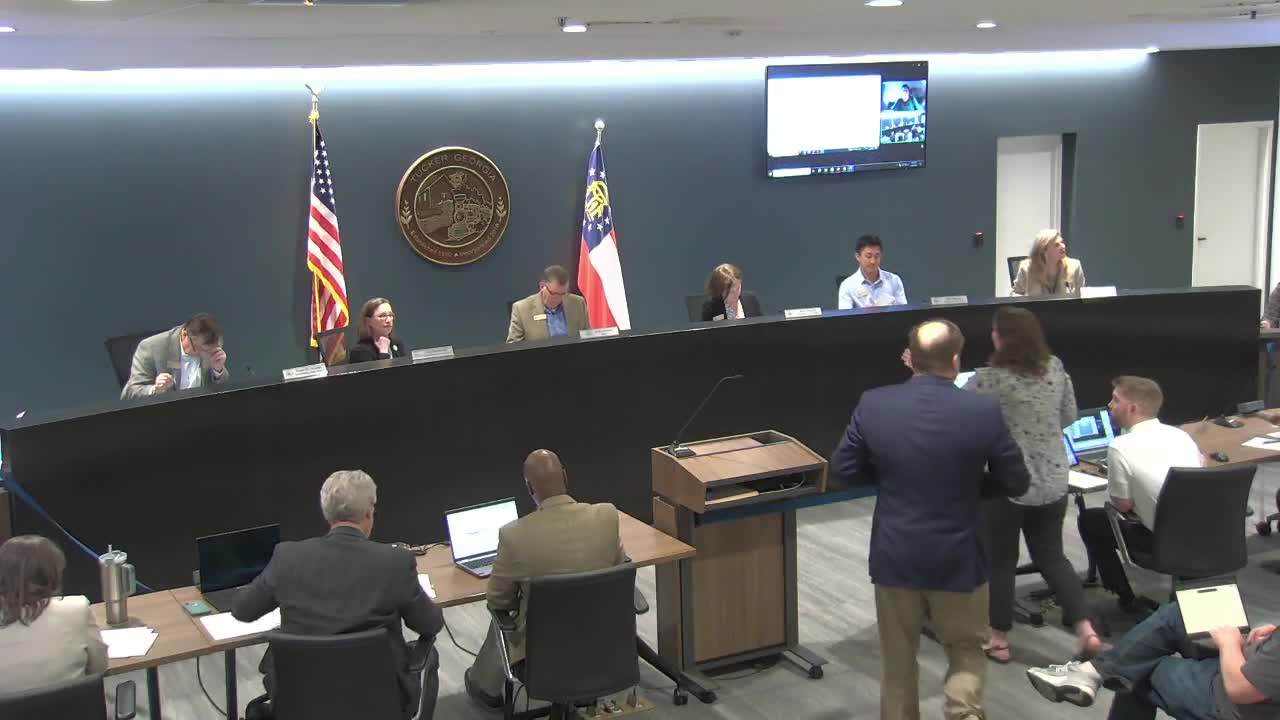
John Toppin, a developer with Tapestry Development, gave the Tucker mayor and city council an overview of the low-income housing tax credit (LIHTC) program and steps local governments can take to attract projects on March 24, 2025.
Toppin told council that “the low income housing tax credits is a housing program embedded in the IRS tax code,” and that the Georgia Department of Community Affairs (DCA) administers the credits in Georgia through a Qualified Allocation Plan that awards points to applications that meet state priorities.
The program targets households at 60% of area median income, Toppin said, and projects that win credits typically require many layers of financing and take years from application to completion. “It takes 3 or 4 months of a lot of work to submit,” he said. He described the typical timetable: applications in spring, awards several months later, then 12–15 months to close and roughly 18 months for construction. Projects carry affordability restrictions for at least 30 years.
Why it matters: LIHTC is a major source of subsidized rental housing across the U.S. and in metro Atlanta. Toppin said the competition for credits is intense — he estimated roughly one in four applications are funded — and said cities can improve their chances of hosting funded projects by taking specific policy and administrative steps.
Key local actions Toppin recommended: - Entitle potential sites in advance. “The zoning has to be in place when you submit the application,” he said, because applicants must tell DCA they can build the project if funded. - Join state programs that yield application points, such as the Georgia Initiative for Community Housing (GICH). Toppin said a city that participates and can provide a supportive letter can gain points in the DCA scoring process. - Adopt redevelopment plans for target census tracts. DCA awards points to projects in designated “redeveloping” areas with active redevelopment plans that address housing and infrastructure. - Provide soft financing or local subsidy. Toppin said DCA gives points for locally supplied soft money (grants or forgivable loans) that increase a project’s competitiveness. - Identify and assemble suitable land. Toppin said infill land and assemblage are common challenges in Tucker; he recommended cities assemble or offer land and run an RFP for affordable housing developers when possible.
Toppin described common project constraints: rising construction costs (he said they have increased “50% in the last 5, 8 years”), expensive land in the Atlanta region, multiple overlapping funding rules and long entitlement and permitting timelines. He also discussed design and program constraints, including unit-size rules, accessibility requirements and tradeoffs between garden-style buildings versus denser multi-story buildings.
Council members asked about mixed-income projects, homeownership pathways, management and maintenance. Toppin said LIHTC is rental-only but developers sometimes include a portion of market-rate units in mixed-income projects; townhouses and single-family affordable ownership are separate funding lines and more expensive to build. On property management he said oversight is substantial: DCA inspections, investor oversight and on-site professional management companies are standard, and “most developers that I know well really care a lot about their business and their properties.”
Toppin closed by noting demand: “Most of our properties have waiting lists of well over a hundred,” and he characterized the need for affordable rentals in the region as a crisis.
Ending: City staff and Toppin said they will continue dialogue; council members asked staff to consider the specific zoning, land‑assembly and policy steps Toppin described as the city updates its plans and looks for sites.