Get Full Government Meeting Transcripts, Videos, & Alerts Forever!
Get email alerts on the Summer Ebt topic
No spam. Unsubscribe anytime.
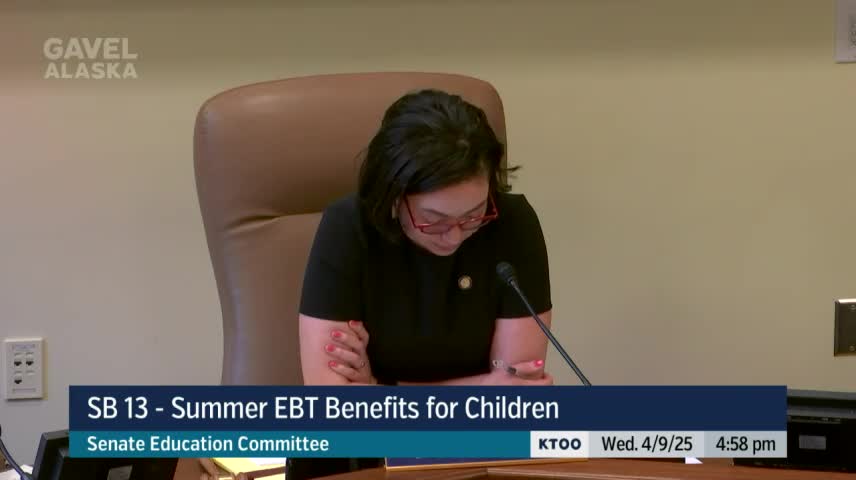
Senate education committee adopts substitute for Summer EBT bill, reports it with fiscal notes
Summary
The Senate Education Committee adopted a committee substitute on April 9 for Senate Bill 113 to establish a Summer EBT program for children and voted to report the bill from committee with individual recommendations and fiscal notes; the substitute assigns administration to the Department of Education and Early Development.
Juneau — The Senate Education Committee on April 9 adopted a committee substitute for Senate Bill 113 and voted to report the bill from committee with individual recommendations and attached fiscal notes. The bill would create a summer electronic benefit transfer (Summer EBT) program to provide benefits to children during the summer months.
Sponsor and committee staff said the substitute (work order 34‑LS‑0141\I) moves administration of the program from the Department of Family and Community Services (as drafted in an earlier version) to the Alaska Department of Education and Early Development (DEED) under AS 44.27. Rachel Levy, staff to Senator Dunbar, said DEED was the only department that agreed to administer the program during interagency discussions.
Why it matters: Supporters said Summer EBT would provide targeted nutrition benefits to children during months when school meals are not available. Committee questioning focused on which agency should run the program and on administrative costs associated with issuing EBT benefits.
Administration and fiscal questions Gavin Northey, child nutrition programs manager at DEED, told the committee the program requires extensive student eligibility data and therefore a state education agency’s involvement is common. Northey said DEED would attempt to use existing Department of Health contracts for issuing EBT cards to limit costs but that the program’s administrative percentage is higher than a typical SNAP administrative rate because the Summer EBT program has a smaller benefit pool over which to spread fixed costs.
Northey said the summer benefit pool is roughly $10,000,000 in the department’s estimate and that a large share of administrative costs is for the contractor that issues EBT cards. Committee members, including Senator Keel, expressed concern that the bill’s administrative percentage appeared higher than the typical administrative overhead for SNAP and asked whether DEED could coordinate more functions with existing public‑assistance vendors.
Actions and committee disposition President Stevens moved to adopt the committee substitute (work order 34‑LS‑0141\I) as the working document; the committee adopted the substitute by unanimous consent. President Stevens then moved to report Senate Bill 113 from the Senate Education Committee with individual recommendations and attached fiscal notes; the committee reported the bill out with no recorded roll‑call vote.
Context and closing Senator Forrest Dunbar, sponsor, said he hopes the funds reach children who need them and thanked the committee for considering the bill. Committee members emphasized continued interagency coordination on eligibility platforms and contracting to limit administrative cost overruns as the bill moves forward to the next stage of the legislative process.