Get Full Government Meeting Transcripts, Videos, & Alerts Forever!
Get email alerts on the School Board Terms topic
No spam. Unsubscribe anytime.
Bill would let municipalities change school board term lengths to align with state and federal elections
Summary
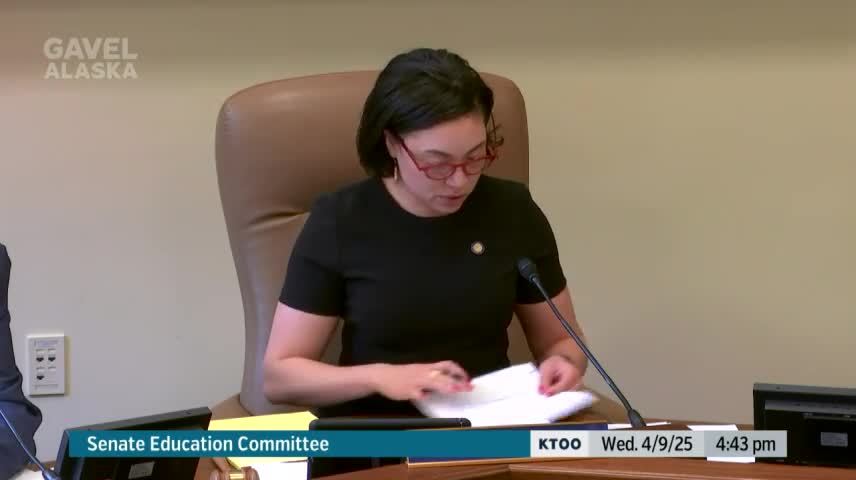
The Senate Education Committee heard testimony on April 9 for Senate Bill 143, which would allow municipalities to set school board term lengths by local ordinance so that local school elections can be aligned with even‑year state and federal ballots.
Juneau — The Senate Education Committee on April 9 heard testimony in favor of Senate Bill 143, a bill that would allow municipalities, by local ordinance, to alter the length of municipal school board terms so they can align school‑board elections with state and federal election dates.
Sponsor Senator Rob Yount of Wasilla told the committee that some local offices in his borough already shifted from three‑ to four‑year terms to reduce costs and improve turnout, and he said communities would benefit if school board seats could be similarly adjusted. “Our goal would be able to do that with school board seats as well,” Yount said.
Why it matters: Supporters said the change is optional and would increase turnout by placing local school board races on the same ballots as higher‑profile state and federal contests. Deputy borough manager George Hayes and Mat‑Su School District officials said aligning elections raised turnout significantly in recent local cycles and reduced administrative costs for the borough.
Support and questions George Hayes, deputy manager for the Matanuska‑Susitna Borough, testified on behalf of the borough and said SB 143 “strengthens local control, promotes flexibility, and allows municipalities like ours to tailor governance to our community.” Hayes and others argued the change simply provides municipalities with an option rather than imposing a statewide mandate.
Ryan McKee, staff to Senator Yount, walked the committee through the statutory changes described in the draft: additions and subsections to AS 14.12.050 and AS 29.23.00 that would permit municipalities to alter school board terms by ordinance and set an immediate effective date for the change if adopted locally.
Committee members asked about turnout. Senator Yount and municipal witnesses said aligning elections in the Matanuska‑Susitna Borough produced much higher participation; Yount cited turnout near 48% in his most recent local election cycle after aligning municipal elections with even‑year state and federal contests. Senators also discussed whether local voter approval would be required for ordinance changes; Yount said the bill merely gives municipalities the option to change terms, and it would not itself force any locality to act.
Local education perspective Catherine Gardner, deputy superintendent for the Matanuska‑Susitna Borough School District, said the district supports the change as a legislative priority. Gardner added that the additional year can help new board members gain experience and training, improving effectiveness in governing schools.
Actions and next steps The committee took testimony but did not take a roll‑call vote on SB 143. Chair Tobin set the bill aside for a future meeting and asked sponsors to work with committee staff on any amendments.
Context and closing Supporters described SB 143 as a local‑control measure that is voluntary for municipalities and intended to increase voter participation and administrative efficiency. Opponents did not offer formal testimony at the hearing; committee members raised procedural questions about direct voter approval that sponsors said could be handled locally if jurisdictions chose to require it.