Get Full Government Meeting Transcripts, Videos, & Alerts Forever!
Get email alerts on the Complex Care Residential Homes topic
No spam. Unsubscribe anytime.
State introduces bill to create 'complex care residential homes' for Alaskans with high medical/behavioral needs; licensing and Medicaid questions remain
Summary
House Bill 73, introduced at the governor’s request, would authorize a new licensure type—"complex care residential homes"—to serve a small subset of Alaskans with overlapping medical, behavioral and disability‑related needs. Department officials said the homes would offer 24/7 multidisciplinary care for up to 15 residents; lawmakers pressed the
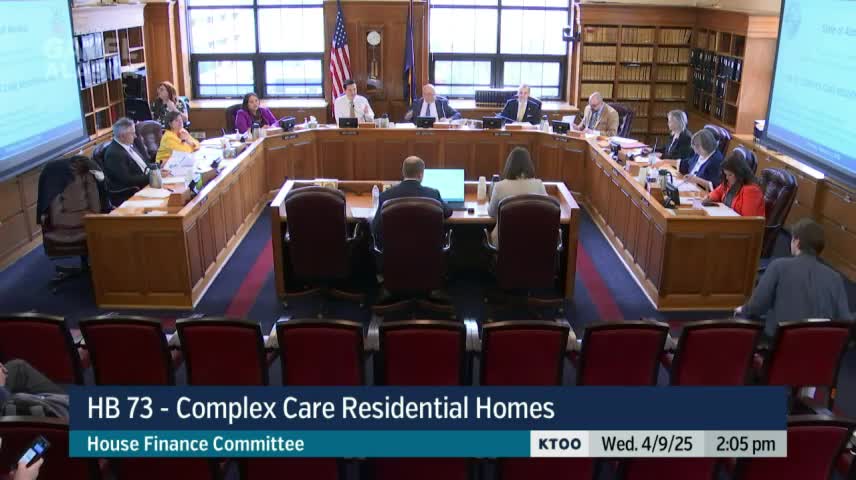
House Bill 73 was introduced to the House Finance Committee on April 9 at the governor’s request to establish a new licensure category for "complex care residential homes," a home‑like setting intended for Alaskans with overlapping medical, mental‑health and behavioral needs that current state services do not adequately serve.
"HB 73, was introduced at the request of the governor. And this bill is a result of collaborative work between the Department of Family Community Services and the Department of Health," Deputy Commissioner Emily Ricci told the committee. Dr. Robert Lawrence, the Department of Health’s chief medical officer, said the homes are intended for a narrow subset of people "who require a multidisciplinary team to determine the diagnosis, to determine treatment outcomes, and resource needs."
Department officials described the target population as individuals whose needs are so complex—examples offered included severe co‑occurring mental illness, medical conditions, autism or fetal alcohol spectrum disorders combined with difficult, disruptive behaviors—that they repeatedly cycle through emergency departments, hospitals, correctional facilities and assisted‑living or general‑relief placements because a stable, long‑term, community‑based placement cannot be found.
The bill would authorize the Department of Health to adopt regulations and a licensure type for homes that provide 24‑hour multidisciplinary care and monitoring. In the section analysis, the department described the definition as "a setting that provides 24 hour multidisciplinary care on a continuing basis for up to 15 individuals, with mental health, behavioral, medical or disability related needs requiring special care services and monitoring." Officials said the 15‑bed maximum and other operational details are intended to be refined in regulation, in part to comply with federal Medicaid rules such as the Institute for Mental Disease (IMD) exclusion.
Fiscal presentations accompanying the bill estimated administrative startup costs for licensing and program development. Tracy Dumpling of the Division of Behavioral Health said the division requests one full‑time position and gave a first‑year total-cost estimate of roughly $153,200 (including personal services, some federal receipts and support costs). Bobby Nave, division operations manager for Health Care Services licensing, said licensing staff would require one full‑time nurse consultant (salary and benefits budgeted in the mid‑$100,000s, with the state expecting to draw approximately 50% federal funding for that position), plus travel and equipment costs; the Medicaid fiscal note was provided as a net‑zero estimate while the department explores waiver options.
Committee members pressed officials on operational details the bill leaves to regulation. Representative Galvin asked why the statute uses a 15‑resident cap; Ricci said the number was chosen to align with IMD considerations but that the department expects to refine bed limits and other operational rules in regulation. Members also raised zoning and community‑placement concerns, security and whether homes would be locked or otherwise secure; Ricci said the bill intentionally did not set locked‑facility rules and that those details would be addressed later when regulators and providers design model standards.
Lawmakers asked about potential Medicaid cost impacts and whether the state would grow overall costs by adding a new service type. Ricci said many individuals now incur high costs in hospitals, psychiatric facilities or incarceration and that the department intends to pursue Medicaid waivers (for example 11‑15 or other home‑and‑community‑based options) that must meet federal budget‑neutrality tests. The department’s preliminary fiscal notes included administrative costs for staff and licensing but recorded a $0 net fiscal impact to Medicaid pending waiver design and federal approval.
Supporters told the committee hospitals and providers have expressed interest in an in‑state option for people currently placed out‑of‑state or who otherwise cycle through acute systems. Several members urged the department to work with stakeholders to refine staffing ratios, bed counts and payment mechanisms.
Ending: The bill was introduced and discussed in detail; members left multiple technical questions for regulators and fiscal staff to address in drafting regulations and waiver proposals before the state could license and fund complex care residential homes.