Get Full Government Meeting Transcripts, Videos, & Alerts Forever!
Get email alerts on the Deaf Education topic
No spam. Unsubscribe anytime.
Senate panel adopts substitute and hears broad testimony on education for deaf and hard‑of‑hearing students
Summary
The Senate Education Committee on April 9 adopted a committee substitute for Senate Bill 8 and heard more than an hour of testimony on legislation to require schools to provide families with unbiased information about communication options and to establish a centralized statewide support program for deaf and hard‑of‑hearing students.
Juneau — The Senate Education Committee on April 9 adopted a committee substitute for Senate Bill 8 and heard more than an hour of invited and public testimony on legislation intended to expand and protect educational services for deaf and hard‑of‑hearing students across Alaska.
Senator Alvy Gray Jackson, the bill sponsor, told the committee the measure “affirms one of our most fundamental values that every Alaska child deserves access to a high quality education regardless of ability, background, or ZIP code.” The bill would require schools to provide families with unbiased, comprehensive information about communication options and technologies and direct the Department of Education to establish a centralized program to support students statewide.
Why it matters: Witnesses said the bill would protect access to services at a time when local budgets threaten staff at the Alaska School for the Deaf and Hard of Hearing. Jackson told the committee that the Anchorage School District’s proposed budget could eliminate two full‑time staff who are fluent in American Sign Language, including a long‑time counselor and an intervention coach. Committee members adopted a committee substitute and held the bill for a future meeting to allow time for additional amendments.
Committee discussion and testimony Senator Alvy Gray Jackson, sponsor and member of the Senate, opened the hearing by describing the bill’s intent to “ensure our schools empower parents with unbiased, comprehensive information about communication options and technologies.” Jackson said the legislation also “guarantees that services are delivered by professionals fluent in the method chosen by the family.”
Diedred Goins, legislative aide to Senator Jackson, summarized the substitute and said it clarifies that decisions about residential placements and related funding are made in consultation with parents.
Clara Baldwin, testifying as chair of the Deaf Education Committee of the Alaska Deaf Council, said deafness is a low‑incidence disability and families frequently lack exposure to options. “If they don’t know how can you not know what you’re not told?” Baldwin said, urging the committee to ensure families receive a full menu of options and culturally competent services.
Parents and advocates described a range of experiences. Jillian Schroeder, a parent of a deaf child, recounted an early diagnosis and a mix of services that included listening and spoken language supports and an American Sign Language classroom. Schroeder said many parents do not receive comprehensive counseling about language and service options and urged the committee to preserve parental choice: “Parents need consistent, comprehensive, and unbiased information on what their child’s language options and the educational services available to them.”
Multiple witnesses described the residential host‑family support that allows students from rural areas to attend the Alaska State School for the Deaf and Hard of Hearing. Duane Mays and Michael Merritt explained that Hope Community Services screens and licenses host families and that the program emphasizes ASL fluency and periodic contact between students and their families back home.
Fiscal and statutory points Deborah Riddle, division operations manager at the Department of Education and Early Development, told the committee the bill carries a zero fiscal note for the department’s listed component because funding for the Alaska School for the Deaf and Hard of Hearing is already appropriated and administered under the state’s existing agreements with Anchorage.
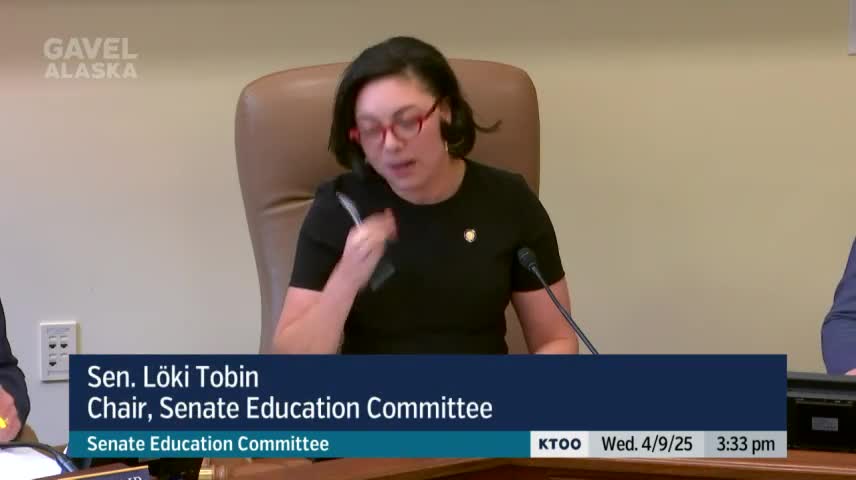
Actions and next steps President Stevens moved to adopt the committee substitute (work order 34‑LS‑0075\N), and the committee adopted the substitute by unanimous consent with no recorded roll‑call vote. Chair Tobin later announced the bill would be held aside for a future meeting and invited potential amendments to be worked with the bill sponsor’s office.
Context and closing Supporters framed the bill as protecting language acquisition and access to services for children across Alaska, while several witnesses emphasized the importance of parental decision‑making and culturally competent services. The committee did not take a final vote on the bill itself; it adopted the substitute as the working document and deferred further action to a later meeting.