Get Full Government Meeting Transcripts, Videos, & Alerts Forever!
Get email alerts on the Fisheries Tax Credit topic
No spam. Unsubscribe anytime.
Senate panel hears support for expanding fisheries product-development tax credit to all species
Summary
The Senate Resources Committee heard testimony supporting Senate Bill 130, which would broaden an existing fisheries product-development tax credit to apply to all commercially harvested fish and shellfish and clarify qualifying investments; the committee set the bill aside and set an amendment deadline for Friday at 8 a.m.
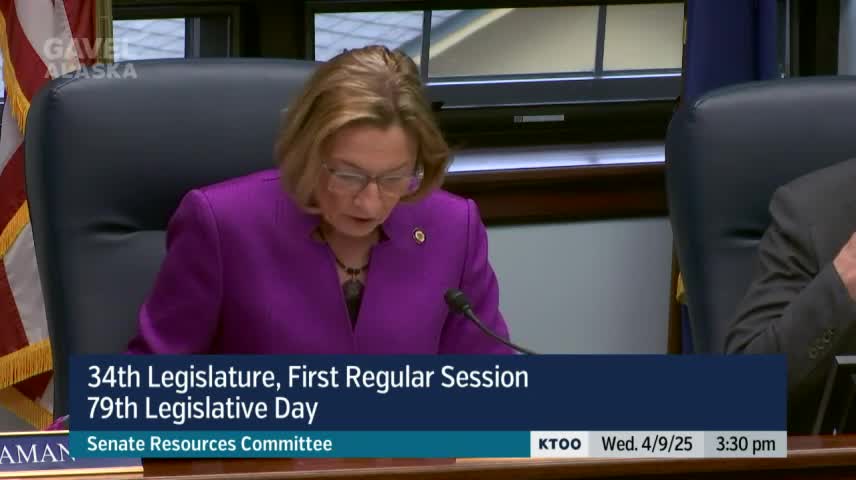
Senate Resources Committee Chair Senator Giesel opened the committee’s April 9 hearing on Senate Bill 130, which would expand Alaska’s fisheries product-development tax credit beyond the specific species named in statute to include all commercially harvested fish and shellfish and clarify what investments qualify.
The bill, presented briefly by Tim Lampkin, staff to Sen. Stevens and the joint legislative task force on Alaska’s seafood industry, would “extend some tax credit considerations for not just the few named species that are in statute currently but to all fish species,” Lampkin said. He also told the committee the bill updates qualifiers for innovation investments so processors can claim credits for eligible modernization steps.
Industry witnesses representing processors and processors’ trade groups told the committee the change could help Alaska retain higher-value processing in state. “This bill ensures that processors can continue investing in value-added production, new technologies and product diversification,” Toni Marsh of EC Phillips and Son said during public testimony, describing her company’s nearly 100-year history in Ketchikan and its reliance on quality and innovation. Trident Seafoods’ Shannon Carroll and other processors testified similarly, emphasizing rising costs and global competition and urging incentives for equipment that increases product quality.
State tax officials clarified eligibility and nexus rules. Brandon Spanos, deputy director of the Alaska Department of Revenue Tax Division, told the committee the processing equipment must be located in Alaska for an investment to qualify. Chris Becker, lead auditor with the tax division, added that floating or at-sea processors can be eligible for the credit “but it's based on the amount of processing done in state waters.” The committee also heard that the phrase “use predominantly” in the bill was intended to mean 51% or more of use.
Committee members asked technical questions about what types of equipment and investments would qualify; Lampkin and industry witnesses identified icing and automation equipment and other capital investments that support value-added processing as typical examples. Witnesses and staff also discussed that the credit historically offsets fisheries business tax liability and that some participants expect the credit would encourage more onshore or in-state value enhancement.
The committee set SB 130 aside to allow time for amendments. Chair Giesel reminded members of an amendment deadline Friday at 8 a.m.